How to use the Viscometer and calibrate it
The Ubbelohde Viscometer meets the requirements stipulated in the industry standard SY/T 5651 "Technical Conditions for Petroleum Products Kinematic Viscosity Tester" of the People's Republic of CHINA, and is suitable for use in accordance with the People's Republic of CHINA Standard GB/T 265 "Petroleum Products Kinematic Viscosity Test Method and Power According to the Viscosity Calculation Method, the kinematic viscosity of liquid petroleum products (referring to Newtonian liquid) at a certain constant temperature is determined.
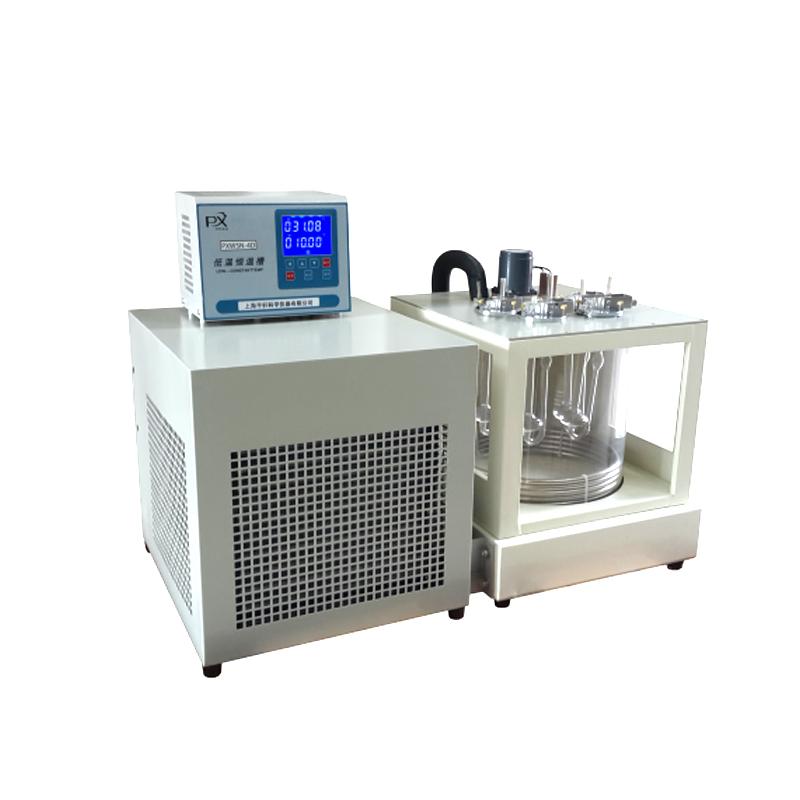
Instructions
Take it out, make a solution with a certain concentration according to the regulations, filter it with a No. 3 vertical fusing glass funnel, and discard the initial filtrate (about 1ml);
Take the filtrate (not less than 7ml) and inject it into B along the inner wall of the clean and dry tube 2, and fix it vertically in a constant temperature Water Bath (the temperature of the Water Bath should be 25±0.05°C unless otherwise specified), and make the liquid in the Water Bath The surface is higher than ball C, after 15 minutes;
Connect nozzles 1 and 3 to a latex tube, clamp the hose of nozzle 3, pump air from nozzle 1, make the liquid level of the test solution rise slowly to the middle of ball C, and open the nozzle first 3. Open the mouth of the tube again to let the test solution fall naturally in the tube, and use a stopwatch to accurately record the outflow time when the liquid level drops from the measuring line to the measuring line;
Repeat the measurement twice, the difference between the two measured values shall not exceed 0.1 seconds, and take the average value of the two times as the outflow time (T) of the test solution.
Take the solvent filtered through the No. 3 vertical fusing glass funnel and perform the same operation, repeat the measurement twice, and the two measured values should be the same, which is the outflow time of the solvent. Calculate the intrinsic viscosity according to the formula
Calibration steps
Visual inspection. The appearance is made of transparent borosilicate glass. Its chemical properties and stress should meet the water resistance level 1, acid resistance level 1, and alkali resistance level 2. The residual stress optical path difference is less than or equal to 100nm/cm. The inner wall of the capillary should be smooth and clean, without any foreign matter that may hinder the flow of liquid. The measuring tube, the vent tube and the inlet tube are parallel to each other, and the entire capillary needs to be vertical.
The choice of standard solution. Choose at least two different standard liquids for each calibration, the kinematic viscosity should not be too close, and the flow time should be more than 200s.
Load the standard solution. Draw a certain volume of standard solution of known viscosity into the upper storage bulb and put it in a constant temperature Water Bath. Be careful not to have air bubbles, otherwise the flow time of the standard solution will be slowed down. Adjust the level and control the constant temperature time between 15 and 30 minutes.
start the timer. Filling a liquid should repeat the timing at least 4 times, and the repeatability should meet the relevant requirements of JJF1059.1-2012. After the flow rate measurement of a liquid is completed, the inner wall of the capillary should be cleaned before loading the next liquid. Remain vertically still throughout the entire process.
The constants are calculated according to the formula, and the average value of the viscometer constants calculated by various standard liquids is taken as the final calibration result.
The following points should be paid attention to when using the Ubbelohde viscometer
Using the Ubbelohde viscometer, it is necessary to measure the outflow time of a series of solutions whose concentrations are in a simple proportional relationship in the same viscometer. Accurate volumes of liquid are drawn and added each time. In order to avoid volume changes that may be caused by temperature changes, the solution and solvent should be pipetted at the same temperature, so the experiment should be carried out in a constant temperature tank, the temperature in the constant temperature tank should be constant, and the solution can be measured after each dilution and constant temperature.
Every time a solvent is added to dilute the solution, the liquid in the viscometer needs to be mixed evenly, and the solution must be sucked into the small ball above the E line twice to rinse the capillary, otherwise the repeatability of the solution outflow time is poor.
The viscometer needs to be cleaned. If there are water droplets hanging on the capillary wall, it needs to be dried with a hair dryer.
When measuring, the viscometer should be placed vertically, otherwise the accuracy of the result curve will be affected.
- 1Viscosity of polypropylene (PP) amide measured by NDJ Viscometer
- 2Which Viscometer to Choose for Licorice Extract Viscosity Testing? How to Test?
- 3Application of Rotational Viscometer in juice viscosity test
- 4Working Principle, Classification and Application of Capillary Viscometer
- 5Principle, Characteristics and Application of Dial Viscometer
- 6Basic Principle and Application of Ceramic Viscometer
- 7Principle, Characteristics and Application of QND Viscometer
- 8Determination of epoxy resin viscosity by Rotational Viscometer
- 9Rotational viscometer selection suggestions


