Application of Rotational viscometer in Coating Viscosity Detection
Measuring paint viscosity is one of the important evaluation indicators for its fluidity and handling performance, and can be used to evaluate the consistency, viscosity and fluidity of paint. The measurement process of coating viscosity can be realized by using equipment such as viscometer or rheometer. During paint manufacturing and application, changes in paint viscosity may have an important impact on its application performance, process parameters, and paint effects. For example, when painting, the viscosity is too high or too low may lead to poor fluidity of the paint, uneven coating thickness or problems such as bubbles and shrinkage cavities. Too high or too low viscosity may also affect the drying time and anti-peeling performance of the coating. Therefore, the measurement of coating viscosity is of great significance for the production and application of coatings. It can be used to control the consistency and viscosity of coatings to ensure that the quality and performance of coatings meet the requirements.
application
Rotational viscometer is mainly used to measure the viscosity of liquid under shear force. It can measure the viscosity and the rheological properties of materials under shear force, such as the influence of shear rate on viscosity. In paint manufacturing and painting process, viscosity is an important parameter because it has a great influence on the fluidity, applicability, drying time and other aspects of paint. By measuring the viscosity of the paint, the quality of the paint can be controlled, thereby ensuring the performance of the paint during the painting process.
Detection steps
Prepare paint samples: Take a certain amount of paint samples from the production site or paint barrels, stir them well, and filter to remove impurities.
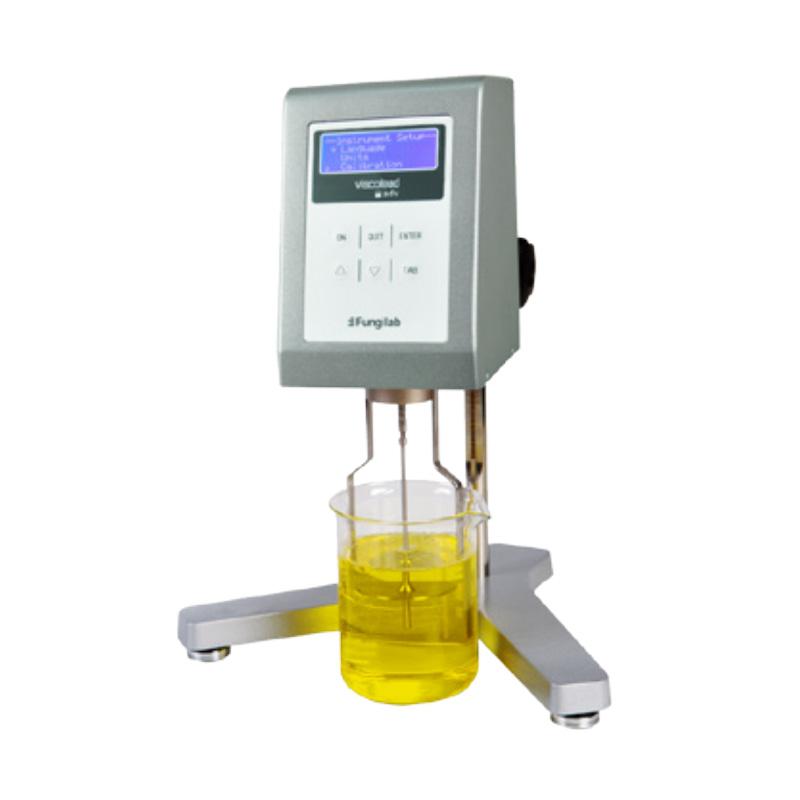
Prepare the Rotational Viscometer: According to the properties of the coating and the testing requirements, select a suitable Rotational Viscometer, and install the measuring head and rotor.
Preparations before measurement: turn on the power of the viscometer, and adjust the instrument parameters, such as rotation speed, temperature, etc., according to the instrument manual.
Start the measurement: Pour the paint sample into the test cup of the Rotational Viscometer, and use a needle to remove air bubbles to make the paint surface smooth. Slowly put the spindle into the paint, wait for the paint to stop fluctuating, start the Rotational Viscometer and start measuring.
Record data: The Rotational Viscometer will automatically record the measurement data, including viscosity value, rotational speed, temperature, etc.
Analyzing data: According to the measurement results, analyze the rheological properties, viscosity and other information of the paint, and carry out quality control and production process optimization for the paint.
To sum up, the Rotational Viscometer is a very practical coating testing instrument, which can help manufacturers control the quality and production process of coatings, and improve production efficiency and product quality.
- 1Rotational viscometer - principle, classification, application and calibrating
- 2Application of NDJ-8S digital Rotational Viscometer in viscosity measurement of cosmetic raw materials
- 3NDJ-5S digital Rotational Viscometer accurate measurement of natural oil viscosity
- 4Viscosity of polypropylene (PP) amide measured by NDJ Viscometer
- 5Application of HBDV-1H swirl/spin High Temperature Viscometer in Viscosity Determination of Plastic Particles
- 6Rotational viscometer selection guide: How to choose the right viscosity equipment for you?
- 7Principle, type and accuracy control of Rotational Viscometer
- 8Which Viscometer to Choose for Licorice Extract Viscosity Testing? How to Test?
- 9Application of Rotational viscometer in Waterborne Polyurethane Adhesive