How to determine the lacquer acid value for Paints and varnishes?
1 Definition, Purpose and Significance
The acid value is the number of milligrams of potassium hydroxide (KoH) required to neutralize the high acid in the non-volatile matter of 1 gram of the product, expressed in mgKoH/g.
The determination of acid value is an important control item in the coating manufacturing process, and it has its control significance from incoming raw materials, intermediate products to finished products. Vegetable oil commonly used in lacquer making is mainly composed of fatty acid diglyceride. During storage, due to heat, light, and water absorption, it decomposes to form a small amount of free fatty acid. Excessive content will affect the subsequent lacquer making process. In the process of acidification in the production of alkyd resin, the reaction can be seen from the change of acid value and viscosity. Similarly, the acid value of crystallization also affects the performance of the paint film, storage stability and adaptability to metal substrates.
2 Relevant standards
GB/T 6743-86 Determination of acid value of binder base for paints and varnishes
3 Introduction to key points of inspection methods
3.1 GB/T 6734-86 Determination of acid value of binder base for paints and varnishes
3.1.1 Test Principle
This method adopts the volumetric analysis method, that is, the potassium hydroxide-ethanol standard solution is used to determine the titration, and the neutralized high acid is changed by the color of the indicator (or PH = 7) to display the "titration end point". Calculate the acid value of the sample from the liters of standard solution consumed by titration and its molar concentration, as well as the mass and non-volatile content of the sample to be tested. This method is not suitable for the determination of acid value of phenolic resin, because potassium hydroxide can react with free phenol in aldehyde resin, which makes the acid value test value higher.
3.1.2 Materials and equipment
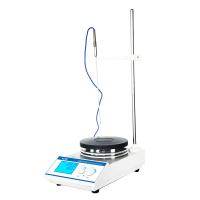
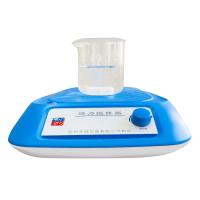
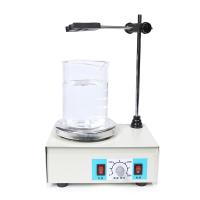
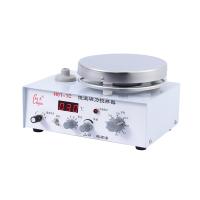
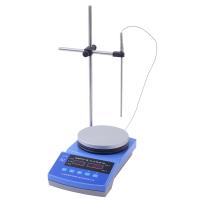
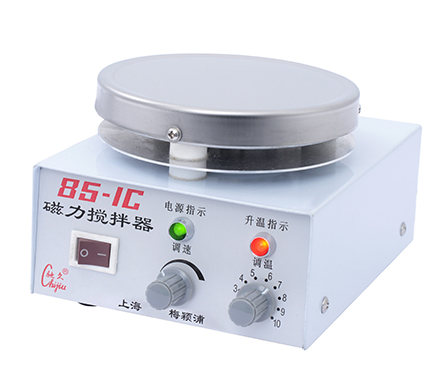
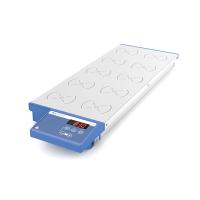
Ordinary laboratories should have a conical flask with a capacity of 250 ml and an alkaline burette with a capacity of 50.0 ml. Potentiometric titration equipment (with glass electrode and reference electrode) and magnetic stirrer should be provided if necessary.
3.1.3 Operation points
Weigh an appropriate amount of sample so that the volume of the consumed potassium hydroxide solution is within the range of 10 to 30ml, accurate to 1mg. Dissolve the sample with 50ml of mixed solvent, pre-warm if necessary, but the solution needs to be cooled to room temperature before titration. Add 2-8 drops of moving ohm indicator, and titrate with potassium hydroxide solution until the red color appears and remains stable for at least 10 seconds, which is the end point. If the color change is not obvious when phenol is used as the indicator, other indicators such as bromothymol blue can be used. When there is doubt about the end point, especially for colored solutions, the potential 1 should be used to reach pH=7. At the same time, a blank self-test of the mixed solvent (without adding a sample) should be carried out. Since the mixed solvent is neutralized, the result of the blank test should be zero.
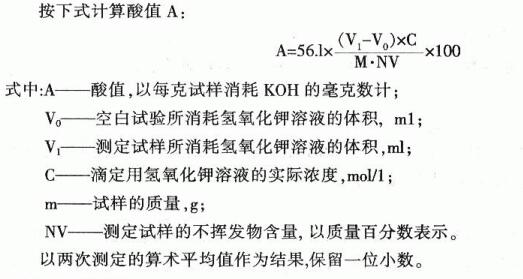
3.1.4 Result presentation
3.1.5 Precautions
If the sample needs to be heated during the dissolution process, it should be carried out on a Water Bath, and cannot be directly heated by an electric furnace, so as to avoid safety problems. During the titration, the dripping liquid should be dripped into the sample quickly, and the conical flask should be shaken continuously, and the dripping liquid should not be dripped in a line. When the end point is approaching, it should be added to the observation step by step. After turning pink and keeping the same color for 10 seconds under the motion, the end point is the end point. With the eyes looking straight up, take the reading at the lowest point of the arc shape of the liquid level of the full-scale tube, and the milliliter of the standard solution consumed is the difference between the two liquid level readings before and after the agreement. The full stop tube used during the test should be calibrated. If the ambient temperature of the test is not 20°C, the volume of the solution should be corrected for temperature.
-
![CHIJIU H01-1C Digital thermostatic Magnetic Stirrer 5L/150 ℃ Timing]()
-
![CHIJIU MYP11-2 thermostatic Magnetic Stirrer 5L/300 ℃ Timing]()
-
![CHIJIU 08-3G thermostatic Magnetic Stirrer 20L/150 ℃ Timing]()
-
![CHIJIU 85-1C Laboratory thermostatic Magnetic Stirrer heating type, capacity up to 2000ml]()
-
![IKA KMO 3 basic Magnetic Stirrer 5L]()
-
![Germany IKA C-MAG HS 7 digital Magnetic Stirrer]()
-
![IKA RO 10 Point Digital Magnetic Stirrer Stainless Steel Disc]()
-
![IKA RO 15-Point Digital Magnetic Stirrer Stainless Steel Disc]()
-
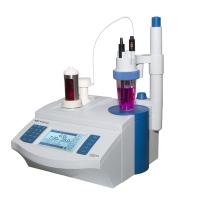
![LEICI ZDJ-4A Potentiometric Titrator]() LEICI ZDJ-4A Potentiometric Titrator$ 2914.00
LEICI ZDJ-4A Potentiometric Titrator$ 2914.00



- 1Comparison and Application of Magnetic Stirring and Mechanical Stirring
- 2Application and Selection Guide of Electromagnetic Stirrer in Laboratory
- 3Describe 4 Common Stirrers in detail
- 4Principle and Application of Water Bath Magnetic Stirrer
- 5What are the main differences between Varnish and Paints?
- 6Paints gloss detection and measurement procedures
- 7What is a mixer? Applications, advantages and disadvantages of mixers
- 8How to prepare polymer blended solid film materials?
- 9What is varnish? (for packaging and printing)
-
![DaDi 85-2 digital temperature control magneticstirrer]()
-
![HUXI HMS-203D magneticstirrer]() HUXI HMS-203D magneticstirrer$ 251.00
HUXI HMS-203D magneticstirrer$ 251.00 -
![Qiwei CL-R magneticstirrer 1000ml]() Qiwei CL-R magneticstirrer 1000ml$ 103.00
Qiwei CL-R magneticstirrer 1000ml$ 103.00 -
![DADI CJJ78-1 Magnetic Stirrer]() DADI CJJ78-1 Magnetic Stirrer$ 101.00
DADI CJJ78-1 Magnetic Stirrer$ 101.00 -
![RONGHUA HJ-6 Six Head Magnetic Heating Stirrer]()
-
![RONGHUA Instrument 99-1A Dual digital display high power thermostatic magnetic heating Stirrer]()