Measurement of thickness of nonconductive coatings
Why measure?
The main reason for measuring the thickness of insulating paint film is to ensure the insulation performance of electrical equipment. Insulating varnish is a coating material used to protect the surface of electrical equipment. It has good insulation performance and high temperature resistance, and is widely used in electronics, electric power and other fields.
The quality and insulation properties of insulating varnish coatings are closely related to their thickness. Coatings that are too thick or too thin will result in reduced performance or complete failure of the coating. Excessively thick coatings may cause problems such as unevenness, cracking, and blistering of the coating surface, while too thin coatings may result in reduced insulation performance of electrical equipment.
Therefore, measuring the thickness of insulating paint film can help manufacturers to detect quality problems in time, avoid potential safety hazards in electrical equipment, and help improve the reliability and efficiency of the production process. At the same time, the measurement of insulating paint film thickness can also help to formulate appropriate coating process parameters in order to optimize the coating process, improve the quality and insulation performance of insulating paint, and ensure the safe operation of electrical equipment.
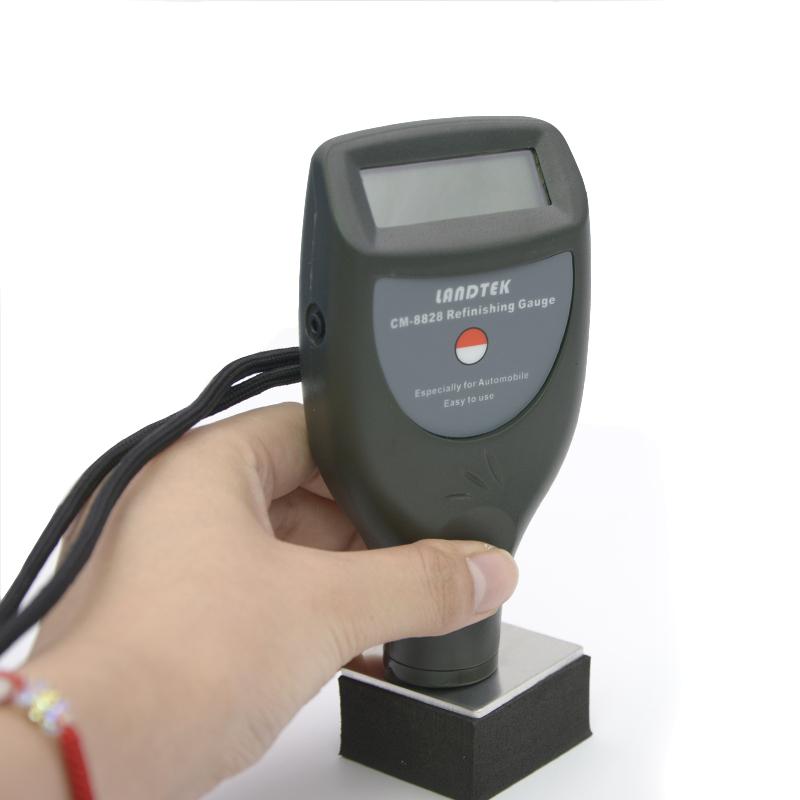
How to measure it?
Coating Thickness Gauges can be used to measure the thickness of non-conductive coatings such as insulating varnishes. The following are the operation steps of the coating Thickness Gauge in the measurement of insulating paint film thickness:
Select the appropriate measurement mode, such as single point measurement, scanning measurement, etc. For non-flat surfaces, the scan mode is recommended.
Clean the surface of the measured object, and use the special fixture provided by the coating Thickness Gauge to fix the measured object on the measuring table.
Use a standard sample of known thickness for calibration, and operate according to the instrument manual.
Aim the probe of the coating Thickness Gauge at the surface of the object to be measured, and lightly press the trigger button to measure. In scanning mode, the probe can be moved back and forth along the surface of the measured object to obtain more accurate results.
According to the measurement results, record the coating thickness value and analyze it. If the measurement result does not match the required insulating paint film thickness, it is necessary to re-measure or adjust the spraying amount.
Precautions:
Before measurement, the surface of the measured object should be cleaned to avoid dust, oil, etc. from interfering with the measurement results.
For the measurement of non-conductive coatings, it is necessary to use the special fixture provided by the coating Thickness Gauge to ensure the accuracy of the measurement.
The measurement accuracy and stability of coating Thickness Gauges are affected by many factors, such as probe diameter, coating type and color, surface flatness, etc. When measuring, it should be noted that these factors may have an impact on the measurement results.
During the measurement process, avoid tilting or skewing the measuring head, so as not to affect the measurement accuracy.
When using the coating Thickness Gauge, you should pay attention to safety and avoid touching electrodes and live parts to avoid dangers such as electric shock.
- 1Principle, Characteristics and Application of Wet Film Comb
- 2Basic principle and application analysis of insulating paint gloss Detector
- 3Determination method of dry and wet paint film thickness
- 4How to detect the thickness of steel structure paint?
- 5Measuring method of ISO 2808 film thickness
- 6Coating Thickness Gauge measurement circuit board film thickness scheme
- 7Epoxy asphalt film thickness measurement solution
- 8Coating film thickness measurement scheme
- 9Application of coating Thickness Gauge in thickness measurement of steel pipe paint film