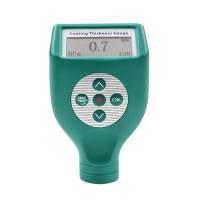
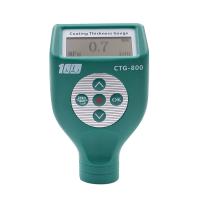
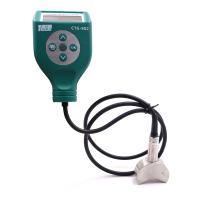
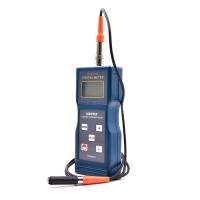
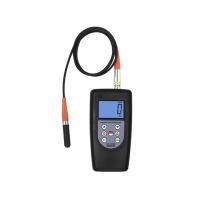
Coating Thickness Gauge measurement circuit board film thickness scheme
measured value
It is very important to measure the thickness of the paint film on the circuit board, because the thickness of the paint film directly affects the quality and performance of the circuit board. If the paint film is too thin, it may cause damage and corrosion on the surface of the circuit board, affecting the function and life of the circuit board; if the paint film is too thick, it may cause the components on the circuit board to be unable to connect to the surface of the circuit board, affecting the circuit Board performance and stability. In addition, measuring the paint film thickness of the circuit board can ensure the quality and stability of the circuit board, improve production efficiency and reduce costs. Therefore, for any industry that needs to use circuit boards, such as electronics, communications, computers, etc., measuring circuit board paint film thickness is a necessary step to ensure the quality and performance of circuit boards, while improving production efficiency and reducing costs .
The coating Thickness Gauge can accurately measure various types of coatings in circuit board paint film thickness measurement, including single-layer paint film, electroplating, electroless copper plating, etc. for example:
1. Measure the thickness of the circuit board paint film to determine its quality and reliability.
2. Make adjustments and control the production process according to the measurement results to ensure that the product meets the specification requirements.

Steps
1. Preparations
Lay the board flat on the measuring table, making sure the surface is clean and free of stains or uneven blemishes.
2. Select the probe
Choose the appropriate probe according to your needs. Different types of probes are suitable for different types of coatings. For example, magnetic inductive probes are suitable for measuring coatings on substrates such as iron and steel, while non-metallic inductive probes are more suitable for coating substrates. Suitable for measuring paint films on circuit boards.
3. Calibration
Before using a coating Thickness Gauge, it needs to be calibrated to ensure the accuracy and reliability of the measurement results. Calibration can be performed using standard samples or calibration blocks provided by the manufacturer.
4. Measure
Put the probe close to the surface of the circuit board, press the "Measure" button, the coating Thickness Gauge will automatically measure the coating thickness and display the result. Repeat the measurement several times for more accurate results.
5. Record and analyze results
Records measurement results, performs data analysis, and makes necessary adjustments and controls the production process to ensure products meet specifications.

Precautions
1. Before using the coating Thickness Gauge, it needs to be calibrated to ensure the accuracy and reliability of the measurement results.
2. Different types of probes are suitable for different types of coatings, choosing the correct probe can get more accurate measurement results.
3. The coating Thickness Gauge needs to be kept dry and clean to ensure normal work and accurate measurement results.
4. Keep a stable hand-holding posture during the measurement and avoid shaking or sliding of the probe to obtain accurate measurement results.
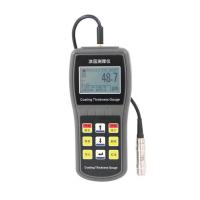
- 1Nondestructive measurement Coating thickness
- 2Principle, application and selection of traffic coatings Coating Thickness Gauge
- 3Principle, Application and Selection of Eddy current Coating Thickness Gauge
- 4Principle, Application and Type Selection of Electronic Coating Thickness Gauge
- 5Explore the principle, application and selection of phosphating layer Coating Thickness Gauge
- 6Principle, Application and Type Selection Analysis of Chrome Coating Thickness Gauge
- 7Principle, Application and Selection of Coating Thickness Gauge for inner wall of small pipe
- 8Basic principle and application scenario of steel Coating Thickness Gauge
- 9Principle and Application Analysis of Coating Thickness Gauge