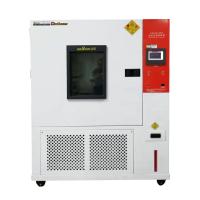
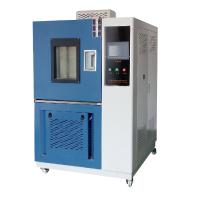
Low/high Temperature Test Chamber for plaster
Gypsum may undergo physical and chemical changes in different temperature environments, affecting its strength, stability and durability. Therefore, in order to ensure the quality and reliability of gypsum in various environments, high-low temperature resistance tests are required to determine whether its performance under different temperature environments meets the requirements.

Detection steps
The high-low Temperature Test Chamber can be used for the high-low temperature resistance test of gypsum. The following are the general test steps:
Prepare the sample: Make the plaster sample to the appropriate size and shape and make sure the surface is smooth.
Place the sample: put the sample in the high-low Temperature Test Chamber, select the appropriate fixture or support according to the need, and ensure that the sample is in the correct position.
Set test conditions: According to the test requirements, set the temperature and humidity conditions of the high-low Temperature Test Chamber, and run the Test Chamber to a stable state.
Conduct the test: start the Test Chamber and start the high-low temperature test. The Test Chamber will be cyclically heated and cooled according to the set temperature and humidity conditions until the preset test time or test target is reached.
Observe the sample: During the test, the changes and conditions of the sample can be observed at any time. It can be observed through the observation window in the high-low Temperature Test Chamber or by opening the door of the Test Chamber.
Analyzing test results: After the test, samples were taken out for analysis and evaluation. Tools such as microscopes can be used to analyze surface morphology, structure and performance, and evaluate the high-low temperature resistance of samples.
North and South Chao reminds you: When conducting high-low temperature tests on gypsum, appropriate test conditions should be selected according to actual conditions to ensure the accuracy and reliability of test results. At the same time, it is also necessary to abide by the safety operation rules to ensure the safety of the test process.




- 1Application and structure principle of low/high Temperature Test Chamber
- 2Principle, application and selection of low/high Temperature Test Chamber for plastic belt
- 3Principle, application and selection of fire-proof coatings low/high Temperature Test Chamber
- 4Principle, application and selection of ultra low/high Temperature Test Chamber
- 5Principle and application of desktop low/high Temperature Test Chamber
- 6Application of FRP low/high Temperature Test Chamber
- 7The working principle and application scenario of non-standard high-low-Temperature Test Chamber
- 8Application of programmable low/high Temperature Test Chamber NBC-CDW-150M in luminaire testing
- 9What are the reasons why the high-low temperature alternating heating and Humidity Chamber cannot be thermostatic?