Hardness of different coats
Hardness is one of the important mechanical properties of the coating, which is related to the wear resistance, strength and service life of the coating during use. The hardness of the coating is related to the spraying method, spraying conditions (spraying equipment, spraying materials, spraying temperature) and other factors.
Due to different spraying methods and spraying conditions, the hardness of the coating is usually different. This is because the hardness of the coating depends on the size and structure of the crystalline particles of the coating, the number and size of pores, the content of compounds such as oxides, etc., and the difference in spraying methods or conditions often causes the differences in the above factors, resulting in the coating layer hardness. In general, the hardness of the particles that make up the coating itself is higher than that of the original sprayed material, which helps to enhance the wear resistance of the coating. For example, Table 11-6-1 is the comparison between the microhardness of the sprayed wire material and the microhardness of the microhardness of the air-sprayed coating particles using the wire material.
Table 11-6-2 shows the average hardness of coatings made of several practical metals and alloy materials under commonly used spraying conditions.


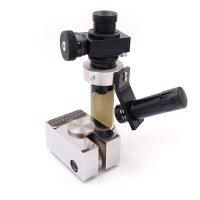
The high-temperature hardness of the metal alloy coating after melting treatment is generally higher than that of other heat-resistant steels. As shown in Figure 11-6-1 and Table 11-6-3, the high-temperature hardness of the cobalt-based alloy coating after melting treatment is different from that of other heat-resistant steels. Comparison of high-temperature hardness of heat-resistant steels. Here, a Vickers Hardness Tester is used, the load is 20kg, the loading speed is 8 seconds, and the results are measured in a vacuum of 0.133-0.532Pa.

The self-fluxing alloy coating after melting treatment has a wide range of hardness due to the complex composition of the alloy. The self-fluxing alloy material mixed with tungsten carbide powder can form a very hard coating with tungsten carbide (HV2 100-2 900) structure distributed on the surface of the billet.
In addition, Table 11-6-4 shows the high-temperature hardness measurement results of three nickel-based alloys at 650°C under different loading times. At high temperatures, the hardness of these materials is only slightly reduced, and has the characteristic of returning to the original hardness when cooled to normal temperature after heating.

Table 11-6-5 lists the K-hardness of ceramic coating particles made by molten rod gas spraying method.

Table 11-6-6 shows the Vickers hardness of several ceramic coatings made by deflagration spraying method.

Table 11-6-7 lists the hardness of several material coatings made by plasma jet spraying method.


- 1What is the principle of the Vickers test?
- 2Basic knowledge of hardness testing
- 3The principle and subdivision type of Vickers Hardness Tester
- 4Learn the basics of Vickers hardness testing
- 5Comparison of six hardness test methods of Vickers, Rockwell, Brinell, Mohs, Shore and Knoop
- 6How to use the Dutch TQC coating hardness test pen SP0010
- 7What is the Vickers hardness test? How to test Vickers hardness?
- 8Microindentation Hardness Testing Principle and Its Typical Applications
- 9Which hardness test is suitable for stainless steel?