Film performance measurement -- humidity cabinet test
Damp heat test is a method of artificially accelerating the corrosion test of the coating layer by simulating the environmental conditions of the coated product in which the temperature and humidity are constant or frequently alternate and cause condensation. Due to the clean high temperature and high humidity conditions caused by humans The effect of wide candle is not very obvious, so it is generally not used as a separate coating quality inspection item, but only its comprehensive performance is tested.
Test Equipment
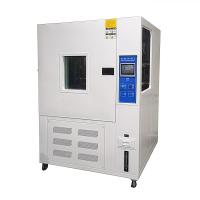
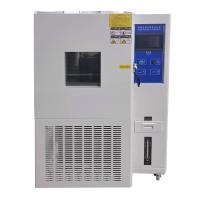
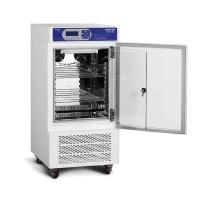
Various types of constant temperature and humidity Test Chambers can be used for the damp heat test.
Test Methods
There are three common methods of damp heat test.
(1) Constant temperature and humidity Test Chamber After the sample is connected to the specified surface, it is placed in a damp heat Test Chamber, and the corrosion test is carried out when the test temperature is controlled at 40 °C, 2 °C, and the relative humidity is above 95%.
(2) Alternating temperature and humidity test After the surface of the sample is oxidized according to the regulations, it is placed in a damp heat Test Chamber, and the temperature and humidity are alternated as follows:
①Raise the temperature from 30°C to 40°C, the relative humidity is not less than 85%, and the time is 1.5-2h.
②High temperature, high humidity, temperature 4o ℃ i2 ℃, relative humidity 95%, time 14-14.5h.
③Reduce the temperature from 40 ℃, 2 ℃ to 30 ℃, and the relative humidity is not less than 85%, at the same time for 2-3 hours.
④ Low temperature, high humidity, temperature 30 ℃, 2 ℃, relative humidity 95%, time 5-6h.
(3) High temperature and high humidity test After the surface of the sample is purified according to the regulations, it is placed in a damp heat Test Chamber. The control test temperature is 55°C±2°C, the relative humidity is at least 95%, and it is kept for 16 hours when there is condensation. Turn off the heat source Let the air circulate, cool down to 30 °C and keep warm for 5 h as a cycle, and check the sample after each cycle.
Evaluation of test results
Good: the coating and base metal are sensitive to corrosion, and only the color becomes darker;
Qualified: the corrosion-sensitive area of the coating does not exceed 1/3 of the total area of the sample, but the base metal has no corrosion-sensitive except for edges and corners:
Unqualified: 1/3 of the corrosion area of the normal layer has passed through the sample, or the base metal has corrosion sensitivity.




- 1GB/T 10586-2006 Detailed explanation: Core technical indicators and acceptance specifications for damp heat Test Chamber
- 2Humidity chamber core components dismantling: how to select compressors/Sensors
- 3Inaccurate lab data? 90% of people ignore Test Chamber calibrating issues
- 4Polyurethane-graphene composite prepative film
- 5Chip high-low temperature heat and humidity performance test
- 6Humidity cabinet test equipment
- 7Application of Humidity Chamber in building materials and flooring industry
- 8Principle, application and selection of programmable Humidity Chamber for die casting
- 9Humidity Humidity Chamber principle, application and selection