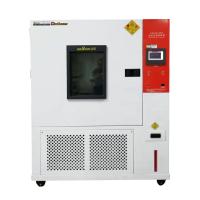
Application of low/high Temperature Test Chamber in high-low temperature resistance test of space launch vehicle components
Space launch vehicle components need to operate normally in extreme high temperature and low temperature environments. For example, engines, fuel pipelines, and electronic equipment all need to withstand the effects of thermal expansion and contraction, expansion differences and other factors caused by high temperature and low temperature alternately. High-low temperature resistance test to verify its reliability and safety. In an extremely high temperature environment, the material will crack or deform due to thermal expansion, while in an extremely low temperature environment, the material will lose its toughness due to becoming brittle, resulting in equipment failure. Through high-low temperature resistance tests, the performance and reliability of components under various extreme temperature conditions can be evaluated, and scientific data support can be provided for the design and manufacture of space launch vehicles to ensure their reliable operation in extreme environments.
High-low Temperature Test Chambers are widely used in aerospace, aviation, military and other industries, and are also indispensable in the high-low temperature resistance tests of space launch vehicle components.

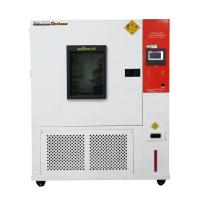
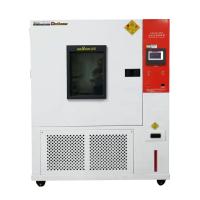
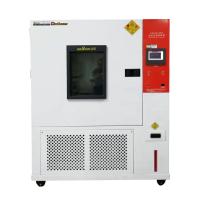
The high-low Temperature Test Chamber can simulate the working conditions of space launch vehicles in extreme environments, such as high temperature, low temperature, dryness, humidity, etc. Through the simulation test of the high-low Temperature Test Chamber, the durability and reliability of space launch vehicle components in extreme environments can be tested to ensure their performance and safety in actual use.
experiment procedure
Prepare space launch vehicle components for testing, inspect and prepare according to specified requirements.
Install the sample to be tested in the high-low Temperature Test Chamber, and pay attention to connecting the relevant sensors, measuring instruments and other equipment in order to record the test data.
According to the test requirements, set the test conditions, including temperature range, temperature change rate, holding time and other parameters. Before setting the conditions, the Test Chamber needs to be preheated or precooled to reach the set temperature.
Start the high-low Temperature Test Chamber and start the test. During the test, it is necessary to observe the samples, record relevant data, and deal with abnormal situations in time.
After the test time is over, stop the high-low Temperature Test Chamber, take out the test samples, and conduct observation and test data analysis.
According to the test results, conduct data analysis and report writing, and report the test results and conclusions.



- 1Application and structure principle of low/high Temperature Test Chamber
- 2Principle, application and selection of low/high Temperature Test Chamber for plastic belt
- 3Principle, application and selection of fire-proof coatings low/high Temperature Test Chamber
- 4Principle, application and selection of ultra low/high Temperature Test Chamber
- 5Principle and application of desktop low/high Temperature Test Chamber
- 6Application of FRP low/high Temperature Test Chamber
- 7The working principle and application scenario of non-standard high-low-Temperature Test Chamber
- 8Application of programmable low/high Temperature Test Chamber NBC-CDW-150M in luminaire testing
- 9What are the reasons why the high-low temperature alternating heating and Humidity Chamber cannot be thermostatic?