Electrolytic Thickness Gauge and Magnetic Induction Thickness Gauge?
Electrolytic coating Thickness Gauge is an instrument used to measure the thickness of electrolytic coating on metal surface. Electrolytic coating refers to a coating formed on a metal surface through an electrochemical reaction, such as chrome plating, nickel plating, zinc plating, etc.
The working principle of electrolytic coating Thickness Gauge is to measure the thickness of electrolytic coating by electrochemical method. By connecting the metal to be tested with the standard reference electrode, a certain voltage and current are applied during the measurement process, so that the current passes through the electrolytic coating to generate an electrochemical reaction, and the potential on the surface of the metal substrate under the coating is measured. The thickness of the electrolytic coating can be calculated by measuring the potential difference between the potential of the metal substrate surface under the coating and the standard reference electrode.
The electrolytic coating Thickness Gauge has the characteristics of high measurement accuracy, fast measurement speed, non-destructive and non-contact measurement, etc. It is widely used in the quality control and quality inspection of electrolytic coatings in the fields of electronics, automobiles, aerospace and other fields.
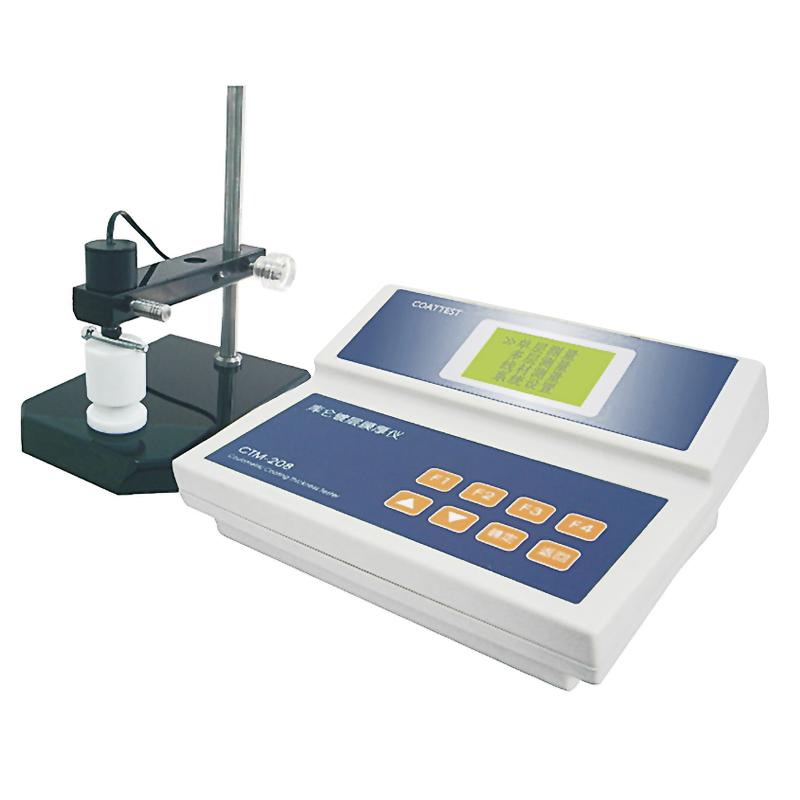
Both the electrolytic coating Thickness Gauge and the magnetic induction Thickness Gauge are tools used to measure the coating thickness of metal surfaces, but their measurement principles are different, with the following differences:
The measurement principle is different: the electrolytic coating Thickness Gauge uses electrochemical reaction to measure the coating thickness, while the magnetic induction Thickness Gauge uses the coating's response to the magnetic field to measure the coating thickness.
Different measurement ranges: Electrolytic coating Thickness Gauges are usually suitable for measuring the thickness of electrolytic coatings on metal surfaces, such as chrome plating, galvanizing, etc.; while magnetic induction Thickness Gauges are suitable for measuring various non-magnetic coatings on metal surfaces, such as paint film, plastic film, etc.
The measurement accuracy is different: the measurement accuracy of the electrolytic coating Thickness Gauge is relatively high, which can reach the level of 0.1 μm; while the measurement accuracy of the magnetic induction Thickness Gauge is generally between 1 and 2 μm.
Different prices: Generally speaking, the price of electrolytic coating Thickness Gauge is higher than that of magnetic induction Thickness Gauge.
Therefore, when selecting a measurement tool, comprehensive consideration should be given to factors such as the type of coating to be measured, measurement accuracy, and budget, and a suitable measurement tool should be selected.