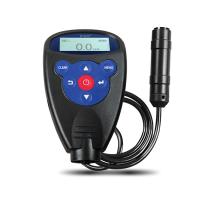
Film Thickness Gauge FAQ and its solution
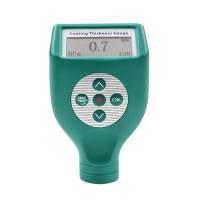
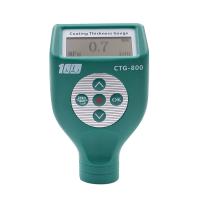
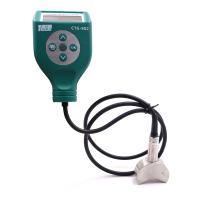
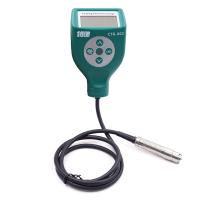
A Film Thickness Gauge is an instrument used to measure the thickness of a film or coating, also known as a Film Thickness Gauge. It measures the thickness of thin films or coatings to assess and control the quality of the material.

Common problems and solutions
Inaccurate instrument readings: check the calibration and calibration of the instrument, whether recalibration or calibration is required; check the preparation of the sample surface, such as whether there are oxides or impurities; Probes and measurement methods; ensure that the temperature and humidity conditions of the instrument meet the requirements.
The instrument reading is unstable: check the environmental conditions of the instrument reading, such as whether there is an interference source, whether there is a radiation source, etc., and keep it away from the interference source; check whether the instrument probe and measurement method are correct, and adjust the probe and measurement method to improve measurement accuracy ; Check the power supply of the instrument to ensure that the power supply is stable.
The instrument is faulty: check if there is any damage to the appearance or parts of the instrument, such as whether there is a loose connector or a damaged probe; check the power supply of the instrument to see if there is a power problem; For repairs, contact professionals in time.
There are residual data or letters on the display screen of the instrument: clean the display screen of the instrument, and wipe the screen with a special cleaner or a cloth.
The instrument reading is too large or too small: Check whether the probe is tilted or placed unevenly, adjust the position of the probe; check whether the probe needs to be replaced, because the damage of the probe will also affect the reading.
The zero point drift of the instrument: check whether the instrument is operating in an appropriate environment, such as temperature and humidity; check whether the probe is damaged or has a damaged circuit, and repair or replace it; recalibrate the zero point of the instrument to ensure that the zero point is accurate.
The instrument has measurement deviation: check whether the instrument needs to be calibrated, and if it needs to be calibrated, please calibrate according to the instructions in the operation manual; check whether the connector of the probe is loose or needs to be replaced; check whether there is an interference source and keep it away from the interference source; check the surface of the sample Check whether the state of the sample is normal, if the surface of the sample needs to be reprocessed; check whether the size of the probe and the measurement method are suitable for the sample.
Other failures of the instrument, such as noise, abnormal display, etc.: Contact the manufacturer or maintenance personnel for inspection and maintenance in time.
Precautions
Before using the film thickness meter, you should read the operation manual carefully to understand the use method and precautions of the instrument.
During the measurement, it should be ensured that the preparation of the sample surface meets the requirements to avoid affecting the measurement accuracy.
Calibrate and calibrate the Film Thickness Gauge regularly to ensure the accuracy of the measurement results.
Keep the instrument clean and maintained, and avoid dust or dirt from affecting the instrument.
Pay attention to safety when using the film thickness meter to ensure the personal safety of the operator.
In short, in order to maintain the accuracy and stability of the Film Thickness Gauge, we need to carry out calibration and calibration regularly, and perform correct operation according to the instructions in the operation manual. If there is a failure, it should be dealt with in time to ensure the normal use of the instrument.
- 1Principle characteristics and application of silver Film Thickness Gauge
- 2Film Thickness Gauge and its calibration method
- 3Type, application and selection method of film thickness meter
- 4What is the difference between Magnetic Induction Film Thickness Gauge and eddy Current Film Thickness Gauge?
- 5Application of Film Thickness Gauge in glue thickness measurement
- 6Key elements of dual-purpose Film Thickness Gauge selection
- 7Specific selection method of magnetic film thickness meter
- 8The correct selection method of non-destructive film thickness meter
- 9Coating film thickness selection 2 big tricks to avoid pits