Detection of dry and wet films for container coating
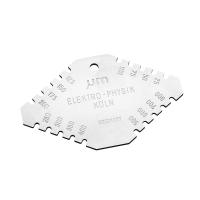
The detection of conventional coating thickness can be divided into two types: wet film thickness measurement and dry film thickness measurement . In container supporting material removal, such as epoxy, aerated rubber and acrylic container coatings dry quickly, and the fast-paced assembly line process of containers , It is impossible and inaccurate to control the film thickness by detecting the wet film thickness at the production site. Only asphalt paint on the bottom of the box can still use the wet film detection method to estimate the film thickness. The rice-shaped wet film thickness meter is commonly used. This is a metal plate or plastic sheet that can be carried around in your pocket. It is square or rectangular in shape as shown in Figure 8.2. There are teeth with different readings cut on its four sides, and the two ends of each side are in the on the same horizontal plane, while the middle teeth have different distances that rise rapidly in sequence from the horizontal plane. When using it, connect it vertically to the surface of the general hand test, so that a part of it will be wetted by the feeding film. Wet thickness is the reading between the last wetted tooth and the next unwetted tooth. (Related instruments: wet film gauge)

This is a low-value and easy-to-use simple measuring instrument, especially for use on construction sites. Some foreign products are triangular.
When the wet film thickness is only used to detect the humidity thickness, it should be carried out as soon as possible after the paint is called, so as to avoid large measurement errors caused by the thinning of the wet film due to the volatilization of the solvent. to estimate the dry film thickness (DFT).

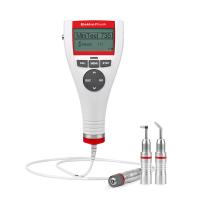
The film thickness of the container is basically measured by dry film thickness measurement after the coating is dried. It is a non-destructive pre-measurement method. The magnetic Thickness Gauge is commonly used. Its test accuracy is 2µm. The operating principle of the instrument is to measure the magnet The magnetic attraction and magnetic flux between the coating or the magnet and the substrate change according to the thickness of the non-magnetic layer of the paint film between the magnet and the substrate, and the thickness of the paint film can be measured according to the change.
In recent years, some digital display paint film thickness Testers with more intuitive calculations, smaller and lighter volumes have come out one after another, but in the measurement step ring, it usually needs to be zeroed and calibrated, and then several stages of test readings are required. For example, the Qua Nix7500 Thickness Gauge is one of the non-destructive thickness loss gauges manufactured by the Cologne Automatic Testing Instrument Company in Germany. This instrument with molded soft mechanism is widely used and has a strong structure. The probe can be fixed on the thickness control instrument for portable use, or it can be connected through an electric group to form an external probe. With different probes, the instrument can measure the thickness of the coating on the steel, and can also measure the Such as the coating thickness on non-ferromagnetic metal substrates such as aluminum, it should be noted that the Qua Nix7500 blue thickness meter with storage function can store the measured data in categories. In addition, the Thickness Gauge also has a specific software for statistical data, which can statistically print out the average film thickness, 1r, maximum film thickness x max , minimum film thickness x min .
- 1Determination method of dry and wet paint film thickness
- 2Coated steel coatings - Determination of dry-film thickness
- 3Dry-film thickness measurement: an important step before Coating mass evaluation
- 4How to convert Dry-Film and wet film thickness of concrete structure paintings?
- 5Dry-film thickness measurement of conformal paint
- 6Discuss the relationship between wet film and dry film
- 7What is "film thickness"?
- 8Dry and wet film thickness formula
- 9What is Dry Film Thickness (DFT)?