How to measure the color difference of Coated Glass?
With the development of the national economy, people's demand for the appearance quality and aesthetic effect of buildings has been continuously strengthened, and the coated glass has been favored by many architectural designers and users because of its beautiful materials, energy saving and good light transmission. develop. Today, coated glass has been used in CHINA for more than 10 years, and there are more than 200 domestic production lines.
However, in the actual production process of coated glass, there will be some chromatic aberration problems, and the problem of chromatic aberration of coated glass has been paid more and more attention. Color mainly stimulates the eyeballs through object reflection, and produces sensory information about the brightness and color of the object. This information will be transmitted to the brain center, and after processing, it will form the perception of color. The color of a transparent object, in addition to its own color elements, is mainly determined by the composition of the transmitted spectrum. It is mainly related to the object material, thickness and the refractive index of the medium.
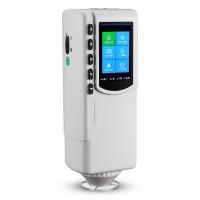
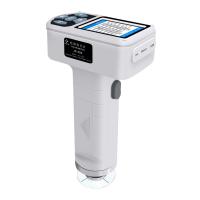
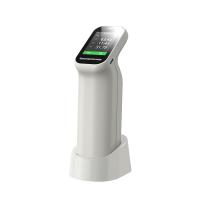
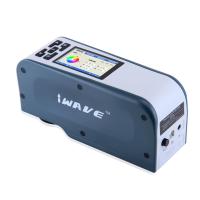
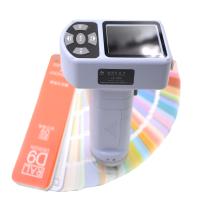
It can be seen from the principle that the size of the color stripe and color difference of the coated glass has a very important relationship with the quality of its appearance. Only when the color tone of the coated glass is moderate, and the error value of the color difference is within the specified range, can the effect of uniform and beautiful color of the glass curtain wall be achieved. All, the production materials, equipment, process and quality of the original glass of coated glass will have a direct impact on the color difference index of coated glass. Correct determination of color yield is a very critical and important factor in the production of coated glass. (Related instrument: Colorimeter)
1. CIE1976 (L* a* b*) uniform color space

2. Detection of chromatic aberration of coated glass
1. Sampling method
Take out 5 small samples of 50mm×50mm in the four corners and the middle of the same glass, and the outer edge of the sample is 50mm away from the edge of the glass. No. 0 means that the samples on the other four corners are numbered 1/2/3/4 respectively, as shown in Figure 1 below.

2. Color difference detection
From the above companies, the detection of color difference is mainly related to the accurate detection of the tristimulus value of the color sample, that is, the spectral reflectance Q(K) (or transmittance) of the color sample is measured, and then the sample is calculated according to formula (9). The tristimulus values are finally calculated very poorly.
3. Calculation of film thickness
Regarding the introduction of the principle of coated glass, we know that the thickness of the film layer will have a certain impact on the chromatic aberration of the coated glass. The film thickness of coated glass can be measured by some testing instruments. The thickness of a single-layer film is easy to measure, but the measurement of the thickness of each layer in a multi-layer film is more complicated, and it is necessary to simulate the parameters of each layer of film and measure them separately. This method is mainly used when doing scientific research in the laboratory, and is rarely used by the staff in actual production. When it is necessary to obtain the data of film thickness, industrial production generally adopts the estimation method, as follows:

In industrial production applications, in order to improve productivity, we make the glass run faster, but the sputtering power cannot be infinite, and there must be a certain upper limit. Therefore, always set the power to the maximum value first, and then condition speed.
- 1Sanenchi NR20XE Color Difference Tester Beauty Appreciation
- 2How to choose the correct color difference meter?
- 3CS-580 Spectrophotometer for color difference measurement of Coating lame plating
- 4What is color difference measurement?
- 5Why do color readers play an important role in the paper industry?
- 6Application of Spectroscopic Colorimeter in Pesticide Industry
- 7Application of Spectroscopic Colorimeter in Capsule Quality control
- 8WF28 Precision Colorimeter Operating Instructions
- 93Nh High Quality Portable Computer Colorimeter Operating Instructions (NR200, NH310, NH300)