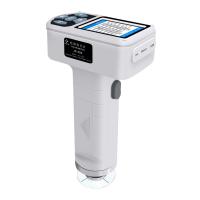
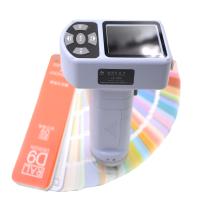
Experimental principle of color difference meter
A Colorimeter is an instrument used to measure the color difference of objects. Its experimental principle is mainly based on the human eye's perception of color and the basic principles of colorimetry.

The following is the main experimental principle of the Colorimeter:
Colorimetric space: Colorimetric Colorimeters use a colorimetric space to describe color. Commonly used chromaticity spaces include CIE Lab color space and CIE LCh color space. In these spaces, colors are represented by three coordinates, lightness (L*), the red-green axis (a or C), and the yellow-blue axis (b or h).
Standard light source: Colorimeters use a standard light source to illuminate the sample and collect the reflected light for measurement. Commonly used standard light sources include D65 light source, which has a balanced spectral distribution similar to natural light.
Measure the sample: the sample is placed in the measurement area of the Colorimeter and receives the reflected light after being irradiated by the standard light source. The color of a sample is determined by measuring the spectral distribution and intensity of reflected light.
Photoelectric Sensors: Colorimetric Colorimeters use photoelectric sensors to measure the light reflected from a sample. Photoelectric sensors convert light in different wavelength ranges into electrical signals.
Comparison and Calculation: Colorimeters compare the measured color of a sample with a reference color. By calculating the difference between the sample coordinates and the reference coordinates, the color difference value of the sample is obtained. Common color difference calculation methods include ΔEab and ΔE94, etc., which are used to represent the color difference between the sample and the reference.
Through the above experimental principles, the color difference meter can quickly and accurately measure the color of the sample, and provide a color difference value to describe the color difference between the sample and the reference. This has important applications in quality control, color matching and brand standardization in various fields.