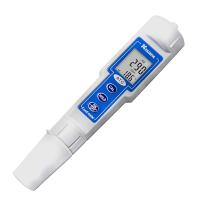
Principle of Conductivity Analyzer
A Conductivity Analyzer is an instrument used to measure the conductivity of a solution. It works based on the principle of the conductivity of ions in a solution.
Basic principle:
Conduction principle: Ions present in a solution have an electric charge and can move in an electric field. When an electric field is applied, ions are moved by electric field forces. Within a given distance, ions move at a speed proportional to their charge and electric field strength. Solutions with higher concentrations or higher conductivity have more ions, and ions move faster.
Conductivity Definition: Conductivity is an indicator that describes the ability of a solution to conduct electricity. It is defined as the amount of current passing through a unit cross-sectional area per unit length. Conductivity (κ) can be calculated according to the following formula: κ= G × (1/l) where G is conductivity, representing the current passing through a unit length; l is the distance the current passes through.
Conductivity Measurement: Conductivity analyzers use sensors (conductivity electrodes) to introduce current into a solution and measure the strength of the current passing through the solution. Depending on the definition of conductivity, the instrument can calculate conductivity values based on the measured current and the distance between the electrodes.
Temperature Compensation: Conductivity is closely related to temperature because the conductivity of a solution is affected by temperature. In general, conductivity increases with increasing temperature. Therefore, temperature compensation is often required in conductivity measurements. Conductivity analyzers are usually equipped with temperature sensors and use temperature compensation algorithms to correct the measurements.
Calibration and Unit Selection: To ensure accurate measurement results, Conductivity Analyzers often need to be calibrated. The calibration process involves calibrating using a standard solution with known conductivity to adjust the instrument's measurements. In addition, Conductivity Analyzers offer the ability to select different conductivity units such as S/cm, mS/cm, μS/cm, etc.

To sum up, a Conductivity Analyzer evaluates the concentration and conductivity of ions in a solution by measuring the conductivity in the solution. It uses an electric field to drive the ions in the solution and measures the strength of the current passing through the solution to calculate the conductivity value. Accurate conductivity measurements can be obtained through temperature compensation and calibration.
- 1The Working Principle of Gel Conductivity Meter Has Been Detailed
- 2Detection Principle and Application Analysis of Conductivity Meter
- 3Several common electrode types for Conductivity Meters
- 4Differences between three STIP-scans: pH Meter, Conductivity Meter, and Dissolved Oxygen Meter
- 5Conductivity Meter and Ion Meter specific differences
- 6Common types and application differences of STIP-scan
- 7How to detect the conductivity of lithium battery coating slurry?
- 8How to choose a high-precision conductivity meter?
- 9How to choose a microcomputer conductivity meter?