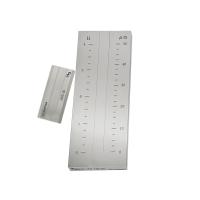
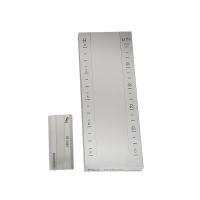
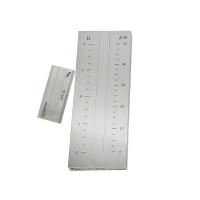
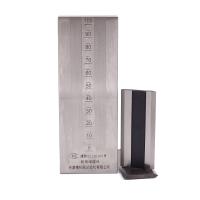
Fineness gauge detection principle
The principle of the fineness gauge is based on the relationship between the depth of particle settlement and the particle size. It is mainly used to measure the size and distribution of particles in samples such as pigments, inks, and coatings.
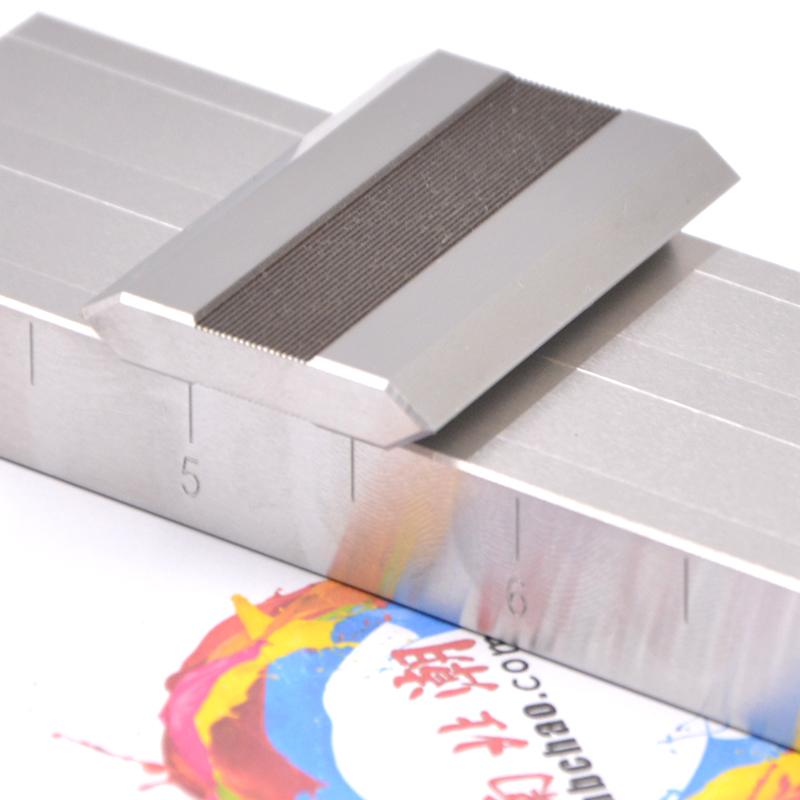
How it works
Sample Smear: Apply the sample to be tested on a flat surface of the Fineness gauge.
Flatten the sample: Use a drawdown blade or a scraper to flatten the sample so that it fills the entire measurement area of the Fineness gauge.
Particle sedimentation: Particles in the sample will be sedimentation in grooves or channels of the Fineness gauge.
Particle size Fineness: According to the size of the particles, particles of different sizes will be sedimentation to different depths in the groove.
Reading results: Fineness gauges are usually marked with scales corresponding to different particle sizes Fineness or abrasive particle grades. By reading the scale, the size and distribution of particles in the sample can be determined.
The principle of Fineness gauge is simple, intuitive, and does not require complex equipment, so it is widely used in industries such as pigment, inks, Coating and pigment to quickly assess the particle size and distribution of samples. It is a tool for rapid qualitative assessment of particle Fineness, but is not suitable for absolute particle size measurement. For more accurate particle size measurement, more sophisticated instruments such as Laser particle sizer or Electron Microscope (EM) are often required.
- 1Coating fineness of ground - Fineness gauge
- 2Coating fineness test method and influencing factors
- 3Fineness Detection of Precious Metal Slurry in Microelectronic Technology with Fineness Meter
- 4Inks Fineness gauge principle results and usage introduction
- 5Basic Principle and Application Analysis of Coating Fineness Scraper
- 6Coating Fineness Determination and Its Importance
- 7Detection Steps of Coating Fineness and Operation Method of Ground Gauge
- 8How to use Fineness of Ground Gauge to measure colorants?
- 9Frequently Asked Questions about Fineness Plates in 2022