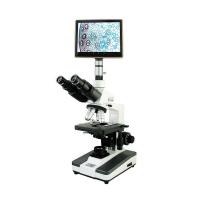
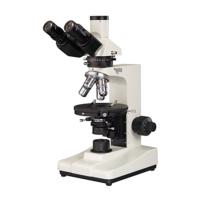
Polarized Microscope: A Scientific Journey to Explore the Special Properties of Light
Polarizing microscopes are unique microscopes that exploit the polarization properties of light to allow us to delve into and identify substances with birefringent properties. These microscopes can perform monopolarized, orthogonal polarized, and cone light observations, helping scientists understand the optical properties of matter.

Polarization characteristics of light:
Before understanding how a polarizing microscope works, we need to understand the polarization properties of light. Light is an electromagnetic wave that usually travels uniformly in the direction of vibration in all directions. However, under certain conditions, the vibration of light can be confined in one direction, which is called polarized light. Polarized light is usually produced by a polarizer, which only allows light in one specific direction of vibration to pass through.
How Polarizing Microscope Works:
Polarizing microscopes use polarizers and polarizers to adjust the polarization direction of light to explore the optical properties of matter. These instruments can be divided into the following modes:
Unipolarized light observation
In this mode, with only one polarizer and one polarizer, the light passes through the sample and is split into two beams of light with different vibrational directions, which are then combined again. This allows observation of birefringence properties in the sample.
Orthogonal polarized light observation
This mode uses two polarizers whose vibration directions are orthogonal to each other. This can help identify whether a substance is monorefringent (isotropic) or birefringent (anisotropic), since isotropic substances do not change the polarization state of light.
Cone observation
Cone light observation is a special mode of polarizing microscopy commonly used in mineralogy research. It uses a special lens system to generate cone light to further improve the observation of the sample.
Transmitted light, scattered light (reflected light) and transflected light:
In a polarizing microscope, light can interact with a sample in different ways, including transmitted light, scattered light (reflected light), and transflected light:
Transmitted light: This is how light passes through the sample and travels to the microscope. Transmitted light is used to observe the internal structure of the sample, such as the birefringent properties of crystals.
Dropped light (reflected light): In this case, light is reflected back to observe the surface of the sample. This is useful for studying surface morphology and properties.
Transflective Light: Transflective light is a combined mode in which light both passes through the interior of the sample and reflects back. This allows observation of the interior and surface of the sample.
Application field:
Polarizing microscopes are widely used in materials science, geology, mineralogy, biology, and pharmacy. They help scientists study the structure of crystals, the birefringence properties of materials, the orientation of tiny crystals and fibers, and more. In addition, polarizing microscopes are used to identify minerals, observe optical structures in biological samples, and study the properties of crystalline drugs in pharmacy.
In conclusion, polarized light microscopy is a powerful scientific tool that, through the polarization properties of light, allows us to delve into the optical properties and structure of matter. Its many modes and ways of viewing provide researchers with a wealth of information that helps unlock many mysteries in nature and the world of materials. Polarized light microscopy, a scientific window into the beauty of light, allows us to gain a deeper understanding of nature and the complexity of matter.