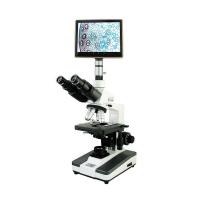
Classification of Objectives: Revealing Key Components of the Microscopic World
Objectives are one of the key components in microscopes, which determine the magnification and resolution of microscopes, thereby affecting our observation and research in the microscopic world. This article will introduce the classification of objectives, including achromatic objectives, flat-field achromatic objectives, and infinity flat-field achromatic objectives, and discuss their functions and advantages and disadvantages in microscopes.

Achromatic objective:
An achromatic objective is an objective designed to correct for chromatic aberration. Chromatic aberration is an optical distortion that causes different wavelengths of light to be focused on different focal planes, affecting the color and clarity of the object being viewed. An achromatic objective corrects this chromatic aberration by using a special lens combination, providing a more accurate color and image. This enables the observer to see the true color of the object, rather than being disturbed by chromatic aberration.
Flat-field achromatic objective:
A flat-field achromatic objective is a further improved objective that corrects aberrations in addition to correcting chromatic aberrations. Aberrations are optical distortions due to the imperfect shape of a lens or the refraction of light, which can cause images to have different sharpness at the center and edge of the field of view. A flat-field achromatic objective corrects these problems by optimizing the lens shape and curvature, ensuring that images maintain consistent sharpness throughout the field of view.
Infinity flat-field achromatic objective:
The infinity flat-field achromatic objective is a further improvement on the flat-field achromatic objective. It is designed to view samples at infinity, which is useful in certain microscopy applications. This objective provides a flat field of view, allowing the observer to maintain uniform clarity throughout the field of view, whether viewing a central object or an object at the edge of the field of view.
The importance of objective lenses:
The objective lens is one of the core components of a microscope, and its design and quality directly affect the performance of the microscope. High-quality objectives can provide higher magnification and better resolution, enabling scientists to observe and study tiny biological and material structures. Different types of objectives are suitable for different applications, and scientists choose the appropriate objective type according to experimental needs.
In conclusion, objective lenses are hard-to-miss components of microscopes that improve microscope performance by correcting chromatic and aberration, and providing a flat-field field of view. The different types and designs of objective lenses allow us to better explore and understand the mysteries of the microscopic world. Objectives are a key component in revealing the beauty of the microscopic world.