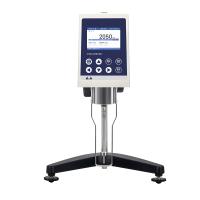
Application of Rotational viscometer in Determination of Adhesive Viscosity
1. Introduction
In the production and application of Adhesive, viscosity is an important performance index, which is directly related to its flowability, construction performance and use effect. Therefore, the accurate determination of Adhesive viscosity is of great significance for product quality control and application effect. This article will introduce the measurement method based on Rotational Viscometer.
2. Testing principles and methods
Under normal circumstances, high-viscosity liquids and viscous Paints, latex paint, etc. have non-Newtonian flow properties, that is, their viscosity will change with the change of shear rate. In order to determine the viscosity of Adhesive, a Rotational Viscometer is usually used. The instrument calculates the viscosity value by measuring the stress required at a fixed shear rate through components such as swirl/spin discs or blades, causing the sample to rotate and flow.
3. Equipment
There are many types of Rotational Viscometers, which can be divided into different types according to the shape of the swirl/spin parts, such as concentric disc type, internal and external swirl/spin type, external and internal simple fixed type, pulp disc type and cone plate type, etc. The thermometer is used to measure the temperature of the sample and requires a division of 0.1 ℃.
4. Operation points
When performing Adhesive viscosity measurement, the following operation points should be paid attention to:
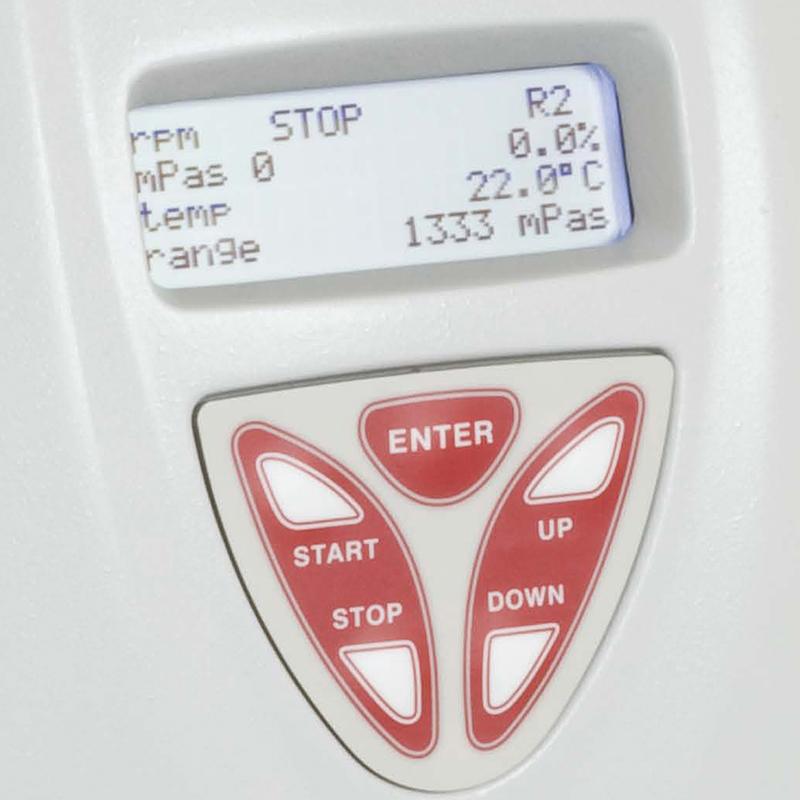
Select the appropriate rotor and Rotation speed: Select the appropriate rotor and Rotation speed according to the viscosity of the sample, so that the measured value falls within the range of 20-80% of the dial.
Equilibrate sample temperature: ensure that the temperature of the sample and the test temperature reach equilibrate, and keep the sample temperature uniform.
Immerse the center of the sample: Immerse the rotor vertically into the center of the sample, and make the liquid level reach the rotor liquid level mark.
Start the Rotational Viscometer: After starting the Viscometer, observe the reading of the pointer on the disc while swirl/spin is unchanged.
5. Results presentation and precautions
Each sample needs to be measured three times for sexual repeability, taking the smallest value as the test result, and retaining three significant digits. During the operation, the following matters should be noted:
Loading and unloading the rotor: Be careful when loading and unloading the rotor to avoid bending the rotor due to excessive force. Do not put the instrument on the side or upside down after the rotor is installed.
Keep it clean: The connection face and thread of the connecting screw and rotor should be kept clean. After each use, the rotor should be cleaned in time and properly placed in the rotor frame.
6. Application and meaning
Adhesive viscosity determination is important in production, quality control and application:
Production control: Adhesive's viscosity is closely related to its formulation and process parameters, and the conformity of the product can be controlled by viscosity measurement.
Application performance: Adhesive viscosity directly affects its flowability, Spreader performance and adhesion during construction and use.
Mass Assurance: Viscosity determination helps to guarantee Adhesive mass and ensure that the product meets the design requirements.
7. Conclusion
The determination of Adhesive viscosity is a difficult or lacking part in the Adhesive industry. Through the measurement method of Rotational Viscometer, the viscosity value of Adhesive can be accurately obtained, which provides an important reference for the production and application of products, thereby improving the performance and mass of products.
- 1Rotational viscometer - principle, classification, application and calibrating
- 2Application of NDJ-8S digital Rotational Viscometer in viscosity measurement of cosmetic raw materials
- 3NDJ-5S digital Rotational Viscometer accurate measurement of natural oil viscosity
- 4Viscosity of polypropylene (PP) amide measured by NDJ Viscometer
- 5Application of HBDV-1H swirl/spin High Temperature Viscometer in Viscosity Determination of Plastic Particles
- 6Rotational viscometer selection guide: How to choose the right viscosity equipment for you?
- 7Principle, type and accuracy control of Rotational Viscometer
- 8Which Viscometer to Choose for Licorice Extract Viscosity Testing? How to Test?
- 9Application of Rotational viscometer in Waterborne Polyurethane Adhesive