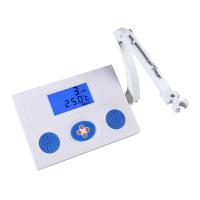
Determination and application of conductivity of pigment water suspension
Pigments are widely used in various Applications, such as paints, plastics, rubber, Printing inks, etc. In order to ensure the stability, applicability and mass of the end point product of the pigment, it is crucial to measure various physicochemical properties of the pigment. This paper focuses on the determination method of conductivity of pigment aqueous suspension and its significance in practical applications.
1. The importance of measurement
The conductivity of pigments can reveal the solubility of pigments in water and the Ion concentration in them. This assay is not suitable for pigments that are significantly soluble in water. However, for most pigments, this assay can provide us with valuable data on pigment stability, applicability and Coating or Miscellaneous composite performance.

2. Determination method
(1) water wettability test:
First, you need to determine the wettability of the pigment. Mix the pigment with boiling distillation water and observe its wetting. If the pigment is easily wetting by water, it is hydrophilic, and if it is not easily wetting by water, it is hydrophobic.
(2) Determination of hydrophilic pigments:
Weigh 20g of pigment, put it in the beaker, and then add 180g of boiled pure water.
After continuous stirring, the mixture was boiled for 5 minutes, chilled down to about 60 ℃, and added to 200g of pure water.
The mixture was filtrated and the initial 10 mL of filtrate was discarded.
Use the ConductivityMeter and Conductivity Detector electrode to determine the conductivity of the filtrate. During this process, make sure that the filtrate temperature is 23 ℃ and the electrode position is accurate.
(3) Determination of hydrophobic pigments:
20G of pigment was mixed with 4~ 16g of methanol to form a uniform slurry.
Add boiling water and dilute to 200 g.
Chill down to 60 ℃ and filtrate, again discarding the first 10 mL filtrate.
Also measured conductivity according to the above method.
3. Interpretation of the results
The measurement results should be the average of the two measurements and accurate to 1%. The measurement results of conductivity can provide an important basis for the selection and application of pigments. For example, high conductivity may mean that there are more soluble salts in the pigment, which may adversely affect properties such as pigment stability, color saturation, and corrosion resistance of coatings.
4. Precautions in the experiment
The instruments and materials used need to be strictly inspected and calibrated. For example, filter paper needs to be washed with pure water first to ensure that its conductivity does not exceed 5.0 μS/cm.
During the measurement process, ensure that the experimental conditions, such as temperature, exact weight of the substance, etc., are strictly in accordance with the standard.
According to the nature of the pigment, the appropriate measurement method is selected. This is crucial to obtain accurate measurement results.
5. Reference standards
The determination method is based on the national standard GB5211.12--86 "Determination of Electrical resistivity of pigment water extract".
6. Conclusion
The determination of the conductivity of pigment water suspension has important guiding significance for the selection and application of pigment. Through this measurement method, the physicochemical properties of pigment can be better understood, thereby ensuring the high mass of the final product. The determination of the conductivity of pigment water suspension plays a key role in the development, production and application of pigment. This measurement of pigment is essential in order to ensure the performance of Coating or Miscellaneous pigment application products.