Stiffness measurement technology and two instruments
Stiffness is one of the important indicators to measure the bending performance of paper and cardboard, and is of great significance for paper applications in different industries. This article will start from the definition and measurement principle of stiffness, introduce the structure and working principle of the measurement part of the Taber stiffness meter and the L&W stiffness meter, and conduct a comparative analysis of the two through experimental data.
1. Stiffness
The definition of stiffness is in accordance with the GB/T2679.3-1996 standard, which refers to the force or moment when bending a specimen of specified size clamped at one end to an angle of 15° under the conditions specified in the standard, expressed in mN or mN·m. The principle of stiffness measurement is to measure the force or moment required to bend a specimen clamped at one end to a given angle, and the force acts on a constant bending length.
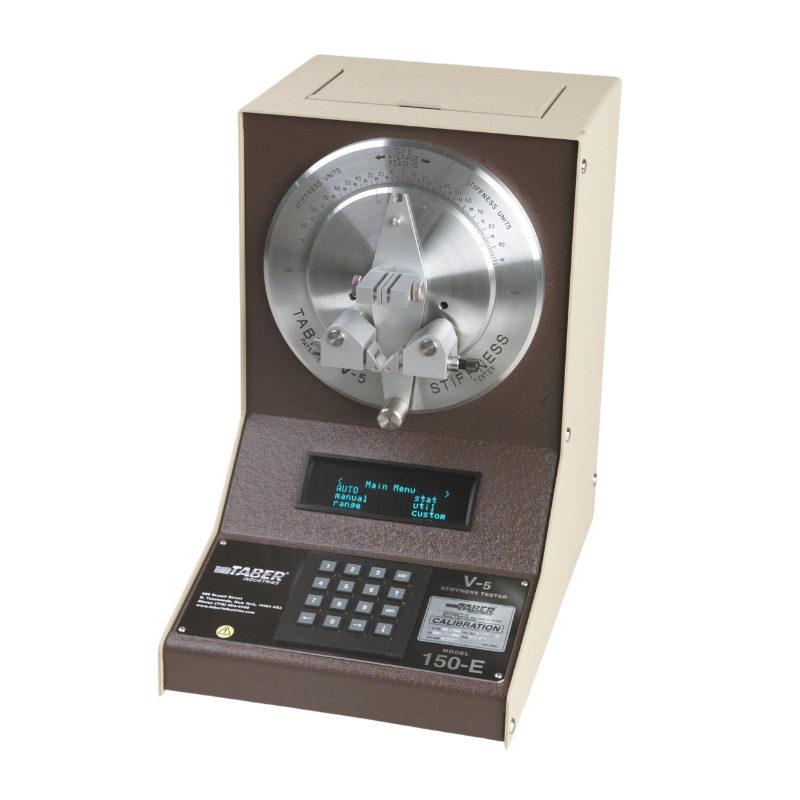
2. Taber type stiffness Tester
structure
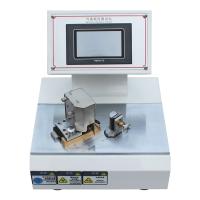
The measurement part of the Taber type stiffness meter mainly consists of an angle plate, a torque dial, a pendulum body, a paper clamp, a paper pushing mechanism, a binning weight, etc.
working principle
When the angle plate is rotated, the force F in the vertical direction of the specimen causes the specimen to bend around the center point. The bending force of the specimen is transmitted to the pendulum of the instrument, causing the pendulum to deflect at a certain angle around the center point. Stop running when the sample is bent at an angle of 15°. According to the definition of stiffness, the stiffness is equal to the bending moment.
3. L&W Stiffness Tester
structure
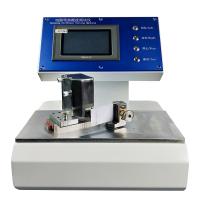
The testing part of L&W stiffness Tester mainly consists of clamping device, blade and load sensor.
working principle
Place the sample on the clamping device. The clamping device clamps the sample and slowly rotates it. The unclamped end of the moving specimen is in contact with the blade, and the test is stopped after the specimen is bent to the selected angle. During the test, the bending force of the specimen is transmitted to the load sensor through the blade and then output.
4. Correlation analysis
The correlation analysis between Taber stiffness and L&W stiffness was carried out through experimental data, and it was found that there is a linear relationship between the two: Taber stiffness (mN·m) = 0.05 (m) à L&W stiffness (mN). Although the stiffness data given by the two instruments are different, the L&W stiffness can be easily converted to Taber type stiffness through a simple conversion formula.
Stiffness is an important performance parameter of paper and paperboard, and its measurement is crucial for paper applications in different fields. Taber stiffness Tester and L&W stiffness Tester are commonly used measurement tools. Although the measured data units are different, they can be easily converted through correlation analysis. Choosing the right instrument depends on the specific application needs, and understanding its structure and working principles is important for correctly understanding the measurement results.
-
![CHINA microcomputer Bending Stiffness Tester NBC-WQTD]()
-
![CHINA NBC-5637A Computer-controlled stiffness Tester]()
-
![LD-TD-A-01 Bending Stiffness Tester]() LD-TD-A-01 Bending Stiffness Tester$ 1691.00
LD-TD-A-01 Bending Stiffness Tester$ 1691.00 -
![CHINA ZY-TD stiffness Tester Cardboard Stiffness meter paper Bending Stiffness Tester]()
-
![CHINA ZY-ZBT paper cup stiffness Tester]() CHINA ZY-ZBT paper cup stiffness Tester$ 1731.00
CHINA ZY-ZBT paper cup stiffness Tester$ 1731.00 -
![LD-BSTD-01 Cup body stiffness Tester Stiffness Meter]()
-
![LD-TD-A Paper Cardboard Bending Stiffness Tester]()
-
![Puyun PY-J632 Cup body stiffness Tester 0-20N]()
-
![PY-H609 Bending Stiffness Tester (touch screen) measuring range ≤ 500mN · m]()