Working Principle and Application of Yoke Flaw Detector
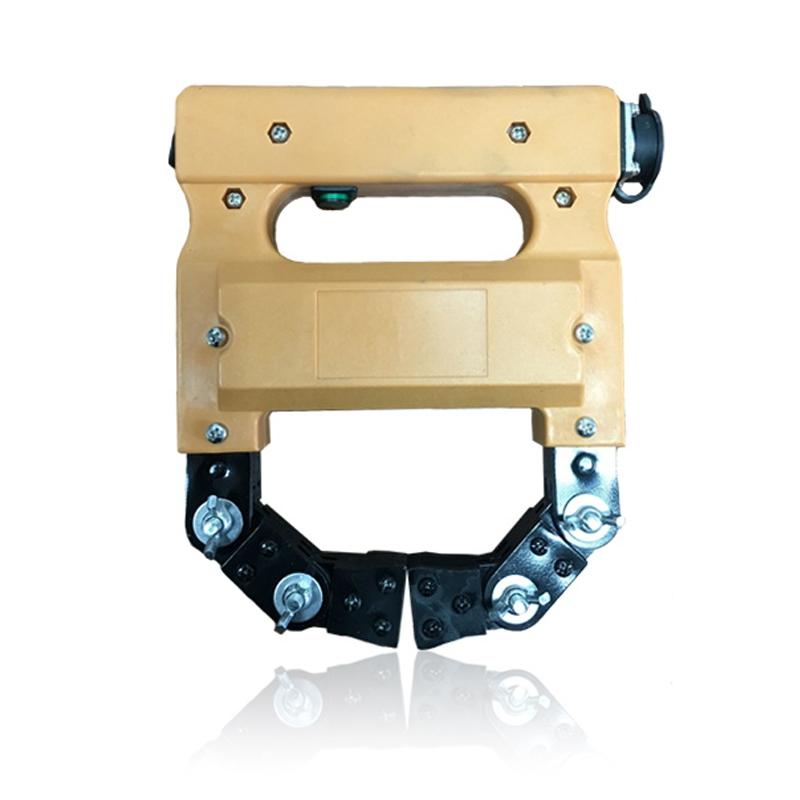
The magnetic yoke flaw Detector is a miniature magnetic particle flaw detection equipment that uses a yoke to magnetize ferromagnetic materials. It is widely used in oil fields, shipbuilding, machinery, coal mining, chemical industry and other industries to detect surface and near-surface defects, such as defects caused by forging, quenching, welding, fatigue, etc.
working principle
The working principle of the magnetic yoke flaw Detector is based on the principles of magnetization and magnetic particle flaw detection. The steps include pre-processing, magnetization, magnetic powder use, observation and post-processing.
Pre-processing
Before magnetic particle inspection, the surface of the object to be tested needs to be treated to remove grease, paint, rust and other foreign matter to ensure that the magnetic particles are adsorbed on the scratches and form a clear indication pattern.
magnetization
Magnetization is a key step in magnetic yoke flaw detection. By adopting various magnetization methods such as axial energization method, right-angle energization method, Prod method, and current penetration method, the object to be measured is properly magnetized and creates conditions for subsequent magnetic particle adsorption.
Magnetic powder use
After magnetization, magnetic particles are used for flaw detection. The types of magnetic powder include white, black, red, etc., as well as fluorescent magnetic powder. Magnetic powder adheres to the scratches on the surface of the object to be measured, forming an indicator pattern that helps detect defects.
observe
In order to clearly observe the magnetic particle pattern, it needs to be observed in an appropriate environment. Conventional magnetic powder requires a bright environment, while fluorescent magnetic powder requires ultraviolet irradiation.
post processing
After the flaw detection is completed, post-processing is carried out on the object to be tested, including demagnetization, magnetic particle removal, anti-rust treatment, etc., to ensure that the object to be tested can be used as a product or enter the next processing step.
Application areas
Magnetic yoke flaw Detectors are widely used in many fields, including oil fields, shipbuilding, machinery, coal mines, chemical industry, etc. It is suitable for detecting various parts, such as chain rods, crankshafts, bearings, high-strength bolts, springs, forgings, valves, blades, gears, rollers, anchor chains, welds and other geometrically complex workpieces.Miniature yoke flaw Detectors include AC, DC, and AC-DC dual-purpose magnetic particle flaw Detectors. The DC power supply is a rechargeable battery, which is suitable for field operations without power supply in the field. AC power supply is directly input, easy to operate, simple, light weight, and suitable for a variety of occasions.
Instrument calibration
Before using the magnetic yoke flaw Detector, it needs to be calibrated to ensure its accuracy. At the same time, select the appropriate magnetization method and magnetic powder type according to the characteristics of the object to be measured to obtain clear detection results. In general, magnetic yoke flaw Detectors play an important role in various industrial fields because of their portability, efficiency, and non-destructive characteristics, helping inspectors to promptly discover and solve defects on the surface and near-surface of materials.