Working Principle and Application Analysis of Confocal Microscope
introduction
In the field of microscopic science, confocal microscopy is a powerful and high-resolution tool that provides scientists with the ability to delve deep into tiny structures and cell interiors. By integrating confocal technology, this microscope is able to acquire high-quality three-dimensional images of the sample surface, allowing researchers to gain insights into cells, biological tissues, and nanostructures. This article will deeply explore the principles, structure, performance characteristics, application scenarios and future development trends of confocal microscopes, and present readers with a high-definition window into this microscopic world.
working principle
The principle of confocal microscopy is based on two basic concepts: confocal and laser scanning.
Confocal is a technique that improves imaging by combining light from different focal points of a sample. Light is focused through lenses or mirrors into different depths of the sample, and these rays are then captured by a Detector to form a high-quality image. Confocal microscopy uses a laser beam to scan the surface of a sample point by point. This ensures that only light rays focused on the current focal plane are detected, improving image clarity and contrast. Confocal microscopy typically uses reflected light detection to acquire images. The light reflected from the sample surface is received and converted into an image after being focused by laser scanning and confocal.
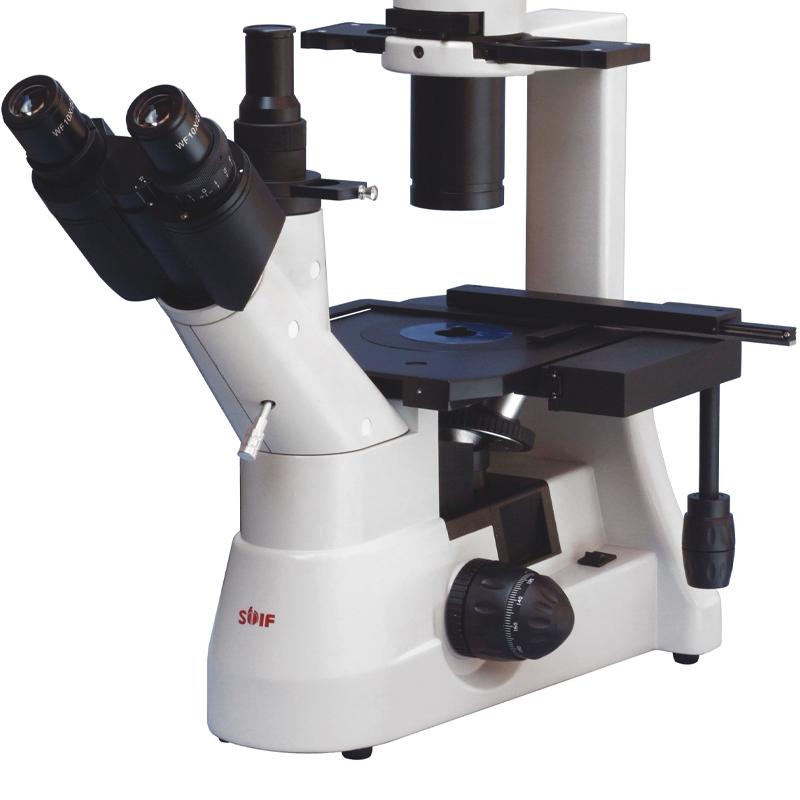
A confocal microscope consists of a laser system that generates a high-intensity laser beam that serves as the light source for scanning and focusing. The scanning system uses a laser beam to scan the sample surface point by point, ensuring that only light focused on the current focal plane is captured. The Detector is used to receive the light reflected from the sample surface and convert it into electrical signals for computer processing and image reconstruction. A lens system is used to focus the laser beam to different depths of the sample and ensure high-quality image acquisition. Through the computer system, the data from laser scanning and reflected light detection are processed to form the final three-dimensional image.
Performance characteristics
Confocal microscopy has good resolution and can capture high-definition images of sample minute structures and biological cells.
Confocal microscopy uses laser scanning technology and focusing systems to generate three-dimensional images of samples, allowing researchers to more fully understand the structure of the sample.
Confocal microscopy can observe the dynamic processes of samples in real time, such as internal activities of cells and biological reactions, providing great convenience for life science research.
Confocal microscopy is generally less invasive to the sample than some other microscopy techniques and is suitable for non-destructive observation of biological samples.
Due to the application of laser scanning and confocal technology, confocal microscopy shows high sensitivity for samples with uneven optical density.
Application scenarios
Confocal microscopes are widely used in the field of biology to observe and study biological cells, tissue structures, intracellular movements, etc. Used in clinical medicine, confocal microscopy can be used to observe and diagnose pathological specimens, providing high-resolution images of tissue structures. In the field of nanotechnology, confocal microscopy can be used to observe and study the morphology and properties of nanomaterials. It is used to study the surface morphology, microstructure and interaction between materials, which is helpful for material design and optimization. Confocal microscopy plays an important role in neuroscience research, helping scientists observe neuronal connections and activity.
Future confocal microscopes may introduce higher-speed imaging technology to achieve faster scanning speeds to observe faster biological processes. With the advancement of micro-nano technology, future confocal microscopes may become smaller and more portable, making them easier to use in the laboratory and in the field. Integrate different imaging technologies, such as fluorescence imaging, super-resolution imaging, etc., to achieve more comprehensive and multi-modal sample observation. Future confocal microscopes may expand the wavelength range to cover more of the optical spectrum to accommodate the needs of different samples. Introduce artificial intelligence and machine learning algorithms to achieve intelligent analysis and interpretation of large amounts of image data, improving data availability and scientific research efficiency.
Conclusion
Confocal microscopy serves as a high-definition window into the microscopic world, providing scientists with the ability to delve into tiny structures and the interior of cells. Its high resolution, three-dimensional imaging, real-time observation and other characteristics make it widely used in life sciences, medicine, nanotechnology and other fields. In the future, confocal microscopy is expected to continue to innovate in high-speed imaging, multi-modal imaging, intelligent analysis and other aspects, bringing more possibilities to microscopic scientific research.


