Experimental principle and application analysis of experimental salt fog
In modern industrial production and manufacturing, the corrosion resistance of materials is a crucial performance indicator. Especially for materials exposed to harsh environments, such as materials used in environments such as oceans and industrial air pollution, their corrosion resistance is even more critical. In order to accurately evaluate the corrosion resistance of materials, scientists have developed various experimental methods and equipment, among which experimental salt spray is an important testing method. This article will deeply explore the principles, structure, usage, application scenarios and future development trends of experimental salt spray, so that readers can better understand and apply this key testing method.
Experimental principle
Experimental salt spray is a test method that simulates salt spray corrosion in the natural environment. The principle is to form a highly corrosive salt spray environment by dissolving salts (usually sodium chloride) in water, and then using special experimental equipment to spray the salt spray onto the surface of the material to be tested to simulate the natural environment. salt spray corrosion. Through exposure for a certain period of time, the corrosion degree of the material is observed and evaluated to determine its corrosion resistance.
Structural features
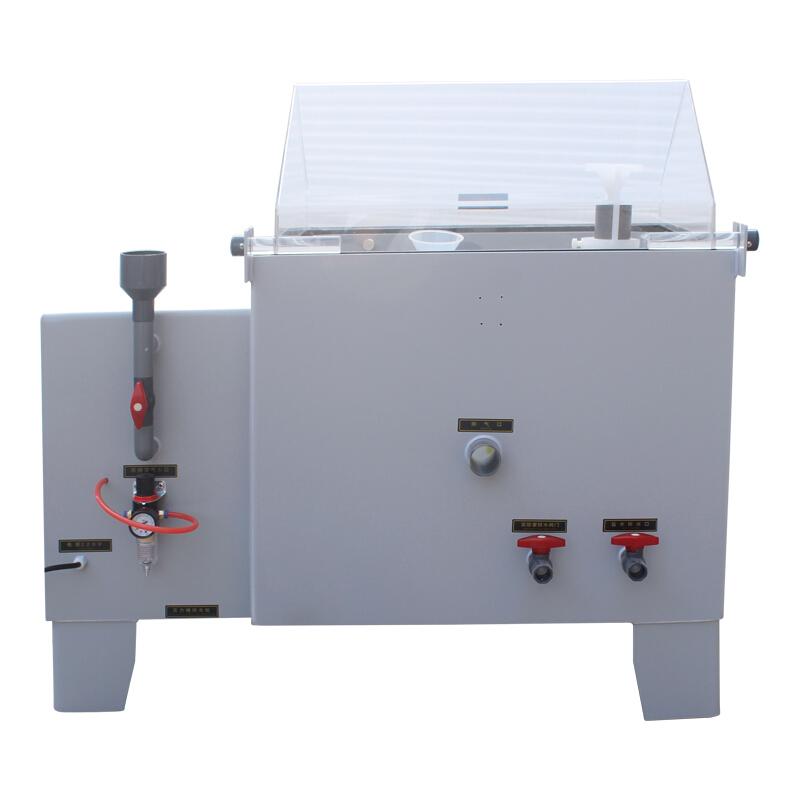
Experimental salt spray usually consists of salt spray generator, spray chamber, control system and other parts. The salt spray generator is used to dissolve salts in water to form a salt spray solution to provide the salt spray environment required for experiments. A spray chamber is a space used to expose samples to be tested and is equipped with a spray head or spray system to evenly spray salt spray onto the sample surface. The control system is used to adjust the working status of the salt spray generator and control parameters such as salt spray concentration, spray time and temperature to achieve precise control and monitoring of the experimental process.
Application scenarios
Experimental salt spray can be used to evaluate the corrosion resistance of automobile exterior components, such as body coatings, body steel plates, etc. Used to evaluate the marine salt spray corrosion resistance of ship structural materials, such as hull coatings, hull steel plates, etc. Used to evaluate the resistance to atmospheric pollution and corrosion of building materials, such as building coatings, metal materials, etc. Used to evaluate the marine salt spray corrosion resistance of electronic products, such as electronic equipment casings, circuit boards, etc.
Future experimental salt spray equipment may simulate more complex environmental factors, such as temperature, humidity, ultraviolet light, etc., to more realistically simulate corrosion in the natural environment. Future experimental salt spray equipment may incorporate intelligent control technology to realize automated operation and data monitoring of the experimental process, improving test efficiency and accuracy. Future experimental salt spray equipment may introduce more comprehensive evaluation indicators, such as electrochemical methods, surface morphology analysis, etc., to comprehensively evaluate the corrosion resistance of materials.
Conclusion
As an important testing method to evaluate the corrosion resistance of materials, experimental salt spray has important application value and development prospects. By in-depth understanding of its principles, structure, usage, application scenarios and future development trends, we can better understand and apply this key testing method and promote development and innovation in the field of materials science.