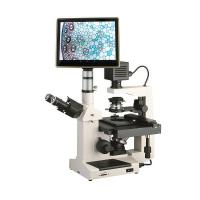
InvertedMicroscope principles, applications, and options
As an important scientific tool, inverted microscopes play a key role in the fields of biology, medicine and materials science. This article will introduce the principles of inverted microscopes, main application scenarios, and how to choose an inverted microscope that suits your needs.
The principle of inverted microscope
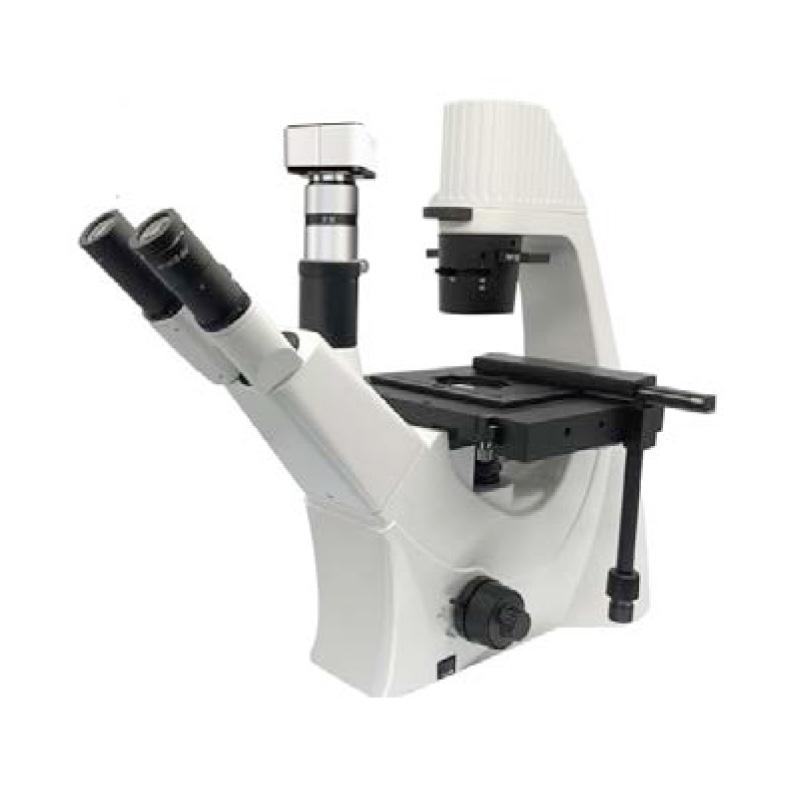
Inverted microscopes subvert the traditional design by placing the light source and condenser above the sample stage, while the objective lens and rotating disk are below. This design allows scientists to view samples from below and is particularly useful for observing living cells or organisms in large containers. Inverted microscopes make the observed samples more natural and realistic by inverting the optical path.
By changing the direction of the light path, an inverted microscope installs the light source and objective lens for observing the sample at the bottom of the microscope, while the eyepieces are installed at the top. In this way, light first enters the microscope through the eyepiece, then enters the sample through the objective lens, forming a magnified real image on the sample, and is finally observed again through the eyepiece. Therefore, the observer sees the object upside down, that is, in the opposite direction to the actual object.
Applications of inverted microscopes
Inverted microscopes are widely used in many fields. Biologists can use inverted microscopes to observe and study the growth, division, and movement of living cells. In the medical field, inverted microscopes are used to observe the structure of tissues and cells, diagnose diseases and study the mechanism of action of drugs. In materials science, inverted microscopes are used to analyze the crystal structure of metals and alloys, surface defects, and the microstructure of materials. The following are some specific application examples:
Biological cell observation:
Inverted microscopes are often used to observe the morphology, structure and behavior of biological cells. Researchers can use inverted microscopes to observe the growth, division and movement of living cells to study the basic principles and mechanisms of cell biology and biochemistry.
Tissue culture observations:
Inverted microscopes can be used to observe and analyze tissue samples grown in vitro, such as cell cultures and tissue sections. Scientists can use inverted microscopes to observe the growth, differentiation and interaction processes of tissues to gain insight into the structure and function of cells and tissues.
Drug development and efficacy evaluation:
The pharmaceutical industry often uses inverted microscopes for drug development and efficacy evaluation. Researchers can use inverted microscopes to observe the effects of drugs on cells and tissues, evaluate the biological activity, toxicity and efficacy of drugs, and provide important data and reference for the design and development of new drugs.
Materials Science Research:
Inverted microscopes also have important applications in materials science. Scientists can use inverted microscopes to observe the microstructure and surface characteristics of metals, alloys and other materials, study the properties, organization and deformation behavior of materials, and provide important reference and guidance for material design and preparation.
Biomedical Research:
In biomedical research, inverted microscopes are often used to observe the mechanisms and pathological changes of diseases. Researchers can use inverted microscopes to observe pathological specimens, cell cultures and animal models to study the pathophysiological processes, diagnostic markers and treatment strategies of diseases, providing important support for the development and progress of clinical medicine.
Selection of inverted microscopes
There are several factors to consider when choosing the right inverted microscope for your needs. The first thing to consider is the purpose of the microscope. If it is used for basic biological research or teaching, a conventional inverted microscope is enough; if it is used for advanced scientific research, you need to choose a research-type inverted microscope with more powerful functions and higher precision. Second, consider the magnification and resolution of the microscope and whether special illumination techniques are required. Finally, consider budget constraints and the ease of use of the device.
Inverted microscopes play an important role in fields such as biology, medicine, and materials science, but choosing the right one for your needs may require considering several factors. Here is a detailed buying guide to help you find the right inverted microscope for you:
1. Microscope use:
First decide what you will use it for. If you are a biologist who needs to observe the growth, division, and movement of living cells or organisms, then you may need a biological research inverted microscope with high magnification and clear imaging. And if you are conducting research in materials science and need to observe the crystal structure and surface defects of metals or alloys, then you may need a professional materials science inverted microscope.
2. Magnification and resolution:
Magnification and resolution are important indicators of microscope performance. For biological research, you may need a microscope with high magnification (usually over 100x) and high resolution to observe the microstructure of cells and organelles. For materials science research, you may need higher magnification (usually above 500x) and higher resolution to observe the microstructure and surface structure of the material.
3. Lighting technology:
Illumination techniques are critical to the quality and clarity of your specimen observations. Common illumination techniques include brightfield, darkfield, phase contrast microscopy, and fluorescence microscopy. Choosing the lighting technology that suits your needs depends on the type of sample you want to observe and the purpose of your research.
4. Budget constraints:
Microscopes range in price from a few hundred dollars to hundreds of thousands of dollars. Therefore, you need to consider your budget constraints and weigh the balance between price and performance. If you have a limited budget, you can choose an entry-level inverted microscope with simpler functions, while if you have a sufficient budget, you can consider investing in a high-performance research inverted microscope.
5. Equipment ease of use:
Finally, you also need to consider the ease of use of the device. An inverted microscope should be easy to operate, have an intuitive control interface, and have stable performance. When choosing, it is recommended to choose a reputable manufacturer and read user reviews to understand the actual experience of using the device.
As an important scientific tool, inverted microscopes play an important role in fields such as biology, medicine, and materials science. Choosing the right inverted microscope for your needs requires considering factors such as purpose, magnification, resolution, lighting technology, and budget. By understanding the principles and applications of inverted microscopes and choosing appropriate equipment, it will help to promote the smooth progress of scientific research and experimental work.