Introduction of working principle and application scope of water-cooled xenon arc weathering Test Chamber
In the fields of engineering materials, coatings, plastics, rubber and other fields, weather resistance is a crucial performance indicator. As climate change and environmental pollution intensify, materials exposed to light, heat, moisture and other factors in the natural environment are increasingly affected. In order to evaluate the weather resistance of materials, the water-cooled xenon lamp weather resistance Test Chamber came into being. This article will deeply discuss the principle, structure, working method of water-cooled xenon lamp weathering Test Chamber and its importance in material research and development and quality control.
working principle
The working principle of the water-cooled xenon lamp weathering Test Chamber is based on simulating natural sunlight radiation, temperature and humidity conditions. It uses a high-energy xenon lamp as a light source to produce ultraviolet and visible light similar to natural sunlight. At the same time, it controls the temperature and humidity in the Test Chamber through a water-cooling system to simulate the exposure of materials under different climate environmental conditions. By exposing material samples to a water-cooled xenon lamp weathering Test Chamber for a certain period of time, and observing changes in appearance, changes in physical properties, etc., the weather resistance of the material can be evaluated.
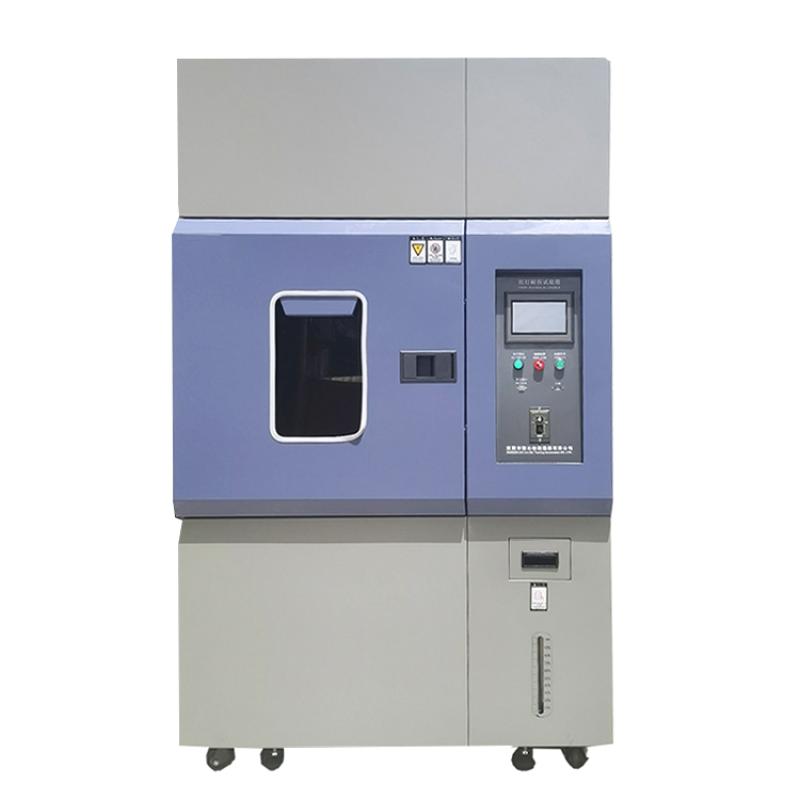
Water-cooled xenon lamp weathering Test Chamber usually consists of a test box, xenon lamp source, water cooling system, temperature and humidity control system, sample holder, etc. Among them, the xenon lamp source produces ultraviolet and visible light, the water cooling system is used to control the temperature in the Test Chamber, and the temperature and humidity control system is used to adjust the humidity and temperature in the Test Chamber. The Test Chamber is usually made of stainless steel or corrosion-resistant materials and has the characteristics of strong durability, good sealing, and easy operation.
When performing a weathering test, the material sample to be tested is placed on the sample holder, and then the required light, temperature and humidity conditions are set. The water-cooled xenon lamp weathering Test Chamber will simulate natural light, temperature and humidity under different environmental conditions, and conduct long-term exposure tests on material samples. During the test process, the light intensity, temperature and humidity in the Test Chamber can be adjusted as needed to simulate environmental conditions in different regions and seasons.
Application scope
Water-cooled xenon lamp weathering Test Chambers are widely used in various fields. In terms of material research and development, they are used to evaluate the weather resistance of different materials and guide the development and improvement of new materials. It is used to test the weather resistance of products and ensure the stability and reliability of products under different environmental conditions. It is used to evaluate the weather resistance of coatings and guide the optimization and improvement of coating formulas. Used to evaluate the weather resistance of plastic and rubber products and guide product design and production. It is used to evaluate the weather resistance of building materials and ensure the stability and durability of building materials in outdoor environments.
Water-cooled xenon lamp weathering Test Chamber is also important and advantageous in material research and development and quality control. The water-cooled xenon lamp weathering Test Chamber can simulate the natural environmental conditions in different regions and seasons, making it closer to the actual use environment. Parameters such as light intensity, temperature and humidity can be precisely controlled to meet different test needs. The weather resistance performance of materials can be evaluated in a shorter period of time, saving time and costs.
As environmental pollution and climate change intensify, the requirements for the weather resistance of materials will become higher and higher. The water-cooled xenon lamp weathering Test Chamber will continue to play an important role in continuously improving test accuracy, expanding test scope, and providing more reliable technical support for material research and development and product quality control.
- 1Basic Principle, Functional Characteristics and Application of xenon arc aging Test Chamber
- 2The difference between fluorescent UV Lamp and xenon arc: Two Light sources in artificial accelerated aging
- 3Xenon arc weathering vs UV weathering: differences in ray of light simulation
- 4Rubber aging talk: xenon arc aging, ultraviolet light aging, ozone aging
- 5Xenon arc aging Test Chamber common faults and solutions, how to maintain?
- 6Application of xenon arc aging Test Chamber in coil coatings
- 7Application of xenon arc weathering Test Chamber in sealing parts
- 8Application of xenon arc weathering box in gluing agent
- 9Xenon arc aging Test Chamber - roof rainproof board durability test equipment