Discussion on the calibration method of coating-4 viscosity cup
In the Coating industry, viscosity measurement is a crucial quality control link. As a common viscosity measurement tool, the accuracy and Reliability of the coating-4 Viscosity Cup have a significant impact on product mass. To ensure the validity of the measurement results, it is particularly important to calibrate the coating-4 Viscosity Cup regularly. This article will introduce three calibration methods of coating-4 Viscosity Cup: kinematic viscosity method, standard Viscometer method and Engra condition method, and discuss their principles and operation steps.
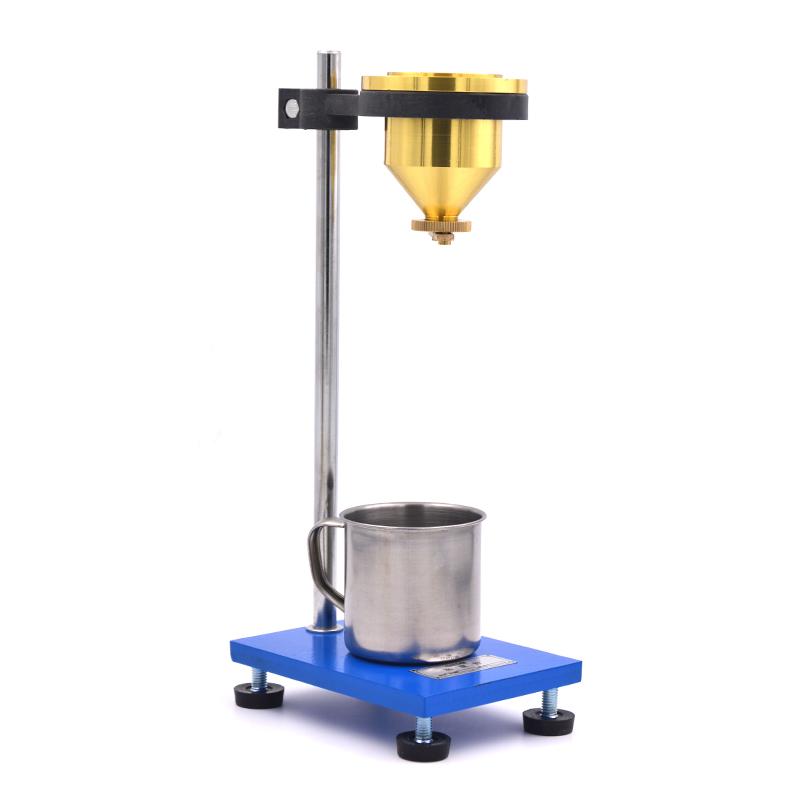
1. kinematic viscosity method
Kinematic viscosity method is one of the traditional methods for calibrating the -4 Viscosity Cup. This method calibrates the -4 Viscosity Cup by measuring the kinematic viscosity of the standard oil.
Principle: Use a capillary tubing Viscometer to determine the kinematic viscosity of a series of standard oils, and then use these standard oils of known kinematic viscosity to calibrate the 4 Viscosity Cup at a specific temperature.
Steps:
Select the appropriate standard oil and determine its kinematic viscosity using a capillary tubing Viscometer.
At standard temperature, the standard oil was poured into a 4 Viscosity Cup and the outflow time t was recorded.
The standard outflow time T and the correction factor K are calculated according to the above formula.
The above steps of repeability, calculate multiple sets of data, and obtain the average value of the correction coefficient.
Advantages: The kinematic viscosity method is easy to operate, low cost, and suitable for most laboratory and production line environments.
2. Standard Viscometer Method
The standard Viscometer method is another method of calibrating the 4-Viscosity Cup by comparing the measurement results of the standard Viscometer and 4-Viscosity Cup.
Principle: Under the same conditions, compare the measurement results of standard Viscometer and Tu-4 Viscosity Cup for the same standard oil, so as to determine the Precision of Tu-4 Viscosity Cup.
Steps:
Select the appropriate standard oil.
Use standard Viscometer and Tu -4 Viscosity Cup to measure the viscosity of the same standard oil.
Record the measurement results and calculate the error between the two.
Adjust the reading or correction factor of the 4 Viscosity Cup according to the error.
Advantages: The Standard Viscometer Method has High Precision and is suitable for applications requiring high Measurement accuracy.
3. Engra conditional degree method
The Engra conditional degree method is a calibration method based on the principle of fluid rheology, which is suitable for non-newtonian fluids.
Principle:By measuring the apparent viscosity of the fluid at a specific shear rate, the calibrating coefficient of the 4 Viscosity Cup is determined.
Steps:
Select the appropriate standard oil and use the Engra Viscometer to measure its apparent viscosity at different shear rates.
According to the measurement results, calculate the coating -4 Viscosity Cup calibrating coefficient.
The correction coefficient is determined by comparing the measurement results of the Engra Viscometer with the measurement results of the 4 Viscosity Cup.
Advantages:The Engra conditional degree method is suitable for different types of fluids and has strong adaptability.
In summary, there are many calibration methods for coating -4 Viscosity Cups, each method has its own unique advantages and applicable occasions. In practice, the appropriate calibration method should be selected according to the type of Coating, Measurement requirements and laboratory conditions to ensure the accuracy and Reliability of measurement results. By calibrating regularly, the Coating industry can better control the product mass and improve production efficiency.


- 1Tu-4 cup viscosity test steps, instruments and usage
- 2Viscosity cup introduction and selection guide
- 3Determination Method of Viscometer and Its Application in Coating
- 4How to use the Coat-4 cup Viscometer for Coating viscosity measurement
- 5What are the differences between the four domestic desktop copper-coated -4 viscosity cups?
- 6Coated 4 viscosity cup - this one is really affordable!
- 7Test Printing ink Viscosity with 4 cups
郭丹 - 《青岛科技大学》
- 8Viscosity cup selection hot problem set
- 9Flow cup Viscometer Reference material selection Reference range