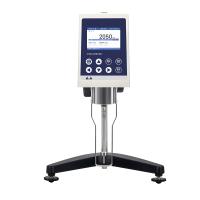
Principle, application and selection of coaxial cylinder Rotational Viscometer
Accurate measurement of fluid viscosity is crucial in various industrial production and scientific research. The coaxial cylinder Rotational Viscometer is an instrument commonly used to measure the viscosity of fluids. It has the advantages of easy operation, accurate measurement, and wide range. It has been widely used in laboratories and industrial sites. This article will introduce the principle, application and selection of coaxial cylinder Rotational Viscometer, aiming to help readers better understand and choose a suitable viscometer.
principle
The principle of the coaxial cylinder Rotational Viscometer is based on Newton's law of viscosity, that is, in the steady state, the viscosity is proportional to the shear rate. The viscometer consists of two concentric cylinders: the outer cylinder is stationary and the inner cylinder is rotated by an external drive. Place the fluid to be measured between the two cylinders, apply shear force to the inner cylinder, and measure the required viscosity.
application
Coaxial cylinder Rotational Viscometer is widely used in the quality control and R&D process of industrial products such as lubricants, polymers, coatings, cosmetics, etc. to ensure that the products meet the required viscosity standards. In drug research and development, coaxial cylinder Rotational Viscometer can be used to measure the rheological properties of pharmaceutical liquids and help evaluate the stability and efficacy of drugs. In scientific laboratories, coaxial cylinder Rotational Viscometers are widely used to study the rheological properties of various fluids, providing important data support for scientific research.

Selection
When selecting a coaxial cylinder Rotational Viscometer, it is necessary to consider that different viscometers have different measurement ranges, and the appropriate instrument needs to be selected according to the viscosity of the fluid to be measured. Where high accuracy is required for viscosity measurement, a viscometer with higher accuracy needs to be selected. Select the appropriate sample chamber volume according to the amount of sample to be tested. Some viscometers have additional functions such as temperature control and automated operation. Select the corresponding functions according to your needs.
Conclusion
As an important viscosity measuring instrument, the coaxial cylinder Rotational Viscometer plays an important role in industrial production and scientific research. Understanding its principles, applications and selection will help you better choose a suitable viscometer and ensure the accuracy and reliability of viscosity measurement. Through a systematic analysis of the principles, applications and selection of coaxial cylinder Rotational Viscometers, this article aims to provide readers with a comprehensive understanding and guidance so that they can fully utilize the role of viscometers in practical applications and promote the development of related fields. development and progress.




- 1Rotational viscometer - principle, classification, application and calibrating
- 2Application of NDJ-8S digital Rotational Viscometer in viscosity measurement of cosmetic raw materials
- 3NDJ-5S digital Rotational Viscometer accurate measurement of natural oil viscosity
- 4Application of HBDV-1H swirl/spin High Temperature Viscometer in Viscosity Determination of Plastic Particles
- 5Rotational viscometer selection guide: How to choose the right viscosity equipment for you?
- 6Principle, type and accuracy control of Rotational Viscometer
- 7Which Viscometer to Choose for Licorice Extract Viscosity Testing? How to Test?
- 8Application of Rotational viscometer in Waterborne Polyurethane Adhesive
- 9Application of Rotational Viscometer in cellulose material