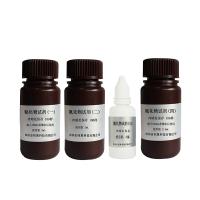
Simple operation process of cyanide reagent
Concentration prediction:Before testing the water sample, the cyanide value of the water sample is predicted, and the operation steps corresponding to the range are selected, for example, the cyanide concentration value is predicted0-0.5mg/L, you need to select the operation step of 0-0.5mg/L range; If the cyanide concentration is predicted to be 0.5-1mg/L, the 0.5-1mg/L range is chosensteps.
Notes:The water sample must be pre-distilled before the cyanide measurement! Depending on the pre-distillation method, total cyanide and easy-release cyanide can be measured. Pre-sample of the sampleHandling (refer to HJ484-2009)
Total Cyanide:In a pH<2 medium, in the presence of phosphoric acid and EDTA, it is heated and distilled to form cyanide of hydrogen cyanide, including all simple cyanides (mostlycyanide of alkali and alkaline earth metals, cyanide of ammonium) and most complex cyanides (zinc cyanide complex, iron cyanide complex, nickel cyanidecomplexes, copper cyanide complexes, etc.), excluding cobalt cyanide complexes.
Easy-to-release cyanide:In a pH=4 medium, in the presence of zinc nitrate, it is heated and distilled to form cyanide of hydrogen cyanide, including all simple cyanides (mostly basescyanide of metals and alkaline earth metals) and zinc cyanide complexes, excluding ferrocyanide, ferrocyanide, nickel cyanide complexes, copper cyanide complexes,Cobalt cyanide complex.
Hydrogen cyanide release and absorption device
1. Connect the distillation device as shown in the diagram, measure 200ml of sample with a graduated cylinder, and transfer it into a distillation flask (ifIf the cyanide concentration is high, less samples can be taken, diluted to 200ml with distilled water), and a few glass beads can be addedPut it to a boil.
2. Add 10ml of sodium hydroxide solution (10g/L) to the receiving bottle as an absorbent solution. When in the sampleIn the presence of sodium sulfite and sodium carbonate, a 40g/L sodium hydroxide solution can be used as an absorbent solution.
3. The upper end of the distillate catheter is connected to the outlet of the condenser tube, and the lower end is inserted into the absorbent solution, and the connection part is checked.Make it tight. During distillation, the distillate catheter is inserted below the liquid level of the absorbent solution so that it is completely absorbed.
(Note: Hydrogen cyanide gas is harmful to the human body, and the distillation process must always pay attention to whether there is a connection.)air leakage and the distillate catheter must be below the absorbent liquid level).

Preparation of samples to be tested for different targets:
a. Preparation of total cyanide samples
Add 10ml of EDTA-2Na solution (100g/L: weigh 10g in 100ml of distilled water) into the distillation flask, and quickly add 10ml of concentrated phosphoric acid to the sampleWhen the alkalinity is large, you can add an appropriate amount of phosphoric acid to make its pH <2, immediately cover the cork, open the condensate and open the adjustable electric furnace, and gradually increase the distillate from resistance
Heat distillation is carried out at a rate of 2~4ml/min.
b. Preparation of easy-release cyanide samples
Add 10ml of zinc nitrate solution (100g/L: weigh 10g to dissolve in 100ml of distilled water) into the distillation flask, and add 7~8 drops of methyl orange indicator (0.5g/L:Weigh 0.05g to dissolve in 100ml, the discoloration range is 3.2~4.4), and then quickly add tartaric acid (150g/L: weigh 15g to dissolve in water and dilute to 100ml) to dissolveliquid, immediately close the cork so that the solution inside the bottle remains red. Turn on the condensate, turn on the adjustable electric furnace, gradually increase from low, and the distillate is fed at a speed of 2~4ml/minHeat distillation. Note: A 600-800W adjustable electric furnace should be used for distillation, and an electric heating jacket should not be used.
c. Collection of samples
When the volume in the receiving bottle is within 70-100ml, the distillation can be stopped, the distillate catheter is rinsed with a small amount of distilled water, the receiving bottle is removed, and diluted to 200ml with distilled waterReticle, to be measured.
1. When the predicted value is in the range of 0 - 0.5mg/L
In the presence of cyanide, the water sample appears violet-blue, and the darker the color, the higher the concentration value. Analytical Procedure: Cyanide L; Watch out for overrange tips!

2, when the predicted value is in the range of 0.5-1mg/L
In the presence of cyanide, the water sample appears violet-blue, and the darker the color, the higher the concentration value. Analytical procedure: cyanide H; Watch out for overrange tips!

3. When the predicted value exceeds 1mgL /L
The water sample needs to be diluted to the corresponding concentration value in sections 1-2 above, and then operated according to the corresponding range, and the determination result is multiplied by the dilution factor.
4. Test steps on the computer