Understand the types, application principles and selection elements of radiant luminometers
Radiometers are used to measure the radiant energy emitted by light sources, ensuring that accurate light intensity measurements such as UV-curable inks, environmental monitoring, and solar applications are relied upon.In scientific research and industrial applications, irradiance meters play a key role in measuring and evaluating the intensity and distribution of optical radiation. From the optimization of solar energy systems to the quality control of UV curing processes, the choice of radiometer is crucial.This article will provide an overview of a radiometer including its types, applications, and rationale.
Type of Radiometer
Radiometers are divided into different types according to specific measurement needs:
Omnidirectional Radiometer (Pyranometer)
It is used to measure the total solar radiation received in the horizontal plane (Global Horizontal Radiation, GHI), including direct and diffuse components. Critical in solar energy applications and meteorological monitoring.
Direct Method Radiometer (Pyrheliometer)
Designed to measure direct radiation, it is mounted on a solar tracker and remains perpendicular to the sun's rays at all times. Critical in centralized solar power systems and solar tracking applications.
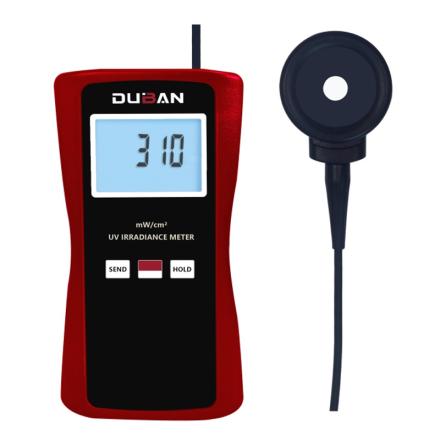
Ultraviolet Radiometer
Designed to measure ultraviolet (UV) radiation, it is essential for industries that use UV curing processes to ensure effective curing of coatings and inks.
Rotating Shadowband Radiometer
Periodic occlusion sensors by rotating shadow strips for measuring GHI and DNI. This type is suitable for long-term solar radiation studies and climate studies.
Applications of Radiometers
In solar energy systems, omnitropic radiometers and direct radiometers are key tools. Isotropic radiometers are used to measure the total solar radiation received in the horizontal plane, including radiation scattered directly from the sun and through the atmosphere. This data is essential for evaluating the performance of solar panels and forecasting energy production.In a solar farm, isotropic radiometers are installed in multiple locations to measure solar radiation levels at different locations. This data helps engineers optimize the layout and inclination of the board to maximize energy capture efficiency.
The use of radiometers in environments such as offices, factories, and museums can help assess light levels, ensure compliance with lighting standards, and promote energy-efficient building design.Radiometers were installed in the office building to monitor the entry of natural light and the distribution of indoor lighting. This data helps architects and designers optimize the building's window and lighting design to minimize the use of artificial lighting and improve employee comfort and productivity.
UV radiometers are essential in industrial processes that use UV curing technology. They are used to monitor the output of the UV lamp and verify the effectiveness of the curing process, ensuring consistent product quality. Like whatUV radiometers are installed in factories that use UV-curable inks in the printing industry. Workers use these instruments to regularly check that the output of the UV lamp meets the standards to ensure that the product achieves consistent quality and hardening results in every production cycle.
How it works
Irradiance meters have different working principles depending on the type.Thermal Detector-class radiometers, such as thermocouples and Bohr heat meters, operate by measuring temperature changes caused by radiant energy. These devices are suitable for a wide range of applications, including solar energy research and control of industrial heating processes.Quantum Detectors, such as photodiodes, are capable of detecting individual radiant energy molecules, which are essential for quantum physics research and UV applications that require high-precision measurements.Although historically long and no longer widely used, the Crookes radiometer works by measuring the difference in thermal expansion caused by different reflections and absorptions of light on its rotating blades.
Choose the right radiometer for you
Choosing the right radiometer depends on a variety of factors, such as the wavelength range of interest, measurement accuracy requirements, environmental conditions, and specific application needs. For example, a UV radiometer must match the spectral sensitivity of the UV lamp used in the curing process to ensure effective and consistent results.
Wavelength range and spectral sensitivity are the first things to consider. Different types of irradiance meters have different responses to the wavelength of light. For example, a UV radiometer is required during the UV curing process, and its spectral sensitivity must match the emission spectrum of the UV lamp to ensure accurate and reliable measurements. Other than thatMeasurement accuracy is also important! Determining the accuracy requirements of the measurement is an important consideration when choosing a radiometer for radiometers. Some applications require high-precision measurements, such as solar energy research and photobiology experiments, while others can accept lower accuracy.
Radiometers can be used in a variety of environmental conditions, including indoor laboratories, outdoor venues, or special industrial environments. Ensure that the selected radiometer is able to operate stably under the temperature, humidity, and other conditions of the target environment.Some applications may require specific radiometer characteristics, such as fast response time, consistent performance, or suitability for a specific installation style (e.g., handheld, benchtop, or fixed installation). Choose the right device according to the specific application scenario.
Whether it's monitoring solar radiation to optimize energy utilization, ensuring the effectiveness of the UV curing process, or maintaining better lighting conditions in a controlled environment, radiometers are improving efficiency and product qualityRadiometers can accurately measure the radiant energy of different wavelengths.With a deep understanding of the principles and applications of radiometers, a wide range of industries can use these instruments to optimize processes and improve product quality.
