Classification of toxic and harmful Gas Detectors
In modern industrial and environmental monitoring, the presence of toxic and harmful gases poses a serious challenge to human health and safety. In order to effectively deal with these potential hazards, various types of gas detection instruments have been developed. These instruments play a key role in industrial production, public safety, and environmental protection by accurately monitoring and measuring combustible gases, toxic gases, and oxygen concentrations in the environment using advanced sensing technology and a variety of detection methods. In order to effectively monitor and manage toxic and harmful gases in different environments, several types of gas detection instruments are used, and they employ a variety of technologies and methods to meet specific detection needs.
1. Classification of detection types
1.1 Combustible Gas Detector
Combustible Gas Detectors are widely used in potentially explosive environments, and common technologies include:
(1) Catalytic combustion sensor- Use catalytic oxidation to detect combustible gases such as methane.
How it works
Catalytic combustion sensors use chemical reactions on the surface of the catalyst to detect combustible gases. Typically, the inside of the sensor is coated with a layer of catalyst, such as platinum or palladium. When a flammable gas, such as methane, mixes with air and comes into contact with the sensor surface, oxidation on the catalyst initiates an exothermic reaction that produces a small amount of heat. This exothermic reaction causes a change in the sensor's resistance, resulting in an electrical signal.
Application scenarios
Catalytic combustion sensors are suitable for applications that require fast response and high sensitivity, such as pipeline and tank monitoring in the oil and gas industry, as well as combustible gas detection in industrial production.
(2) Infrared sensor——Detection of infrared light absorption based on combustible gas.
How it works
Infrared sensors use the absorption of a specific wavelength of infrared light by a flammable gas to detect the presence of gases. These sensors emit a specific wavelength of infrared light through the gas, and the detection receiver measures the amount of infrared light passing through the gas. Combustible gases absorb infrared light of a specific wavelength, causing the receiver to receive less light and thus detect the presence and concentration of the gas.
Application scenarios
Infrared sensors are widely used in environmental monitoring that requires high accuracy and long-term stability, such as in industries such as petrochemical, pharmaceutical manufacturing, and food processing, as well as in fire warning systems inside buildings and on industrial workshops.
(3) Thermal conductivity sensor- Measure the change in thermal conductivity in the presence of combustible gases.
How it works
Thermal conductivity sensors are based on the principle that combustible gas changes the thermal conductivity of air. The sensor contains a hot wire or thermocouple, and when a combustible gas comes into contact with the sensor, the thermal conductivity of the gas changes the temperature of the sensor hot wire. By measuring the change in the temperature of the hot wire, the presence and concentration of the gas can be determined.
Application scenarios
Thermal conductivity sensors are ideal for environments that require quick response and simple maintenance, such as combustible gas detection in ships, underground mines, and aircraft engine compartments.
(4) Semiconductor sensors- When a semiconductor material is exposed to a flammable gas, its conductivity changes.
How it works
Semiconductor sensors detect gases using changes in the conductivity of semiconductor materials in the presence of combustible gases. When the sensor is exposed to a flammable gas, the gas molecules adsorb on the surface of the semiconductor, changing its conductive properties. This change causes a change in resistance or current in the sensor's internal circuitry, resulting in a sense signal.
Application scenarios
Semiconductor sensors are widely used in portable and low-cost gas detection instruments such as household gas leak Detectors, industrial safety detection, and ambient air quality monitoring.

1.2 Toxic Gas Detectors
Primarily used to detect toxic gases that may pose a direct health hazard, common techniques include:Electrochemical Sensors,Metal oxide semiconductor sensors,Photoionization sensors andFlame ionization sensor.
Electrochemical sensors- Chemical reactions are used to generate electrical signals to detect toxic gases.
Electrochemical sensors use electrical signals generated by chemical reactions to detect toxic gases. Sensors typically contain an electrode system that includes at least one working electrode and one contrast electrode, which are immersed in an electrolyte solution. When a toxic gas passes through a sensor, it chemically reacts with a catalyst on the working electrode, producing electrons or ion transfers, resulting in a change in current or a change in voltage. These changes are captured by the sensor and converted into an electrical signal that is used to measure the concentration of the gas.
Metal-oxide-semiconductor sensors- Detect changes in the conductivity of a particular gas when exposed to it.
Metal-oxide-semiconductor sensors detect specific gases by causing a change in conductivity by exposure to the gas. The sensor is made of a thin film of metal oxide, and when the surface of the film is exposed to a target gas, gas molecules adsorb on the surface of the film, changing its conductive properties. This adsorption results in changes in resistance or conductivity, which are measured by sensors to determine the concentration of the gas.
Optoionization sensors- Ultraviolet photoionization of gas molecules and detection of their concentration.
Photoionization sensors use the principle of ultraviolet photoionization of gas molecules to detect gas concentrations. The sensor contains an ultraviolet light source that emits a UV beam into the detection area, which interacts with molecules in the gas. When the ultraviolet beam energy is large enough, it ionizes the gas molecules, producing ionized ion pairs. The sensor determines the concentration of the gas by measuring the number of these ionization pairs.
Flame ionization sensor- Detection by burning organic compounds in a hydrogen flare.
Flame ionization sensors detect target gases by burning organic compounds in a hydrogen gas flame. The sensor typically consists of a combustion chamber that introduces the gas to be detected into the flame for combustion. When an organic compound is present, the ions produced by its combustion in the flame are detected by the sensor and converted into an electrical signal. This variation in the electrical signal is used to measure the concentration of the target gas.
1.3 Oxygen Detector
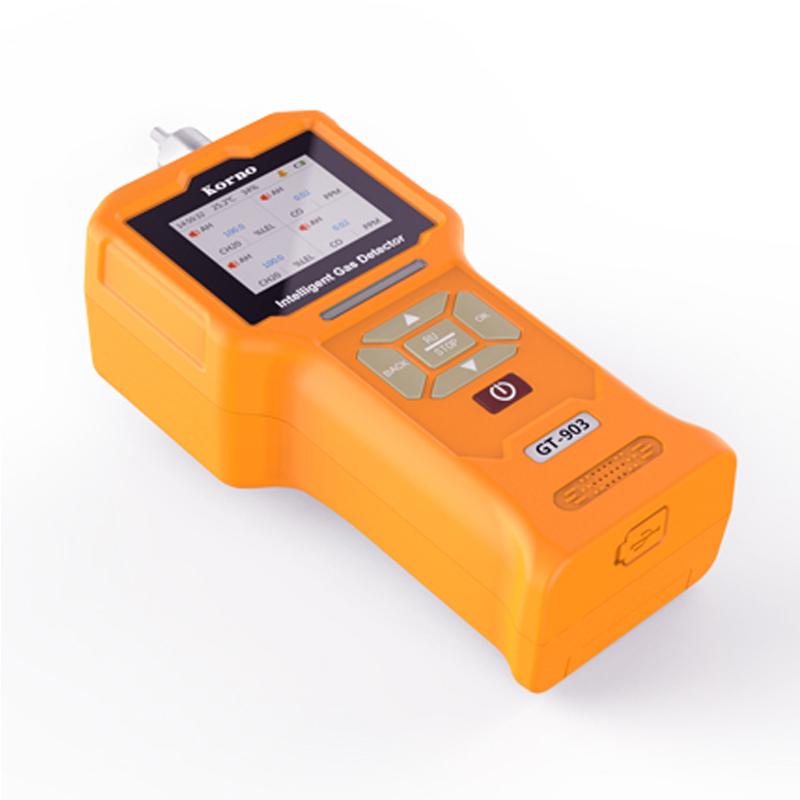
Oxygen Detectors use electrochemical sensors to accurately measure the oxygen concentration in the environment to ensure safety in industrial processes and avoid the risk of suffocation, explosion or fire caused by abnormal oxygen concentrations. It is also widely used in laboratories and medical facilities to monitor the stability of oxygen supply systems, ensure the safety of operators and patients, and play a key role in environmental monitoring and air quality control to ensure public health and ecological balance.
2. Classification of instrument use methods
(1) Portable Gas Detector
Suitable for personal security and on-site mobile monitoring, portable instruments are available in two types:Single Gas DetectorandComposite Gas Detector
Single Gas Detector- Equipped with a single sensor for the detection of specific gases, such as methane Detectors for miners.
Composite Gas Detector-Integrate a variety of sensors to monitor a variety of toxic and harmful gases at the same time, which is suitable for the coexistence of multiple gases in complex environments.
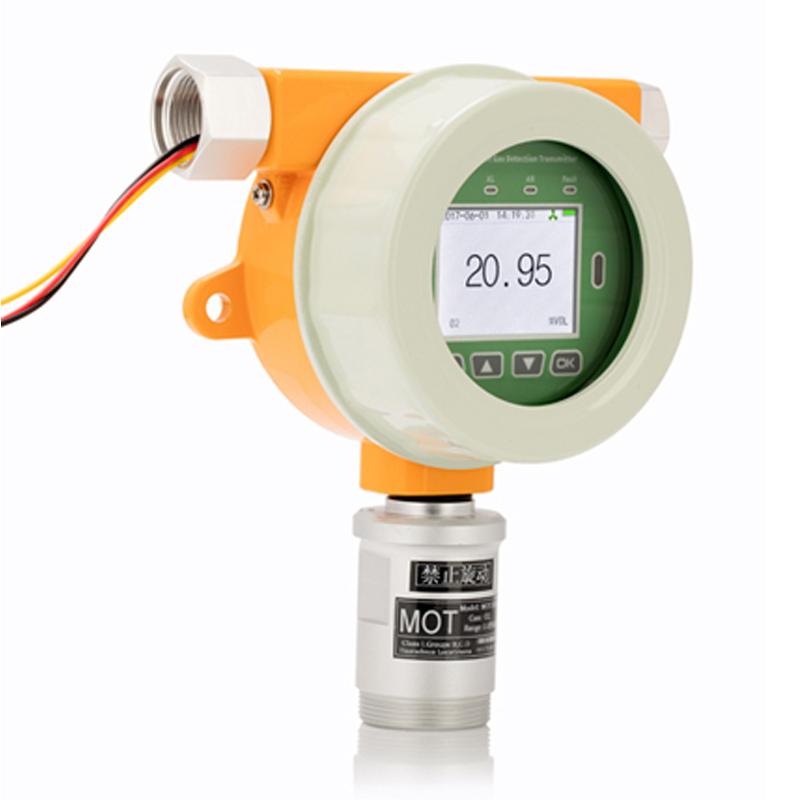
(2) Fixed Gas Detector
It is installed in a fixed position to monitor areas where gas leakage or concentration changes may occur, and transmits concentration data to a central control system through communication signals to achieve real-time monitoring and alarm functions.
3. Classification of gas sampling methods
(1) Diffusion Detects Gas Detectors that rely on the natural diffusion of gases into the sensor and are suitable for personal protection and fixed installations.
(2) Pumping type The concentration of toxic and harmful gases that cannot be directly accessed or in hazardous areas can be detected by introducing the gas into the detection instrument for analysis by means of a built-in or external pump.
There are significant differences between diffuse and pumped Gas Detectors in terms of sampling methods. The diffuse Gas Detector relies on the natural diffusion of gas into the sensor for detection, which is easy to operate and suitable for the monitoring needs of personal protection and fixed installation, without the need for external pump bleed air; The pump-type Gas Detector introduces the gas into the detection instrument through a built-in or external pump, which can accurately control the sampling process, and is suitable for the monitoring of toxic and harmful gases in non-direct contact or hazardous areas, such as confined spaces and high-concentration environments.
-
![SMART SENSOR smart sensor AS8800L Combustible Gas Detector reaction time ≤ 1 second]()
-
![SMART SENSOR ST8306 environment Air Quality Detector]()
-
![HUIRUIPU HRP-1000 Gas Detector EX/O2/CO/H2S]()
-
![KORNO GT903-Y4 Portable 4-in-1 Detector for hydrogen sulfide, carbon monoxide, oxygen, nitrogen dioxide]()
-
![KORNO GT903-Y4 Portable 4-in-1 Detector for hydrogen sulfide, ozone, ammonia, nitrogen dioxide]()
-
![HUIRUIPU HRP-K6000-4 four-way controller, LCD/three-wire system]()
-
![HUIRUIPU HRP-B1000-4 Standard 4 in 1 Gas Detector EX/O2/C0/H2S]()
-
![SMART SENSOR ST8900 Gas Detector]() SMART SENSOR ST8900 Gas Detector$ 234.00
SMART SENSOR ST8900 Gas Detector$ 234.00 -
![KORNO GT-903-Y2 (O2, EX) Standard 2-in-1 Gas Detector]()