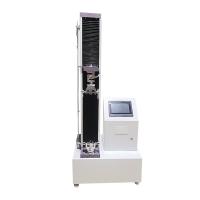
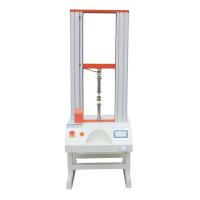
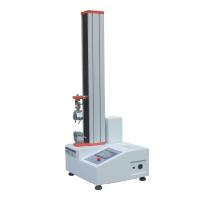
How to choose a suitable electronic Tensile machine?
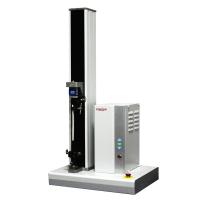
What is an electronic Tensile Testing Machine? Electronic Tensile Testing Machine can also be called electronic tensile machine. It is widely used in composite materials, self-adhesive, protective film, rubber and other industries. It is mainly used to detect quality problems such as peeling, stretching, deformation, and tearing of products. However, there are various types and brands of electronic Tensile Testing Machines in the market, and the prices are both high-low. How to purchase a suitable electronic Tensile Testing Machine is a very necessary topic to understand. The following article introduces the purchase of electronic Tensile Testing Machines.
1. Tensile force range, test stroke, basic configuration
Different force sensors are configured for different tension ranges, which will directly affect the cost of the instrument. For flexible packaging manufacturers, a tension range of 300kN is sufficient. According to the performance and requirements of the flexible packaging film to be tested, a stroke of (600-800) mm is sufficient.
Three basic configurations of intelligence: testing machine, computer and printer, if the microcomputer is powerful, it can print directly. In addition, ordinary computers can also be configured. If a computer is used, the manufacturer should provide a corresponding control system. With a computer, complex data analysis can be carried out, such as data editing, local amplification, and the report form can be adjusted, and statistical analysis of group samples can be carried out.
2. Test items
The flexible packaging industry requires that the tensile machine should be multi-purpose, that is, it can be used for tensile, compression, bending, tearing, shearing, 180-degree peeling, 90-degree peeling and other tests on the basis of different fixtures.
3. Test speed
Some of the speeds of commercially available electronic tension machines are (10-500) mm/min, and some are (0.01-500) mm/min. The former generally uses an ordinary speed control system, which is low in cost and rough in production, which affects accuracy; the latter uses a servo system, which is expensive and high in accuracy. For flexible packaging enterprises, it is enough to choose a servo system with a speed adjustment of (1-500)mm/min, which will not affect the accuracy and the price is within a reasonable range.
4. The main configuration of product machinery and machining accuracy
The transmission is divided into screw drive and rack drive. The former is used for high-accuracy tests, with high test repeatability and slightly higher price; the latter is cheaper, but with low accuracy and low test repeatability. Tensile Testers in the flexible packaging industry are frequently used and require high accuracy. It is recommended to use screw drive. The screw has a decisive effect on the measurement of the tension accuracy, generally there are ball screw, trapezoidal screw and general screw. Among them, the accuracy of the ball screw is the highest, but its performance depends on the operation of the computer servo system.
The main consideration of the sensor is its lifespan. If the photoelectric sensing technology is used, it can generally be used for more than 100,000 times.
Machining accuracy: As far as the machining process of the tension machine is concerned, there are turning, grinding, planing, washing processes, numerical control process, and wire cutting process. The choice of processing technology will directly affect its performance and service life.
5. Measurement accuracy
Accuracy is the same question, including force measurement accuracy, velocity accuracy, deformation accuracy, and displacement accuracy. These accuracy values can reach up to ±0.5. But for general manufacturers, an accuracy of ±1% is enough. In addition, the force value resolution is also one of the primary considerations when purchasing.
The above are some references for the author’s summary of the purchase and purchase of electronic Tensile Testing Machines, hoping to provide references for relevant personnel in the industry.



- 1Tensile machine application in various industries
- 2Technical analysis of key parameters of Tensile machine: Scientific selection from force measurement accuracy to Power system
- 3Tensile machine purchasing guide [dry version]
- 4Talking about the performance test of epoxy resin film coated on PET
- 5ASTM D5019 Single-layer roofing film reinforced CSM board (chlorosulfonated polyethylene (PE)) standard interpretation
- 6The purpose of tensile testing and its application in the plastics industry
- 7Common problems and solutions in tensile testing
- 8What problems can be caused during tensile testing?
- 9What is tensile strength testing and which products can be tested?
-
![Patek Jushi LY-7012C Tensile Tester 1000KG]()
-
![BaidaJUSHI LY-7012A Small Tensile Testing Machine 200KG]()
-
![CHINA NBC-1024-2 Tensile Tester 5T]() CHINA NBC-1024-2 Tensile Tester 5T$ 6635.00
CHINA NBC-1024-2 Tensile Tester 5T$ 6635.00 -
![CHINA NBC-6820 Ring type initial tacking machine Tensile Tester]()
-
![CHINA NBC-1023-1 Computerized Double Column Tensile Testing Machine]()
-
![CHINA NBC-1021 Touch screen single column Tensile Strength Tester 10KG]()