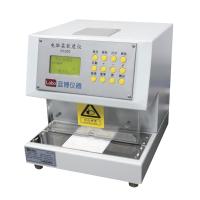
Paper softness test standards and instruments
Paper softness is an important measure of the paper's ability to bend and adapt when subjected to stress. It is often used to describe the flexibility and comfort of paper, especially in applications that require high softness, such as toilet paper, baby diapers, etc. This performance is critical to the consumer experience, as it directly affects the feel and comfort of the paper.
The softness determination method is suitable for a variety of paper products that require certain soft properties, especially wrinkled toilet paper and its derivatives, which need to have good bending and adaptability in practical use. However, some papers, such as napkins, facial tissues or high-stiffness papers, are not suitable for this assay because they have been folded or embossed to change their softness. This measurement method ensures the consistency and quality control of the paper during the design and production process, and provides a scientific basis for meeting the needs of different products.
Definition of softness
Assay conditions
The softness of the paper is determined under specific test conditions. These conditions include the use of standard test instruments and pre-set operating environments to ensure the accuracy and consistency of test results. Specific conditions include using a pattern of a certain width and length, placing it in a precisely controlled slit, and using a plate probe to press the pattern into the slit to a specified depth. During the test, the total amount of bending resistance and friction of the paper sample is measured to reflect its softness.
The formula for calculating softness
Softness = bending resistance of the paper pattern + friction
The sum of the bending resistance and friction of the paper pattern (in Newtons (N)) is used to indicate the softness of the paper. The lower the softness value, the softer the paper. Specific calculations involve actual measured values and may require calibration and standardization to ensure the accuracy of the results.
Description: The relationship between the softness value and the softness of the paper
The softness value is a direct reflection of how soft the paper is. The lower the number, the easier it is to bend when subjected to pressure, and the friction is less, resulting in a higher softness. This means that the paper will be more flexible and comfortable in use. Conversely, if the softness value is larger, it means that the paper is harder, has strong bending resistance, and has high friction, showing lower softness. This indicator is of great significance for the design and quality control of paper, and can help producers and consumers understand the actual performance of paper.
instrument
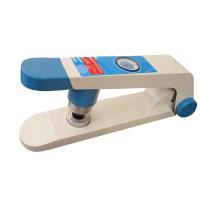
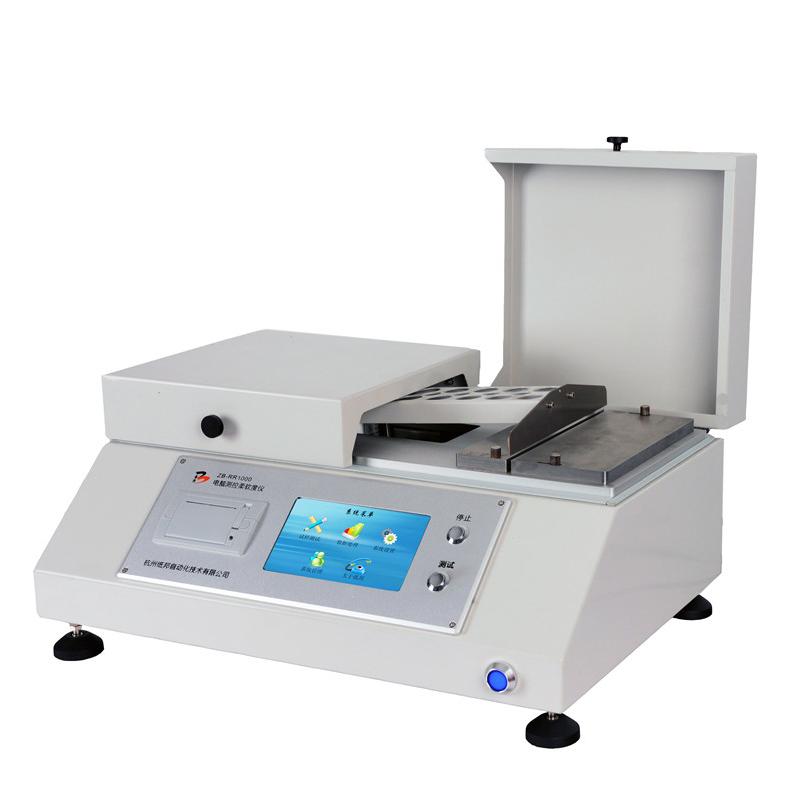
Hand softness meter
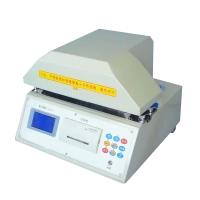
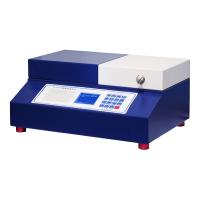
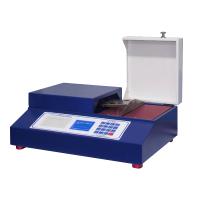
A hand-based softness meter is a special device used to measure the softness of paper, which is designed to measure the softness of paper by simulating its bending and pressure in actual use. The instrument consists of a slit and a plate-shaped probe. The probe is pressed into the paper sample during the test and the softness of the paper is calculated by measuring the force of the paper against bending and friction. The instrument is precisely designed to provide stable and reliable measurement data for paper quality control and product development.
Installation requirements
Horizontal, stable table – The instrument must be mounted on a level and stable table to prevent measurement errors due to tilted or unstable tables. The table should be sturdy enough to support the weight of the instrument and avoid movement during operation.
Avoid external vibration - the installation position should be selected away from the vibration source to avoid the influence of external vibration on the measurement results. External vibrations may interfere with the testing process and result in inaccurate measurement data.
Basic parameter requirements
The slit width should be set at 5.0mm, 6.35mm, 10.0mm, and 20.0mm, and the width error should not exceed ±0.05mm.
The length of the probe is 225mm, the thickness is 2mm, and the radius of the knife edge is 1mm.
The average travel speed should be in the range of 1.2±0.24 mm/s and the total travel should be 12±0.5 mm.
The press-in depth should be 8±1 mm.
The maximum range of the instrument is 1000mN, the load accuracy is less than ±3%, and the reproducibility is less than ±3%.
Instrument parameters and inspection
Slit widthIt should include four grades: 5.0mm, 6.35mm, 10.0mm, and 20.0mm.
The error shall not exceed ±0.05mm.
Measure the slit width using a vernier caliper, and confirm the width error and slit parallelism by measuring the width at both ends and in the middle of the slit. The parallelism error should be less than ±0.05mm.
Plate probe
The length of the probe is 225mm, the thickness is 2mm, and the radius of the arc of the knife edge is 1mm.
Check the size of the probe with a precision measuring tool to ensure it meets the requirements of the standard.
Probe travel speed and total travel
The speed range should be in the range of 1.2±0.24 mm/s.
The stroke range should be 12±0.5 mm.
Inspection method: Use a height gauge to measure the total travel of the probe from the highest point to the lowest point, and measure the travel time of the probe with a stopwatch to calculate the average travel speed.
Press-into the slit depthThe requirement should be 8±1 mm.
Measure the height of the plate probe with vernier calipers to calculate the actual press-in depth.
Instrument accuracy
The maximum capacity is 1000mN.
The load accuracy is less than ±3%.
Reproducibility is less than ±3%.
Accuracy check method: Load test using silicon code and brick code to compare the consistency of the actual measured value with the standard value.
Probe alignment check
The probe should be able to fall symmetrically into the gauge groove in the slit, and the neutralization error should be less than 0.05mm.
Slit parallelism
The parallelism of the slit should be less than or equal to 0.05mm to ensure the consistency and accuracy of the test.
Collection, preparation, and handling of specimens
Specimen collection and handling standards
Specimen collection should follow the prescribed standard procedures to ensure the representativeness and consistency of the sample. Samples should be randomly selected from the production batch and treated according to standard treatment methods to ensure that the samples are stable under the specified environmental conditions.
Specimen size and marking
The specimen should be cut into standard size 100mm x 100mm square pieces and marked in their longitudinal and transverse orientations. The markings should be clear and do not affect the test results, usually using labels or marking methods that do not interfere with the measurement. The dimensional deviation should be controlled within ±0.5mm.
Instrument preheating and set-up
Before the test, it should be warmed up according to the instrument manual, and the warm-up time should meet the manufacturer's requirements to ensure the stability of the instrument. After the preheating is completed, a zero calibration is required and the slit width is adjusted according to the specimen requirements to ensure that the instrument is in excellent working condition.
Specimen placement and testing procedures
The specimen is placed accurately on the instrument test bench, ensuring that the specimen is symmetrical to the slit as much as possible. For multi-layer specimens, they are placed in layers to avoid the influence of uneven thickness on the test results.
Adjust the instrument's peak tracking switch to the peak position, press the start button and the probe will automatically press into the specimen. During the test, the instrument should be kept stable to reduce human interference. After the test is completed, the measured values are read from the display.
Data logging and sample assay requirements
At least 10 data points should be measured for each specimen, and the longitudinal and transverse softness data should be recorded separately. Make sure that the samples are not repeated during the test to ensure that the data is representative. The recorded data should be kept to one decimal place and tabulated for analysis to arrive at the final result.
Calculation of test results
Calculation results
The test results should be statistically analyzed based on all measured data to obtain the average softness value of the specimen. Ensure that the results are accurate to one decimal place to ensure the accuracy of the measurement data.
Accuracy requirements
Data processing should follow accuracy requirements and avoid human error. Comparative verification is performed using standard samples to ensure the accuracy of the measurement system. If an out-of-range error occurs, the instrument and test method should be checked and adjusted or retested as necessary.
summary
Paper softness assays provide a systematic and standardized method for assessing the softness of paper. By using specific instruments and standards-compliant test procedures, it is possible to accurately measure the depth at which the paper is pressed into the slit, the travel speed of the plate probe, and other critical parameters. Ensuring the accuracy of the instrument and the standard handling of the specimen is a prerequisite for reliable test results. Understanding the softness of paper is important for product design and production, and helps to meet the different needs of the market for paper softness.
-
![JINGWEN JW117C Tissue Softness Tester, Single Arm 10-5000mN]()
-
![HP-ZRD-1000 paper softness Tester]() HP-ZRD-1000 paper softness Tester$ 2515.00
HP-ZRD-1000 paper softness Tester$ 2515.00 -
![Essence LD-RRD Toilet Paper Softness Tester]()
-
![CHINA NBC-7124 Leather Softness Tester]() CHINA NBC-7124 Leather Softness Tester$ 1069.00
CHINA NBC-7124 Leather Softness Tester$ 1069.00 -
![YINUO YN-RRY1000 Microcomputer softness Tester 1000mN digital display]()
-
![PY-H613 Softness Tester]() PY-H613 Softness Tester$ 2671.00
PY-H613 Softness Tester$ 2671.00 -
![IMT-RRD01 Softness Tester]()
-
![Huida HD-2045 Leather Softness Tester for Soft Hardness Testing of Leather and Animal Skin]()
-
![LABO LB-R1000 Softness Tester 10-1000mN]()