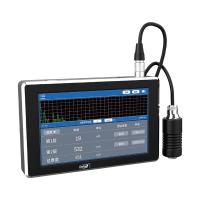
Principle and application of digital non-contact Coating Thickness Gauge
In modern spraying technology, precise control of coating thickness is one of the key factors in ensuring coating quality. In order to improve plasma spray quality, reduce alloy powder consumption, and improve operating conditions, digital non-contact coating Thickness Gauges are widely used as advanced measurement equipment. The instrument has a digital display and, thanks to the non-contact measurement method, the workpiece can be continuously measured during the spraying process. This article will discuss in detail how digital non-contact coating Thickness Gauges work, their measurement circuits, and their application in the spraying process.
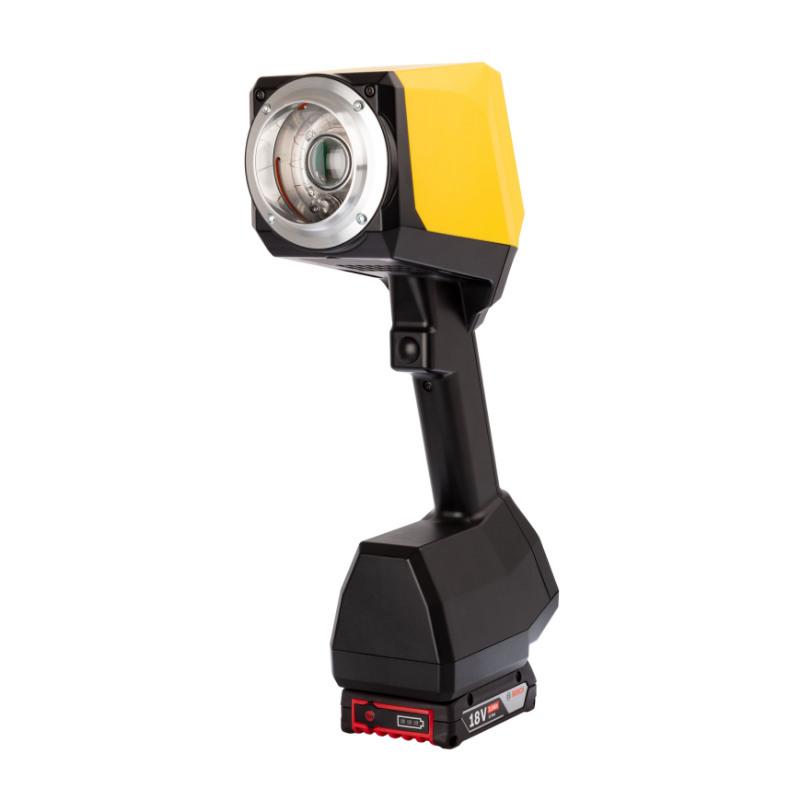
Measuring principle
Digital non-contact coating Thickness Gauges primarily use the eddy current effect for measurements. Eddy currents refer to the induced currents that are generated when a conductive metal is exposed to an alternating magnetic field, and these currents form a closed loop within the conductor. The magnitude of eddy currents is affected by several factors, including the resistivity and permeability of the conductor, the thickness of the coating, and the probe's distance from the conductor surface.
In a digital non-contact coating Thickness Gauge, the frequency of the excitation current of the transducer coil determines the depth of penetration of the eddy current. When a high-frequency electromagnetic field acts on a metal surface, eddy currents are generated inside the coating. The magnetic field of these eddy currents reacts on the probe coil, causing a change in the coil inductance value. By detecting changes in inductance, the instrument can accurately measure the thickness of the coating. The penetration depth of eddy currents is related to the excitation frequency of the probe, and higher frequencies result in shallower penetration, effectively reducing the influence of the metal matrix on the measurement results.
How the measurement circuit works
The measurement circuit of a digital non-contact coating Thickness Gauge consists of three parts: a preamplifier, an offset amplifier, and a digital display.
preamplifier- The preamplifier provides the high-frequency oscillation signal required by the probe coil and amplifies the voltage output from the probe. This segment includes components such as quartz oscillators, AC amplifiers, voltage doubling Detectors, and filters. The quartz oscillator generates a stable frequency signal that excites the probe for measurement. When the coating thickness changes, the inductance value of the probe changes, causing the resonant loop to detune, which causes a change in the output voltage.
Offset amplifier- Offset amplifiers are used to adjust the zero point and further amplify the DC signal. Zero offset adjustment ensures that the output of the preamplifier is zero when the coating thickness is zero. As the coating thickness increases, the DC signal from the offset amplifier is further amplified until the desired multiple is reached.
Digital display- The final measurement results are presented on a digital display panel. The digital display system converts the voltage signal into a readable thickness value using sampling pulses synchronized with the measured value. In order to avoid mechanical errors during the spraying process, the digital display uses a fixed-point measurement method to ensure that each measurement is taken at the same fixed point.
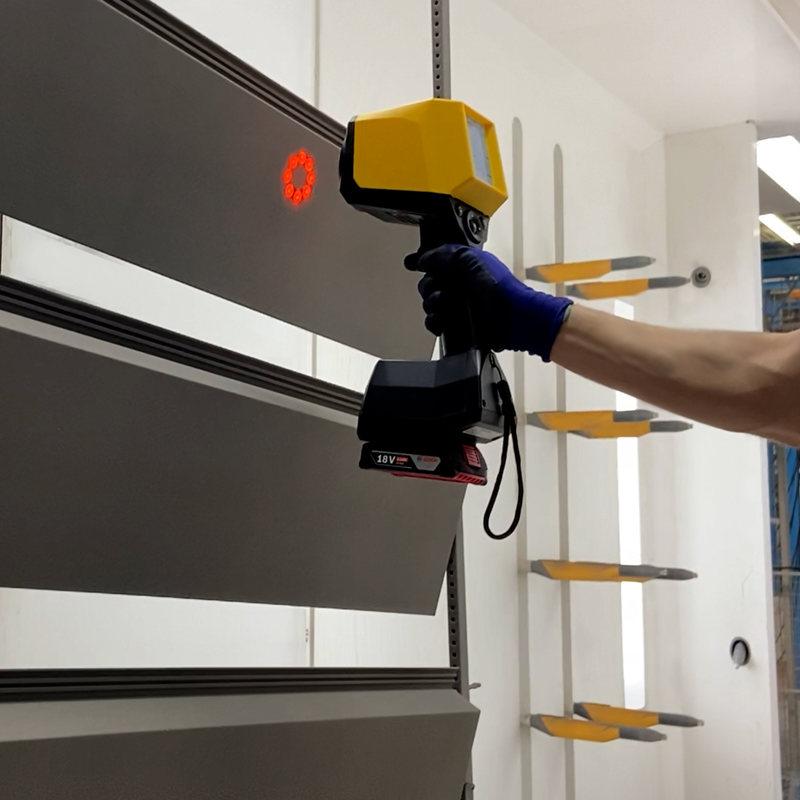
Applications & Benefits
Digital, non-contact coating Thickness Gauges offer significant advantages in the spraying process. First of all, its non-contact measurement method eliminates possible errors in contact measurement and enables real-time monitoring. This is especially important in the plasma spraying process, as it enables adjustments to be made during the coating application process to ensure uniform coating thickness.
peculiarity
Coating Thickness Gauges provide highly sensitive and stable measurement results. As the coating process stabilizes, the measurement error gradually decreases, thus ensuring the quality of the coating.
The digital non-contact coating gauge is able to adapt to a wide range of spray materials and coating types, not only for metals, but also for coatings on other materials.
Continuous measurement and real-time display of coating thickness avoids tedious manual measurement processes and significantly improves productivity.
summary
Digital non-contact coating Thickness Gauge has been widely used in plasma spraying, thermal spraying and other coating processes due to its non-contact, high sensitivity and stability. By accurately measuring the coating thickness, you can effectively improve the coating quality, reduce material waste, and provide reliable data support for the optimization of the coating process. As coating technology continues to evolve, digital non-contact coating Thickness Gauges will play an increasingly important role in the future as an indispensable tool in the coating production process.