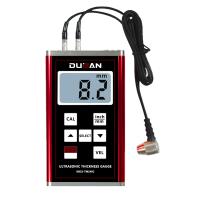
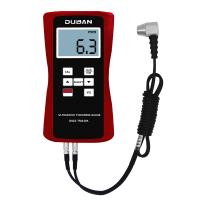
Analysis of Factors Affecting the Accuracy of Ultrasonic Thickness Gauge
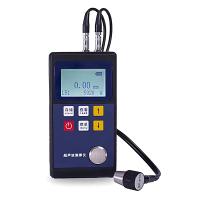
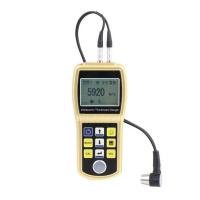
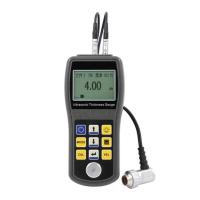
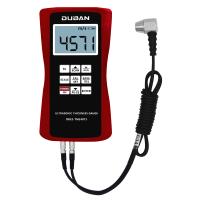
Ultrasonic Thickness Gauge is a kind of non-destructive testing equipment based on the principle of ultrasonic pulse reflection, which is widely used in thickness measurement of metal, plastic, glass and other materials, especially for complex shape parts that are difficult to contact on both sides of the material. However, there are multiple sources of error in the measurement process, which affect the accuracy of the measurement results. In this article, we will analyze these sources of error and introduce methods for measuring measurement uncertainty.
Factors influencing error
Properties of the material to be measured
The physical properties of the material to be measured have a significant impact on the measurement results. The sound velocity, grain structure, surface roughness, internal defects, and temperature of the material can all contribute to measurement errors. For example, castings and austenitic steels can cause severe scattering attenuation as ultrasonic waves propagate through the material due to uneven microstructure or coarse grains, weakening or even disappearing the echo signal. In addition, the rust, oxide scale, coating and other coverings on the surface of the material will reduce the coupling effect and affect the measurement accuracy. Temperature changes can also change the speed of sound, which can affect the measurement results. Therefore, the surface of the material needs to be cleaned before measurement and the sound velocity calibration is adjusted according to the actual temperature.
Device and probe performance
The accuracy of an ultrasonic Thickness Gauge depends on the calibration accuracy of the equipment, the performance of the transducer, and the use of couplant. After the gauge is replaced with the material or transducer being measured, it must be re-calibrated for the velocity and zero calibration to ensure measurement accuracy. Wear and tear of the probe can lead to an increase in surface roughness and a decrease in sensitivity, which can affect the measurement results. The choice and use of the couplant is also important, as improper couplant can lead to measurement errors or flickering coupling marks that make it impossible to measure. Therefore, the appropriate couplant should be selected according to the surface condition of the material to be measured and ensure that it is evenly applied.
Measurement methods and operations
The selection of the measurement method and the details of the operation are critical to the accuracy of the measurement results. Common measurement methods include direct measurement, reflectometry, weld probing, and mode conversion. The direct measurement method is suitable for flat surfaces or objects with regular contours, but requires a high surface quality. The reflection method is suitable for thicker materials, but there are certain requirements for the sound velocity and sound impedance of the material. The weld probe method is suitable for the measurement of weld seams, but requires adjustments to the probe and instrument. The mode conversion method is a relatively new method that calculates the thickness of an object by measuring the mode conversion of a signal. In addition, the coupling technique of the operator, the uniformity of the applied force, and the measurement direction of the probe all influence the measurement results.
Measurement uncertainty assessment
The evaluation of measurement uncertainty is an important part of ensuring the reliability of measurement results. The evaluation process needs to take into account the characteristics of the material to be measured, the performance of the equipment and the probe, the measurement method and operation, and other factors. For example, treating the surface of a material prior to measurement, selecting the right couplant, calibrating the equipment regularly, using the right probe, and mastering the correct operating techniques can reduce measurement errors. By repeating the measurement several times and statistically analyzing the data, the repeatability and stability of the measurement can be evaluated, and thus the measurement uncertainty range can be determined. In addition, calibration and validation of equipment against relevant standards, such as the Calibration Specification for Ultrasonic Thickness Gauges JJF1126-2004), is a critical step in ensuring measurement accuracy.
summary
Ultrasonic Thickness Gauges have important applications in material thickness measurement, but there are multiple sources of error during the measurement process. By gaining a deeper understanding of these sources of error and taking appropriate improvement measures, the accuracy and reliability of the measurement can be effectively improved. At the same time, the scientific measurement uncertainty evaluation method provides strong support for practical work and helps to ensure the fairness and objectivity of measurement results.