Rotational viscometer selection guide: How to choose the right viscosity equipment for you?
A Rotational Viscometer is an important tool for measuring the viscosity of liquids or semi-solids, and is widely used in industries such as chemicals, food, medicine, and cosmetics. However, there are many types of Rotational Viscometers on the market with varying levels of performance, and users are often faced with the question of "how to choose". This article will provide you with a concise selection guide based on actual needs.
1. Clarify the measurement objectives
Before choosing a Rotational Viscometer, you must first clearly define your measurement goals:
Viscosity properties of the fluid being measuredIt is one of the key factors in choosing a Rotational Viscometer.
High-viscosity fluids (e.g., asphalt, honey, glue) have large internal friction and poor fluidity, and the equipment needs to be able to provide enough torque to overcome resistance when measuring. These fluids typically require a viscometer with lower rotational speed but higher torque, paired with a suitable rotor or measuring system. Low-viscosity fluids (such as water, ink, alcohol) have good fluidity and low internal friction, and the requirements for equipment are relatively simple, and Rotational Viscometers in the ordinary speed range can meet the needs. Therefore, it is necessary to clarify the viscosity range of the fluid to be measured and select the equipment that can cover this range.
Flow Characteristics:Newtonian fluids vs non-Newtonian fluids
The flow characteristics of fluids have a direct impact on the measurement results and how the data is processed.
The viscosity of Newtonian fluids (e.g., water, alcohol) does not change with the shear rate, and their fluidity is linear, and only the data needs to be obtained at a fixed rotational speed for measurement. This type of fluid is less demanding on equipment and is suitable for the use of basic Rotational Viscometers. The viscosity of non-Newtonian fluids (e.g., paints, cosmetics, toothpaste) changes significantly with shear rates, and may become thinner at high shear rates and thicker at low shear rates. These fluids require equipment that can support multi-rotation speed regulation with high measurement accuracy and stability to accurately capture viscosity changes at different shear rates. As a result, the measurement of non-Newtonian fluids often requires a higher-end, more versatile Rotational Viscometer.
Measurement Scenario:Lab vs Industrial Production vs Field Testing
The measurement scenario determines the portability, operational complexity, and additional functional requirements of the device.
Laboratory environments often require a high level of precision and versatility, and equipment can be installed permanently for applications that require detailed data analysis and multiple replicates. In this case, you can choose a high-end Rotational Viscometer with high accuracy and multi-speed adjustment, and combine it with a data acquisition function. In an industrial environment, where efficiency and stability are important, equipment needs to be able to measure quickly and adapt to the rhythm of the production line. Industrial-grade Rotational Viscometers with durability, ease of operation, and alarm function are often chosen to ensure quality control during the production process. The on-site environment requires high portability and anti-interference ability of the equipment, which is suitable for the use of lightweight, battery-powered portable Rotational Viscometers, and needs to have protective properties such as waterproof and dustproof to adapt to complex working conditions.
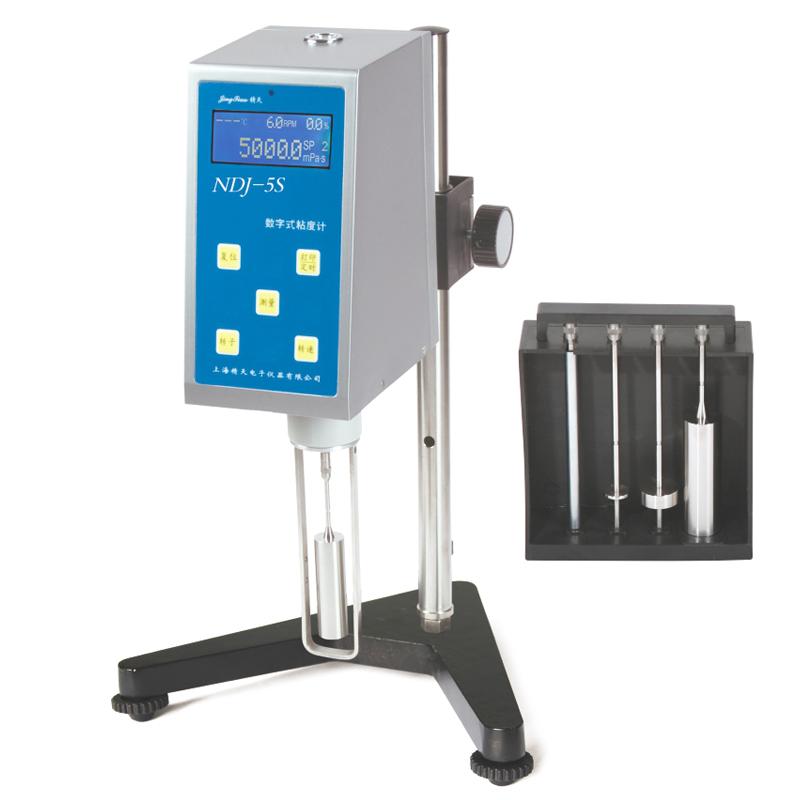
2. Select the appropriate equipment type
According to the characteristics of the fluid to be measured and the measurement requirements, Rotational Viscometers can be roughly divided into the following types:
| Type name | peculiarity | Applicable scenarios |
| Basic | The structure is simple and the price is lower. | Routine tests in the laboratory. |
| Ideal for measuring Newtonian fluids or low-viscosity fluids. | Measurement of low-viscosity liquids such as water and alcohol. | |
| The speed range is limited, usually fixed. | Teaching demonstrations and basic research. | |
| High-end | It supports a wide range of speed and torque adjustments. | Quality control in industrial production. |
| It can measure both high-viscosity fluids (e.g., asphalt, glue) and non-Newtonian fluids (e.g., paints, cosmetics). | High-end research or analysis of complex fluids. | |
| High-precision sensors for complex data analysis. | Occasions where high accuracy and multi-parameter measurement are required. | |
| Portable | It is easy to operate and easy to carry. | On-site inspections (e.g. construction sites, oilfield exploration). |
| Battery-powered, suitable for use in the field or in the field. | Fast measurements that do not require complex experimental environments. | |
| Lightweight design for easy movement. | Evaluation of fluid characteristics in emergency situations. |
Third, the key factors of selection
When choosing a Rotational Viscometer, the following factors need to be considered:
1. Measuring range
Make sure that the device is able to cover the viscosity range of the fluid being measured. For example:If you're dealing with highly viscous fluids, such as asphalt, choose equipment that supports high torque and low speeds.In the case of low-viscosity fluids (e.g., water, ink), you can choose a normal type of equipment.
2. Accuracy and stability
For scenarios that require accurate measurements, such as scientific research or quality control, equipment with high accuracy and stability should be preferred.Pay attention to the calibration function and calibration interval of the device to ensure the accuracy of long-term measurements.
3. Operation mode
If it is a manual operation, you need to pay attention to the convenience of operation of the device (such as whether it supports one-handed operation and whether the adjustment knob is smooth).If automated testing is required, you should choose a device that supports data acquisition and analysis software.
4. Sample size requirements
Different types of Rotational Viscometers have different requirements for sample volume. For example:Some high-end devices require only a small amount of sample (e.g., a few milliliters) and are suitable for the measurement of precious samples.Conventional equipment requires a larger sample volume.
5. Environmental adaptability
If it is used in a complex environment, it is necessary to pay attention to the dustproof, waterproof and anti-interference capabilities of the equipment.For high or low temperature environments, choose a device with temperature compensation.

Fourth, the selection steps are summarized
(1) Clarify the measurement target
Determine the type of fluid to be measured (high/low viscosity/non-Newtonian) and the measurement scenario (laboratory/industrial/field).
(2) Select the device type
Choose from basic, high-end, or portable devices depending on your needs.
(3) Match performance parameters
Ensure that the measurement range, accuracy and sample volume requirements of the equipment meet the actual needs.
(4) Evaluate additional features
If automated testing or data acquisition is required, it is preferred to choose a device that supports the relevant function.
(5) Compare price with brand
Choose a supplier with reliable quality and good after-sales service within your budget.

5. Examples of recommended scenario selection
Basic laboratory research often requires measuring the properties of low-viscosity Newtonian-type fluids, such as water or alcohol. In this type of scenario, the requirements for the equipment are relatively simple, and the pursuit of ease of operation and cost-effectiveness is the pursuit of basic Rotational Viscometers. The basic device is designed to be simple and affordable, making it suitable for routine measurements of low-viscosity fluids and easy for experimenters to get up and running quickly.
In industrial applications, materials such as paints and glues are typically non-Newtonian fluids whose viscosity changes significantly with shear rates. These scenarios require devices that can support multi-speed adjustment and have high-precision sensors to meet complex process requirements. Therefore, it is recommended to use a high-end Rotational Viscometer. The high-end equipment has a wide speed range and a variety of measurement accessories, which can adapt to the non-Newtonian fluid characteristics at different shear rates, ensuring the accuracy of fluid performance parameters in industrial production.
On-site testing, such as on construction sites, often requires a quick assessment of the flow of building materials such as concrete or mortar. This type of scenario requires high portability, anti-interference ability, and ease of operation of the device. Therefore, it is recommended to use a portable Rotational Viscometer. The portable device is designed to be lightweight, battery-powered, suitable for use in environments where power is not guaranteed, and has the speed to measure quickly to help engineers quickly evaluate fluid performance.

6. Precautions
Calibration issues+Maintenance+Technical support
When using a Rotational Viscometer, there are several key considerations to ensure the accuracy of the measurement results, the long-term stable operation of the equipment, and the safety of the operator:
Calibration is the key to ensuring measurement accuracy. Calibration of equipment on a regular basis can eliminate errors caused by the passage of time or changes in the environment. It is generally recommended to use a standard liquid, such as a standard fluid of known viscosity, for calibration, and to set a reasonable calibration frequency according to the equipment manual. In addition, the ambient temperature and humidity should be stable during calibration to avoid external interference affecting the calibration results.
Maintenance is an important part of extending the life of your equipment and maintaining its performance. At the end of each test, the device should be cleaned of residual samples, especially for highly viscous or clumpy liquids, to avoid clogging the measuring unit or causing contamination. When cleaning, use a soft cloth or special tools to avoid wiping the surface of the sensor to prevent damage to the delicate parts. In addition, the device should be stored in a dry, well-ventilated environment, away from heat, humidity, or corrosive gases.
Technical support is also important in the selection and use of equipment. Before purchasing, it is recommended to confirm the after-sales service and technical support capabilities with the supplier, including the warranty period of the equipment, the maintenance response time, and whether operation training is provided. In actual use, if you encounter abnormal situations or technical problems, you should contact the manufacturer or professional and technical personnel in time to deal with them to avoid damage to the equipment due to self-disassembly or incorrect operation.
In addition, operators should receive relevant training and be familiar with the operating procedures and safety precautions of the equipment to ensure that the measurement process is standardized and efficient. At the same time, the safety regulations of the laboratory should be strictly observed during the measurement, such as wearing protective equipment to prevent liquid spills or accidental contact. Through the implementation of the above precautions, the function of the Rotational Viscometer can be fully utilized to provide reliable data support for scientific research or industrial production.
- 1Rotational viscometer - principle, classification, application and calibrating
- 2Application of NDJ-8S digital Rotational Viscometer in viscosity measurement of cosmetic raw materials
- 3NDJ-5S digital Rotational Viscometer accurate measurement of natural oil viscosity
- 4Application of HBDV-1H swirl/spin High Temperature Viscometer in Viscosity Determination of Plastic Particles
- 5Principle, type and accuracy control of Rotational Viscometer
- 6Which Viscometer to Choose for Licorice Extract Viscosity Testing? How to Test?
- 7Application of Rotational viscometer in Waterborne Polyurethane Adhesive
- 8Application of Rotational Viscometer in cellulose material
- 9Application and selection of digital Rotational Viscometer in polyethylene (PE) wax