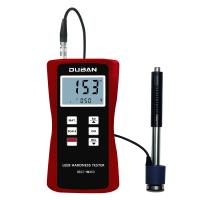
Read the Leeb Hardness Tester in one article
In the field of material hardness testing, the Leeb Hardness Tester occupies an important position with its unique advantages. It is of great significance to have an in-depth understanding of its principles, advantages, structure and fault handling methods to ensure the accurate and efficient development of the detection work.
principle
When the Leeb Hardness Tester works, an impact body of a specific mass is driven by a set test force and impacts the surface of the specimen at high speed. At a distance of 1mm from the surface of the sample, the impact velocity and rebound velocity of the impact body are accurately measured by the principle of electromagnetic induction. Through complex and precise calculations, the Leeb hardness value is determined according to the formula HL = 1000× (VB/VA). Among them, HL represents the Leeb hardness value, VB is the rebound velocity of the impact body, and VA is the impact velocity of the impact body. This innovative measurement method breaks through the traditional limitations and can adapt to a variety of materials, whether it is common metals or new composite materials, and can quickly and accurately obtain hardness data, greatly expanding the application scenarios of hardness testing.
merit
The Leeb Hardness Tester adopts the dynamic load test method, with the help of advanced speed correction technology, breaking the limitation of measurement direction, and can be operated in any direction, which can be easily handled in the laboratory and construction site, and significantly improves the detection efficiency. In addition, the Hardness Tester is compact, compact and lightweight, and the sensor can be operated directly by hand without the need for a large bench. Whether it is a heavy part of a large machine, or a small and complex precision workpiece, it can flexibly and accurately carry out hardness testing, effectively expand the scope of application, and play a key role in machinery manufacturing, building construction, aerospace and other fields.
Design the structure
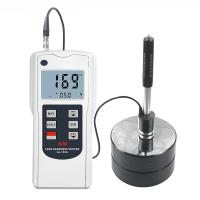
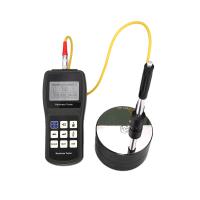
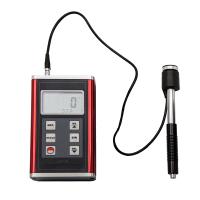
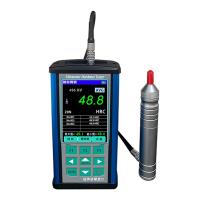
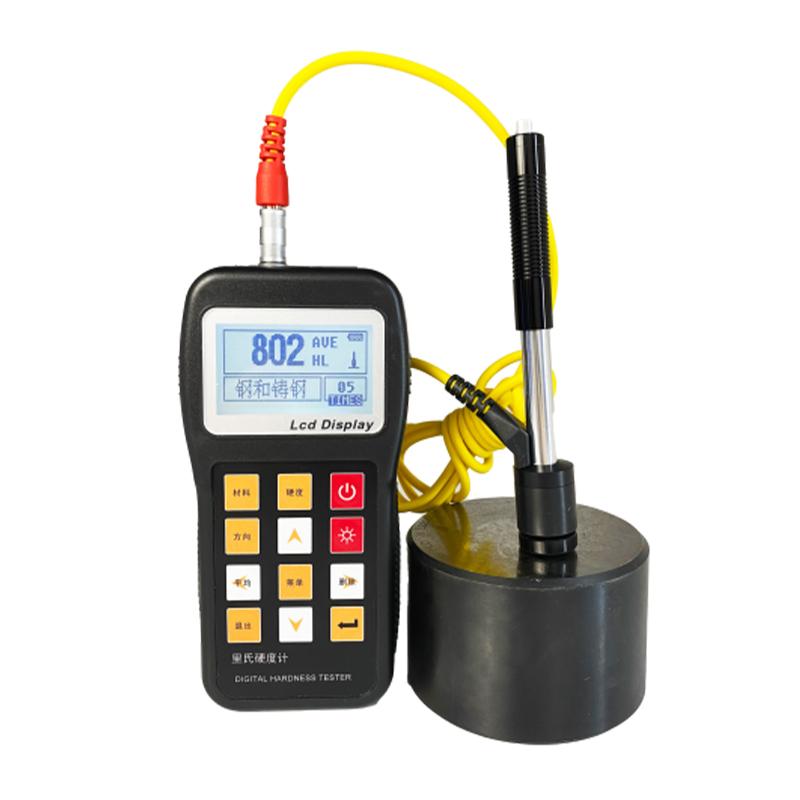
As the core part of the Leeb Hardness Tester, the main machine has an extremely precise internal circuit design, which is responsible for collecting, amplifying, and processing the signals transmitted by the impact device. The clear display screen intuitively presents information such as measurement results, equipment status and operation prompts, so that the operator can grasp the situation in real time. The operation button layout is reasonable, and the user-friendly design is convenient for mode selection, parameter adjustment, data viewing and other operations. The host also has strong communication capabilities and can transmit and share data with external devices. As a supporting device, the printer can clearly print the measurement data for easy recording and archiving. The internal structure of the impact device is complex, the impact body is precisely controlled by the metal grappling hook, and the impact body impacts the specimen at a specific initial position and velocity, and the impact pipe provides a stable guide for the movement of the impact body. After long-term and frequent use, the impact body is easy to wear and the metal grappling hook is easy to loosen, and regular maintenance of the impact device is very important to ensure the measurement accuracy.
Fault problem solved
There is no display problem when start-up, many Leeb Hardness Testers use 4 No. 5 nickel-chromium rechargeable batteries for series power supply, and the service life of domestic batteries is usually hundreds of charging and discharging cycles. The battery is installed inside the main unit, making it difficult for the user to measure the voltage directly. It cannot be turned on when charging, which often leads to misjudgment. When solving, you need to unscrew the back screw of the main engine, disassemble the back cover, and measure the battery pack voltage with a multimeter, if it is lower than 5V or the voltage of a single battery is less than 1.25V, the battery needs to be replaced in time. There is no display fault in the measurement, which is mostly caused by the abnormal connection line between the impact device and the main machine. Carefully check whether the shock device socket is tightly connected with the main machine, and then use a multimeter to measure the impact device terminal, if the resistance value shows infinity, indicating that the coil is broken, it is necessary to check and repair the disconnection, and restore the smooth line. Deviation can be caused by a variety of reasons. The impact body is frequently impacted, and the ball head is easy to wear, resulting in inaccurate indication value, so it is necessary to check the ball head, and replace it if it is seriously worn and ensure that it is installed correctly; The metal grappling hook is loose, so that the initial position of the impact body changes, and the impact height is inaccurate, resulting in repeatability beyond tolerance, and the release button needs to be disassembled and the grappling hook is re-fixed; The dirt of the sample is easy to enter the impact pipeline, which affects the impact speed, so it needs to be cleaned regularly with a nylon brush, and it is strictly forbidden to use lubricants inside; The battery power supply is insufficient, affecting the reference voltage, resulting in the indication value is out of tolerance, some Hardness Testers have voltage detection function, and some have no or fail, users should always pay attention to the power level; After circuit failure or repair, the internal reference value changes, it needs to be calibrated, taking HLN-11 type as an example, according to specific steps, through the switch group and potentiometer calibration, and finally re-calibrated with high, medium and low hardness standard hardness blocks.
summary
The Leeb Hardness Tester is suitable for a wide range of materials by means of a unique principle that the hardness value is obtained according to the impact and rebound speed of the impact specimen by impacting the specimen. It has the outstanding advantages of measuring in any direction and being portable and easy to use, and the main unit works together with the impact device, the former is responsible for core control and data processing, and the latter performs impact measurement. However, there may be faults such as no display on startup, no display on measurement, and deviation of indication value, which are caused by various reasons such as battery, connection line, impact body wear, etc., and it is necessary to take corresponding measures such as replacing the battery, repairing the line, and replacing the impact body for different fault causes, so as to ensure the smooth development of the testing work and provide accurate data support for material quality control.
- 1Leeb Hardness Tester different hardness system difference
- 2What products is the Leeb Hardness Tester with D probe suitable for measuring?
- 3Factors Affecting the Accuracy of Leeb Hardness Tester Testing
- 4Leeb Hardness Tester measurement requirements
- 5Factors Affecting the Test Accuracy of Leeb Hardness Tester
- 6What are the measurement requirements for a Leeb Hardness Tester?
- 7What factors affect the test accuracy, error and repeatability of the Leeb Hardness Tester?
- 8What is hardness testing? What types are there?
- 9Requirements for Casting Hardness in American Standard ASTM and Selection of Sclerometer
-
![Leeb Hardness Tester AMITTARI AL-150A split Leeb Hardness Tester]()
-
![PRLH150 Leeb Hardness Tester]() PRLH150 Leeb Hardness Tester$ 259.00
PRLH150 Leeb Hardness Tester$ 259.00 -
![Hypertherm LSY-W Leeb Hardness Tester]()
-
![KAIRDA NDT271 Ultrasonic hardness gauge display]()
-
![DUBAN DB22-HM455 Leeb Hardness Tester]()
-
![DUBAN DB22-HM450 Leeb Hardness Tester]()