Coating viscosity determination by Zain Viscometer method
Coating quality assurance covers the whole process of raw materials, process formulation, production operation and construction application, and the adjustment and control of viscosity on the construction site is the key. The finished coating has the original viscosity when it is loaded into barrels, but the viscosity will change due to factors such as storage, transportation, and climate, and different construction methods (such as brushing, spraying, dipping) have different viscosity requirements, so on-site measurement and adjustment are required. Immersion viscometer is a simple tool commonly used on the construction site, and portable Tu-4 viscometer is mostly used in CHINA, while Zein viscometer in accordance with ASTM standards is more inclined to be used abroad.
Structure & Function
The Chain's viscometer, also known as the Cai's cup or Chai's cup, is bullet-shaped, made of corrosion-resistant and solvent-resistant stainless steel, with precise small holes at the bottom of the cup, and a handle about 300mm long at the mouth of the cup, and a small ring at the top of the handle, which is easy to hook the fingers to keep the cup vertical. It is a portable instrument that can quickly determine the viscosity of liquids such as base coats, varnishes, spray paints, inks, etc. A set of Zein viscometer contains 5 cups with different pore sizes, each with a volume of 44ml, and a measurement range of 5~1800mm²/s, which is suitable for Newton-type and near-Newtonian liquids, and different pore sizes correspond to fluid materials with different viscosity ranges (such as No. 1 cup with an aperture of 2.0mm, measuring low viscosity oil; No. 5 cup with a pore size of 5.3mm, measuring pole-measuring viscous ink). It is characterized by the fact that it can be measured by immersion in hot or cold liquids, and is particularly suitable for the viscosity determination of hot varnishes, which is widely used in construction sites and workshops, and the measuring principle is to record the time (expressed in seconds) from the small hole in the bottom of the cup to the interruption of the filament.
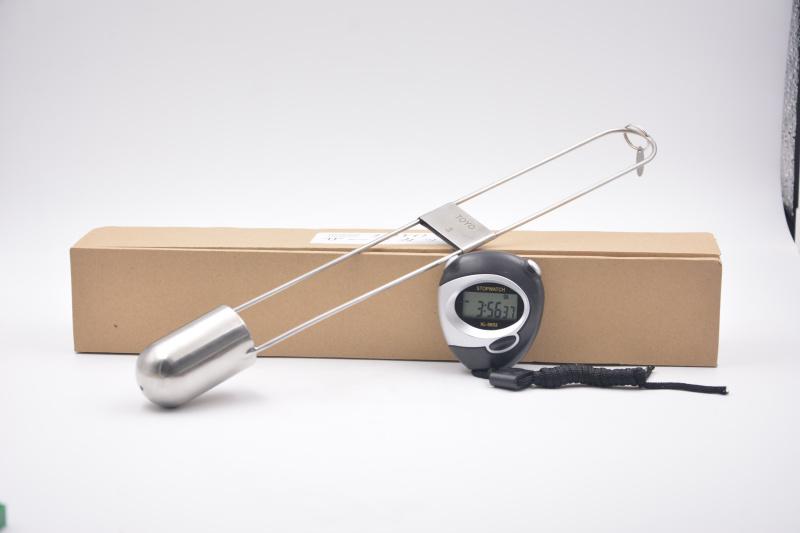
Measurement operation procedures and precautions
During the test, first observe whether there are impurity bubbles in the liquid to be measured, stir well, and then measure the temperature. Hook the small ring of the handle with your fingers, immerse the Viscosity Cup in the liquid until it does not pass the mouth of the cup, stay for 1~5 minutes for thermal equilibrium, and then quickly lift it vertically, and the upper edge will be timed as soon as the liquid level comes out, keeping the cup no more than 150mm away from the liquid level, and stop the timing until the flow wire is interrupted, the reading is accurate to 0.2 seconds, and the average value can be measured many times. When cleaning, use a suitable solvent and soft brush, and it is strictly forbidden to touch the small hole at the bottom of the cup with metal tools, so as not to affect the accuracy of scratches.
Effect of temperature on viscosity and correction curves
Temperature significantly affects the viscosity of liquids, and the temperature varies from site to site. For quality control, a temperature-viscosity curve can be drawn in the laboratory: the viscosity of a product can be measured in 5~10 gradients within the expected temperature range, and the temperature is used as the abscissa and the viscosity is used as the ordinate. After measuring the viscosity at the actual temperature in the field, it can be converted to the viscosity of the laboratory standard temperature through the curve, and then adjusted to meet the requirements with a solvent.
Calibration method of viscometer
The Zein viscometer is an outflow type and can be corrected by standard oil. Select the corresponding standard oil according to the cup number (such as the specific standard oil used for the No. 5 cup), measure the outflow time at a constant temperature of 25 °C, and convert the time into the kinematic viscosity by substituting the formula, the ratio of the actual viscosity of the standard oil to the converted viscosity is the correction coefficient, and the product of the coefficient and the outflow time is the corrected viscosity. Due to the non-precision of the instrument and the difficulty of temperature control, the actual more commonly used calibration method: the initial outflow time of the new cup is measured with standard oil, and the same temperature and oil are calibrated regularly after use, and if the outflow time changes by more than 20%, it will be replaced. Long-term use of paints or inks can also be corrected with their own outflow time.
summary
The Chain Viscometer is simple in structure and easy to use, making it an effective viscosity determination tool. This instrument has been produced in CHINA, although it is currently more used in the ink industry, but its wide measurement range and multi-fluid applicability are more suitable for the coating industry. The promotion of Zeeon viscometer can promote the detection method in line with international standards and improve the quality management level of the coating industry.