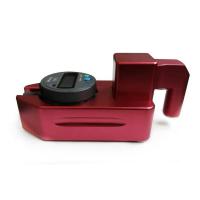
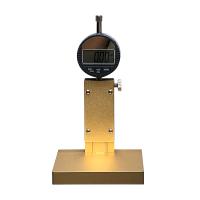
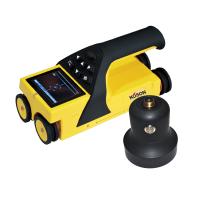
Thickness gauge selection guide: comprehensive analysis of thickness measurement tools from type to application
1. The basic concept and main types of Thickness Gauges
Definition of Thickness Gauge
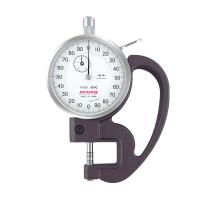
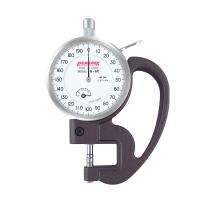
Thickness gauges are a general term for precision measuring instruments used to measure the thickness or gap size of materials. According to different uses and measurement principles, they are mainly divided into two main categories:
• Thickness gauges (for direct measurement of material thickness)
• Thickness gauges (also known as feeler gauges, mainly used to measure gaps)
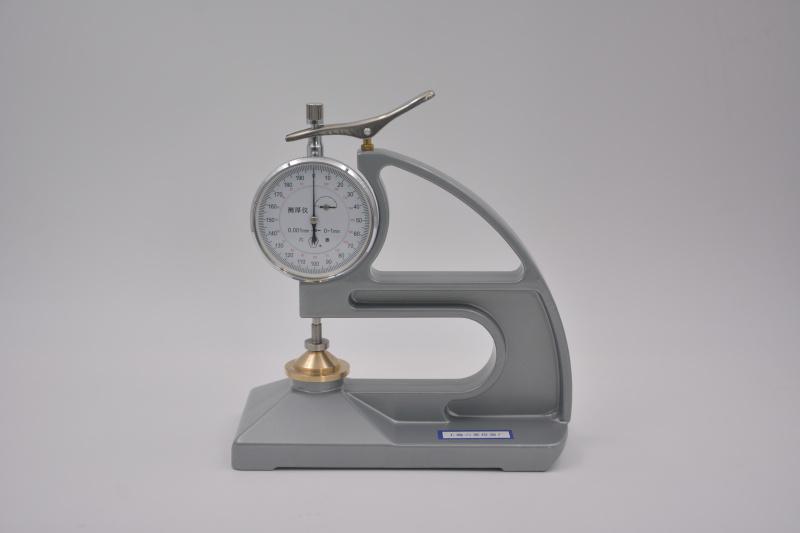
Characteristics and applications of Thickness Gauges
Thickness gauges are a class of instruments that directly measure the thickness of materials through contact or non-contact methods, and have a wide range of applications, including:
•foil
•plastic film
•Paper
•cloth
•glass
• Rubber and other materials
These tools are suitable for thickness inspection of both hard and flexible materials. Its core features are high measurement accuracy and easy operation, and some models also have data storage and transmission functions, which can meet the needs of automated inspection in modern production.
Characteristics and applications of Thickness Gauges
A Thickness Gauge (feeler gauge) is a set of sheet gauges with precise thickness, which can measure dimensional changes from extremely small gaps to large thicknesses by combining sheets of different thicknesses.
These tools are commonly used for:
• Measure the mating clearance of mechanical components
• Steel plate thickness deviation detection and other scenarios
It plays an important role in various industries such as machining, automotive maintenance, and sheet metal inspection.
Other classification methods
According to the differences in measurement methods, structures and application scenarios, Thickness Gauges can be further subdivided into:
• Contact and non-contact
• Readings (mechanical and electronic digital display)
• Areas of application (general purpose and specialized)
2. The main types and characteristics of Thickness Gauges
Mechanical Thickness Gauge (vernier Thickness Gauge)
Based on the structural design of traditional vernier calipers, measurement is achieved through the cooperation between the main ruler and the vernier scale, usually using a metal plane or spherical surface as the measuring surface.
Peculiarity:
• Simple structure
• Low cost
• No power supply required
Applicable scenarios:
It is suitable for rapid manual measurement in the laboratory or in the field, with an accuracy of generally up to 0.01mm~0.02mm, suitable for scenarios with moderate accuracy requirements, especially suitable for thickness inspection of hard or semi-rigid materials such as metal sheets, plastic parts, and paper.
Digital Thickness Gauge (Electronic Thickness Gauge)
Electronic sensors (such as capacity grids, light grids) are used to detect the spacing of the measuring surface, and the values are directly displayed on the LCD screen, supporting unit switching.
Peculiarity:
• Intuitive readings
• Higher accuracy (up to 0.001mm~0.01mm)
• Some high-end models have functions such as data storage, maximum/minimum value statistics, etc
Applicable scenarios:
It is suitable for the inspection of precision electronic components, films, foils, and other materials that require high accuracy, and can effectively reduce human reading errors.
Non-contact Thickness Gauge
Thickness is measured without touching the surface of an object using laser, ultrasonic or infrared technology to avoid damage to soft or deformable materials.
Classification and characteristics:
• Laser Thickness Gauge: Uses laser beam reflection measurement, especially suitable for high-precision measurement of transparent materials such as glass and thin film
• Ultrasonic Thickness Gauge: calculates thickness by acoustic reflection time, suitable for opaque materials such as metals and plastics, and can even measure substrate thickness through coatings
Applicable scenarios:
It is especially suitable for continuous inspection of dynamic production lines in special scenarios such as flexible films, fragile optical components, and high-temperature workpieces.
Special Thickness Gauge
Designed for specific industries or material properties, such as:
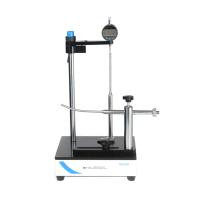
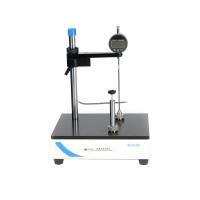
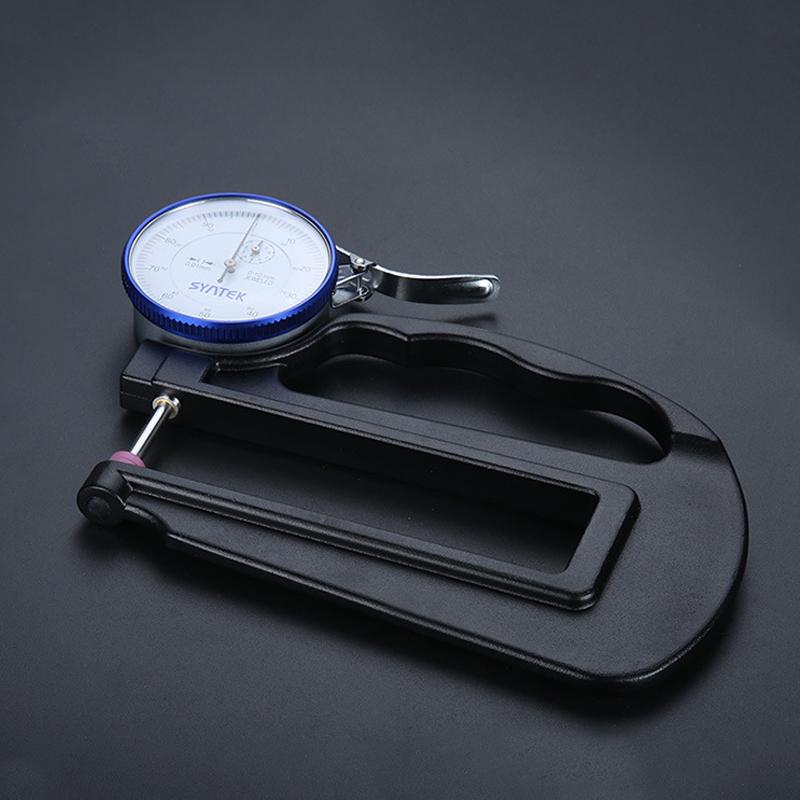
• Paper Thickness Gauge: has a circular measuring surface to avoid paper wrinkles
• Film Thickness Gauge: has adjustable measuring force to prevent film tensile deformation
• Pipe Thickness Gauge: with an arc measuring surface, adapting to the curvature of the inner wall of the pipe
In addition, there are combined Thickness Gauges and Thickness Gauges with locking devices, the former with flexible and adjustable measuring range, and the latter for easy one-handed operation and maintenance of measurement results.
3. Key points and practical suggestions for Thickness Gauge
Choosing the right Thickness Gauge requires considering a variety of factors to ensure a suitable match between the measurement tool and the specific application scenario.
1. Define your measurement needs
Key Considerations:
• Characteristics of the measured object: including material hardness, thickness range, surface condition
• Accuracy requirements: selected according to the accuracy requirements of the application scenario
• Usage Environment: Consider the impact of environmental conditions on the measurement tool
Selection suggestions:
• For hard materials (e.g., metal, glass), mechanical or digital Thickness Gauges are available
• For soft materials (such as rubber and fabric), it is recommended to use non-contact or low measuring force indicators to avoid material deformation
• Choose equipment with the appropriate range according to the actual thickness range of the object, too large a range will affect the measurement accuracy
• For special surface conditions, such as rough surfaces or curved surfaces, it is recommended to choose a spherical measuring head; for smooth surfaces, a plane measuring head is optional; Laser Thickness Gauges are preferred for transparent materials
2. Understand the characteristics and applicable scenarios of different types
Recommendations for different usage scenarios:
• Laboratory static testing usually prioritizes digital explicit Thickness Gauges for accuracy and ease of operation
• Production line dynamic inspection is more suitable for non-contact Thickness Gauges, which support continuous measurement and real-time data transmission
• When used in harsh environments (e.g., high temperature, dust), an industrial-grade Thickness Gauge with a protective housing should be selected to ensure stability
• For applications requiring data management or automation integration, models that support USB/Bluetooth transmission, connect to a computer or PLC system, or have analog output and trigger signal functions can be selected
Special precautions for Thickness Gauge:
For Thickness Gauges (feeler gauges) tools, special attention should be paid to the usage methods and taboos, such as avoiding deformation of steel sheets caused by violent operation, paying attention to temperature restrictions to prevent annealing and deformation of materials, cleaning and oiling in time after use, and properly storing them.
epilogue
As a core tool for accurate measurement of material thickness, Thickness Gauges come in various types, from traditional mechanical to intelligent digital display and non-contact measurement, covering the testing needs of different industries.
When selecting the model, it is necessary to pay attention to the material characteristics, thickness range, accuracy requirements and environmental conditions of the measurement object, and if necessary, professional manufacturers can be consulted to obtain customized solutions.
By reasonably selecting Thickness Gauges, it can not only significantly improve the detection efficiency and measurement accuracy, but also provide reliable data support for product quality control, helping enterprises achieve refined production. In the context of the continuous improvement of precision requirements in modern manufacturing, mastering the selection method and application skills of Thickness Gauges has become one of the necessary professional abilities for quality management personnel and engineering and technical personnel.
Correctly select and use Thickness Gauges to ensure accurate and reliable measurements at every micron level, ensuring product quality.