Comprehensive analysis of UV curing machine: principle, application scenarios and scientific selection guide
1. Basic cognition of UV curing machine
1. What is
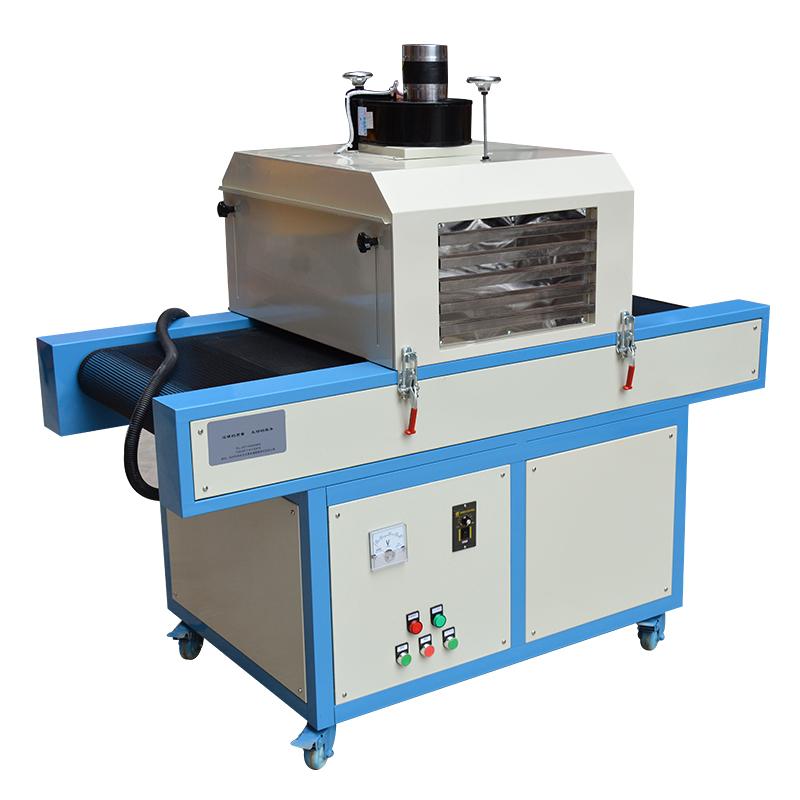
UV curing machine is an industrial equipment that uses ultraviolet (UV) light sources to trigger polymerization reactions of materials to achieve rapid curing. Its working principle is to activate the photoinitiator in the material by emitting ultraviolet light with a wavelength of 200-450 nanometers (mainly concentrated in the 365-405 nanometer band), promoting its photochemical reaction and converting the liquid material into a solid state in a short time.
This curing technique is a typical photochemical reaction process: when a specific wavelength of ultraviolet light hits the surface of a material containing a photosensitizer, the photoinitiator absorbs photon energy to produce active groups, which in turn triggers a cross-linking reaction between polymer molecules to form a stable curing layer.
2. Core technical characteristics
Compared with traditional curing methods, UV curing technology has the following notable features:
• Fast curing: Most materials can be cured in seconds
• Energy saving and environmental protection: No solvent volatilization, zero VOCs emissions
• Precise Control: Precise control of the curing effect by adjusting the wavelength and light intensity
• Wide adaptability: suitable for surface treatment of various material types
2. Equipment composition and working principle
1. Main components
UV curing machines typically consist of four core modules:
Light Source System: A critical component of the device responsible for generating specific wavelengths of ultraviolet light. At present, there are two main types: mercury lamps and UV LEDs, among which UV LED has gradually become the mainstream choice due to its advantages such as energy saving and long life.
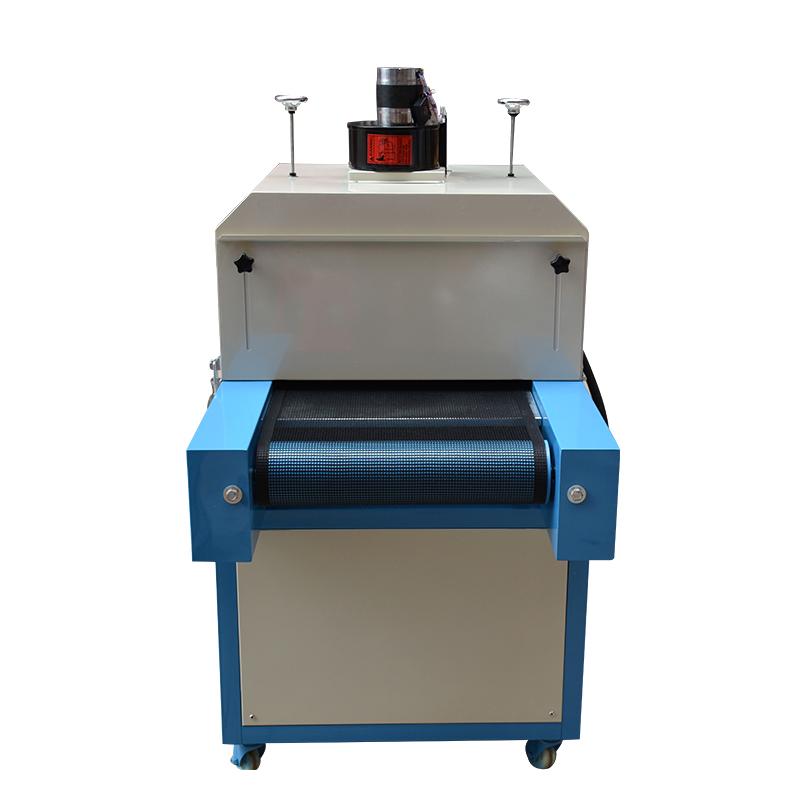
Conveyor system: Designed according to application needs, including two main forms, fixed and conveyor type, to ensure that the material maintains the optimal curing distance from the light source.
Heat dissipation system: Effectively control the operating temperature of the equipment to prevent excessive temperature from affecting material properties and curing results.
Control System: Precisely adjust various process parameters to ensure the stability and consistency of the curing process.
2. Detailed explanation of the working principle
The UV curing process is based on the principle of photochemical reactions. When UV light hits the surface of the material, the photoinitiators in the material absorb photon energy at specific wavelengths, producing reactive radicals or cations, which trigger cross-linking reactions between polymer molecules to form a three-dimensional network structure, thereby transforming the material from liquid to solid.
The efficiency and quality of the entire curing process depend on several factors: the wavelength matching of the UV light, the light intensity, the duration of exposure, and the photosensitive properties of the material itself. By precisely controlling these parameters, optimal curing results can be achieved.
3. Typical application scenarios
1. Printing and packaging industry
In the printing field, UV curing technology is mainly used for rapid drying of inks. Compared to traditional drying methods, UV curing can achieve higher printing speeds while ensuring the quality stability of printed materials. Especially in color printing and special effect printing, UV curing technology can achieve better color performance and surface effects.
2. Electronic and electrical appliance manufacturing
In the electronics industry, UV curing technology is widely used in processes such as protective coatings for circuit boards, fixation and packaging of electronic components. Its fast curing feature is particularly suitable for assembly line production of electronic products, which can significantly improve production efficiency.
3. Building decoration materials
In the field of architectural decoration, UV curing technology is used for the rapid curing treatment of floor coatings, wall coatings, furniture paints, and other products. This technology can provide higher surface hardness and better wear resistance while meeting environmental requirements.
4. Handicrafts and special materials
UV curing technology also shows unique advantages for various handicraft production and bonding treatment of special materials. Its precise curing control capabilities can meet the processing needs of complex shapes and special materials.
4. Equipment selection guidance
1. Material Compatibility Considerations
When selecting UV curing equipment, the first thing to consider is the characteristics of the material to be cured. Different materials have different response characteristics to UV wavelengths, and it is necessary to choose a light source with corresponding wavelengths. Common matching relationships include:
• Thin film material: usually 365-380 nm band
• Thick coatings: 395-405 nanometers of long-wave UV light may be required
• Special materials: It is necessary to select a matching light source according to the technical parameters provided by the supplier
2. Process parameter matching
The choice of curing process parameters directly affects the final result, including:
• Light Intensity: Choose the appropriate light intensity based on material thickness and curing requirements
• Irradiation time: matches the speed of the production line
• Total light energy: ensures that the energy required to fully cure the material is achieved
3. Select the device type
Depending on the actual application scenario, different types of UV curing equipment can be selected:
• Small Equipment: Suitable for laboratories and low-volume production
• Conveyor belt equipment: suitable for continuous production lines
• Customized equipment: for special process needs
4. Key technical indicators
The following technical parameters should be focused on when selecting:
• Light source type and wavelength range
• Light intensity and uniformity
• Equipment stability and service life
• Energy consumption levels and heat dissipation performance
• Ease of operation and maintenance costs
summary
UV curing machines, as essential equipment in modern industrial production, provide efficient solutions for multiple industries through their unique rapid curing capabilities. Understanding its working principle, mastering the key points of selection, and paying attention to use and maintenance can help users give full play to the performance advantages of the equipment and improve production efficiency and product quality.
When selecting and using UV curing equipment, it is recommended to choose the most suitable solution based on specific application needs and material characteristics, considering various factors. With proper use and maintenance, UV curing equipment can bring significant efficiency improvements to the production process.
-
![CHAOGU CG-GHL-700A UV ink LEDUV Curing Oven width 300mm]()
-
![HEIGHT-LED HTBX-II-FS300200-BL (365nm) oven]()
-
![KONYO COLOR NBC-UV30002 UV solidification machine, irradiation area 300 * 300mm]()
-
![YUZHOU GGH-1 Light curing machine Resin UV curing machine]()
-
![HEIGHT-LED HTBX-II-FS200200-BL (405nm) UVLED Curing Oven]()
-
![HEIGHT-LED HTBX-II-FS200200-BL (395nm) UVLED Curing Oven]()
-
![HEIGHT-LED HTBX-II-FS200200-BL (385nm) UVLED Curing Oven]()
-
![HEIGHT-LED HTBX-II-FS200200-BL (365nm) UVLED Curing Oven]()
-
![CHINA UV curing machine NBC-3000 1 lamp]() CHINA UV curing machine NBC-3000 1 lamp$ 1152.00
CHINA UV curing machine NBC-3000 1 lamp$ 1152.00


-
![CHINA UV curing machine NBC-3000 1 lamp]() CHINA UV curing machine NBC-3000 1 lamp$ 1152.00
CHINA UV curing machine NBC-3000 1 lamp$ 1152.00 -
![CHAOGU CG-GHL-1000A LEDUV Curing Oven Width 400mm]()