Selection and application of apparent density (pb) instrument
Apparent density meter is a professional instrument used to measure the apparent density of substances, apparent density refers to the mass of the material per unit volume in its natural state (including internal pores and external gaps), is one of the core indicators for evaluating the physical properties of materials, and is widely used in many industrial and scientific research fields.
1. Core types
Drainage apparent density meter: calculates the density by measuring the volume of the sample drained water, and is suitable for solid materials that do not absorb water, have no porosity or have low porosity.
Pycnometer: Using a known volume of a thermometer, the density is calculated by combining the sample mass and the volume of the filling medium, which is suitable for powder and granular materials.
Apparent density meter of gas displacement method: using inert gas such as helium as the medium, the real volume of the sample is measured by gas volume displacement, which is suitable for high-precision, easily absorbent or porous materials.
2. Test principle
The core test logic of the apparent density meter is calculated based on the "mass-volume" ratio, and the principle of different types is slightly different, but the core process is the same.
1. First, accurately weigh the quality of the sample, usually using high-precision electronic balances to ensure the accuracy of quality data.
2. Measure the apparent volume of the sample (including the total volume of the material itself, internal pores and external gaps) by the corresponding method.
3. According to the formula "apparent density = sample mass / apparent volume", the instrument automatically calculates and outputs the results, and some high-end models support automatic data recording and export.
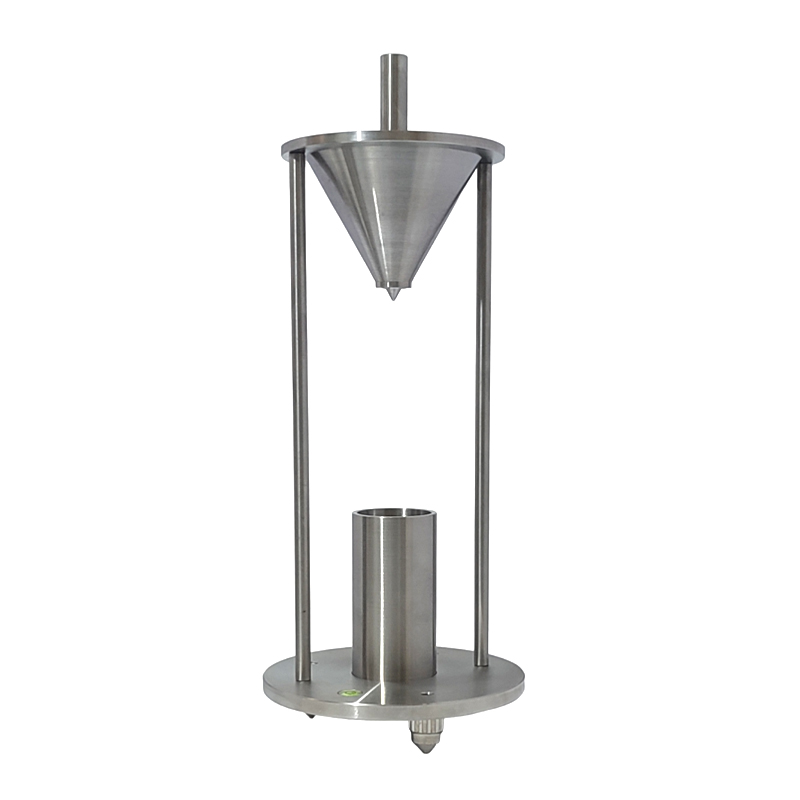
3. Main application fields
The application of apparent density meters covers multiple scenarios such as industrial production and scientific research experiments.
Material industry: quality control of plastics, rubber, metal powders, ceramic raw materials and other materials, to judge the degree of compaction and forming performance of materials.
Building materials industry: performance evaluation of cement, sand and gravel, concrete blocks and other building materials, related to the strength and durability of materials.
Powder industry: Judge the fluidity and processing performance of powders, food powders, chemical powders, etc., and guide the optimization of production processes.
Scientific research field: Physical property analysis in the process of new material research and development, providing data support for material formulation adjustment.
4. Common faults and solutions
Large deviation of measurement results: check whether the sample is dry (absorbent materials need to be pre-dried), calibrate the electronic balance and volume measurement module to ensure that there is no error between sample weighing and volume measurement.
Instrument error cannot start: check the power connection and instrument tightness (gas displacement method needs to ensure that there is no leakage in the gas circuit), restart the instrument and recalibrate.
Unstable data: Confirm whether the test environment temperature and humidity are stable (temperature changes will affect the volume of the medium), and clean the residual samples in the measurement chamber of the instrument.
5. Selection skills
1. Sample characteristics: Powder/granular samples should be preferred by pynovans or gas displacement, and bulk non-absorbent samples should be selected by drainage method.
2. Accuracy requirements: Gas displacement method (accuracy up to 0.001 g/cm³) can be selected for scientific research or high-precision production scenarios, and drainage method or ordinary hydroweight bottle method can be selected for conventional quality control.
3. Industry standards: Select instruments that meet the standards according to industry specifications (such as the building materials industry needs to comply with GB/T 14684 standards).
4. Usage scenarios: Benchtop high-precision models are available for laboratory fixed testing, and portable and lightweight models are available for on-site testing.
summary
As a key equipment for material physical property detection, apparent density meter directly affects the reliability and application value of test data. From the convenience of the drainage method to the high precision of the gas displacement method, different types of instruments are adapted to different scenarios, and clarifying sample characteristics, accuracy requirements and industry standards are the core prerequisites for the efficient application of instruments. Whether it is quality control in industrial production or innovative exploration in the field of scientific research, apparent density meters provide solid data support for material property evaluation with accurate measurement capabilities, becoming an important tool to promote the high-quality development of related industries.