Colorimeter core principle, type, application and selection guide
Colorimeter is a professional instrument used to accurately measure the color characteristics of substances (such as brightness, hue, saturation), which replaces the subjective judgment of the human eye by quantifying color data, provides an objective basis for color consistency control and quality inspection, and is widely used in industrial production and scientific research experimental scenarios.
Core type
Portable colorimeter: compact in size, easy to operate, suitable for on-site rapid testing, such as product outbound sampling inspection, construction site color comparison.
Benchtop colorimeter: higher accuracy, more complete functions, support multi-mode measurement and data storage, suitable for laboratory accurate analysis and quality control.
Online colorimeter: can be integrated into the production line, real-time monitoring of product color changes, automatic feedback adjustment of production parameters, and adaptation to large-scale continuous production.
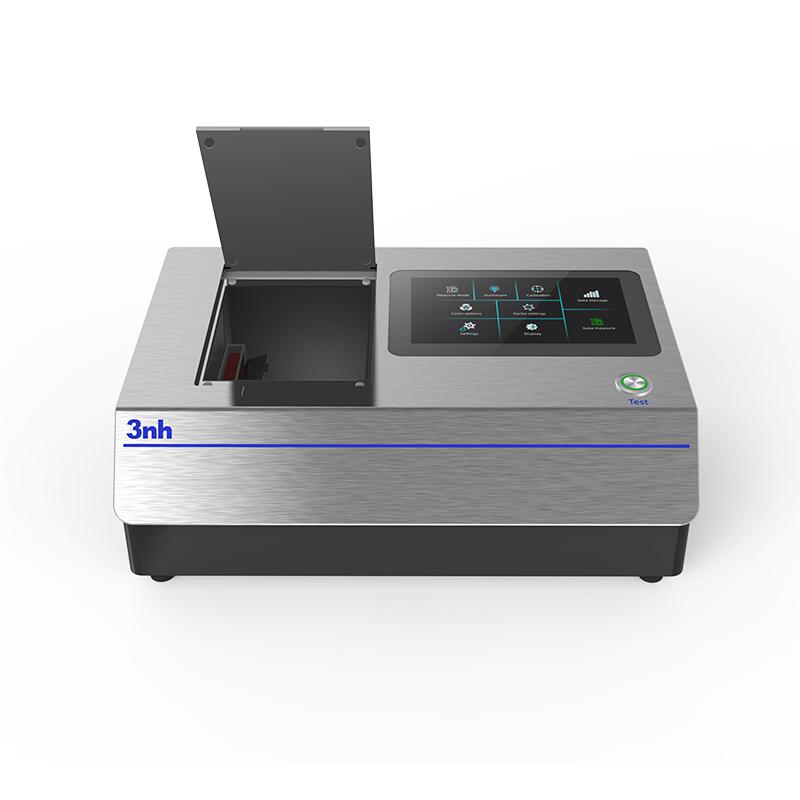
Test principle
The colorimeter core is based on the principle of optical reflection/transmission, which enables color quantification through a standardized process:
The light source emits standard light (such as the D65 standard light source, which simulates natural light) to illuminate the sample surface.
The sensor receives the light reflected or transmitted by the sample, converting the light signal into an electrical signal.
According to international color standards such as CIE Lab and RGB, the instrument calculates and outputs the corresponding color values to achieve objective quantification of color.
Main application areas:
Food industry: Detect the color uniformity of beverages, jams, flours and other products, and judge the quality of raw materials and the stability of processing processes.
Chemical industry: Monitor the color batch consistency of coatings, dyes, plastics and other products to ensure the uniformity of end product quality.
Building materials industry: calibrate the color standards of ceramic tiles, coatings, stones and other decorative materials to match engineering design requirements.
Textile industry: Detect the uniformity of fabric dyeing to avoid color difference affecting product acceptance.
Common faults and solutions
The following problems are prone to occur when using a mid-colorimeter, and the corresponding solution is simple and efficient:
Large deviation of measurement results: check whether the light source is aging and replace it in time; clean the surface stains of the sample and the measuring port of the instrument to ensure that there is no obstruction; Calibrate the instrument as required.
The instrument cannot be turned on or freezes: check the power connection (the battery level needs to be confirmed for portable), restart the instrument; If it crashes frequently, contact the after-sales service to repair the internal circuit.
Abnormal data display (such as numerical runout): confirm that there is no strong light interference in the measurement environment and keep the ambient temperature stable; Check that the sample is placed flat to avoid measurement angle deviations.
Selection skills
Usage scenarios: portable for on-site testing, desktop for accurate laboratory analysis, and online for real-time monitoring of production lines.
Accuracy requirements: general quality control selects entry-level (accuracy ±0.1~±0.3), high-end manufacturing or scientific research selects high-precision level (accuracy ≤±0.05).
Color standards: Select instruments that support the corresponding standards according to industry needs (such as CIE Lab commonly used in the food industry and RGB commonly used in the electronics industry).
Functional requirements: Data export needs to be selected to support USB/Bluetooth connection, and multi-sample comparison is required to select models with storage and difference analysis functions.
summary
As a key equipment for color quantitative detection, the type, principle and application scenario of the colorimeter are highly matched, and scientific selection and standardized fault handling are the core to ensure the reliability of the detection data. From on-site rapid detection to laboratory accurate analysis, from food processing to chemical production, it avoids the bias of subjective judgment of the human eye through objective color data, provides strong support for quality control and process optimization in various industries, and is an important tool to promote the standardized production of products.