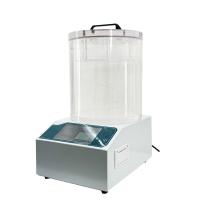
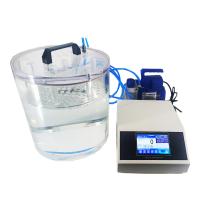
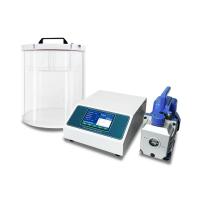
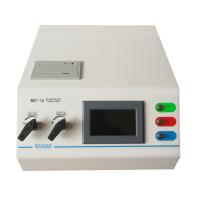
Sealing tester Principle Type Application Selection Guide
The tightness tester is a special instrument that detects the sealing performance of products or packaging by physical methods and judges whether there is leakage, and is a key equipment for various industries to control product quality and avoid leakage risks.
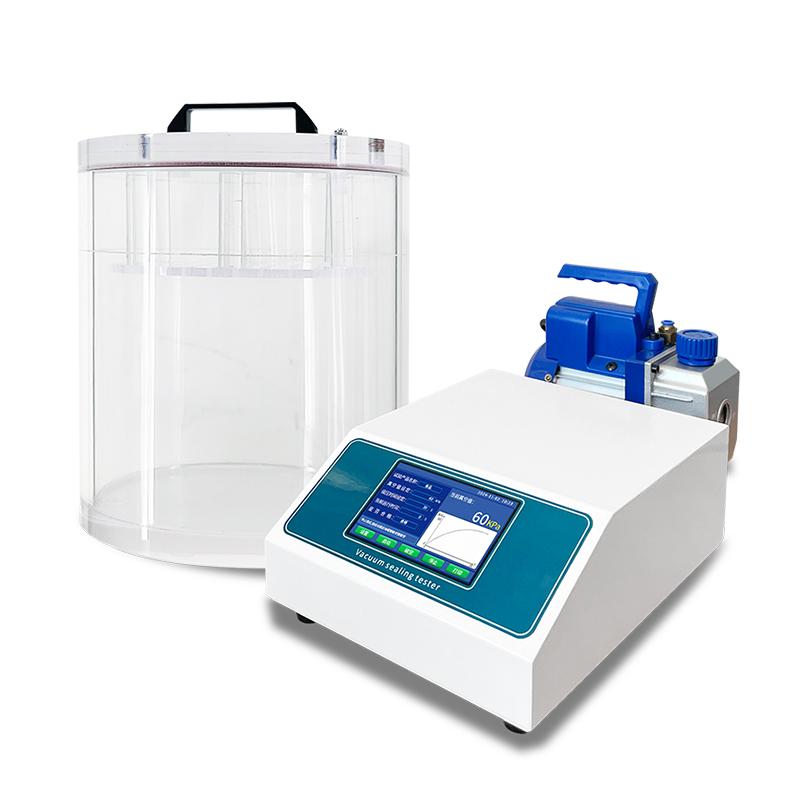
Main types
(1) Classification according to the test principle
Pressure decay method: high precision and no damage, suitable for most conventional product testing.
Vacuum attenuation method: suitable for products sensitive to air pressure, using negative pressure test logic.
Immersion type: Leakage points are visually visible, simple to operate but may cause moisture in the product.
Differential pressure type: high sensitivity, targeted detection of small leaks.
(2) Classification according to application scenarios
Laboratory Special: Comprehensive functions, support data storage and analysis, suitable for R&D and sampling inspection.
Production line online: fast detection speed, automatic linkage, to meet mass production.
Portable: Compact and easy to carry, suitable for on-site mobile inspection.
Test principle
1. Core logic: Inject gas or vacuum into the sealed chamber to create a stable pressure/negative pressure environment and maintain the set time.
2. Judgment basis: Pressure changes are monitored by sensors, and if the preset threshold is exceeded, the seal is judged to be unqualified.
3. Principle focus: non-destructive method (pressure/vacuum attenuation method) is suitable for products that need to maintain integrity, and intuitive method (immersion type) is suitable for products that are not afraid of water erosion.
Fields of application
Food packaging industry: ensure the sealing of snack bags, beverage bottles, cans, etc., extend the shelf life, and prevent deterioration.
Automobile manufacturing industry: Inspect engine blocks, pipelines, etc. to prevent oil and gas leakage.
Electronic and electrical industry: test waterproof mobile phones, sensors, etc., to block water vapor and dust intrusion.
Aerospace industry: Assess the sealing of parts and components to meet the needs of extreme environments.
Common faults and solutions
Unstable pressure - check the air source pressure, investigate pipeline leakage, and replace the aging sealing gasket.
Poor repeatability of test results – calibrate pressure sensors, uniform product placement, and clean test chambers.
Instrument cannot start/error - check power supply and safety door lock, restart instrument, and contact the manufacturer for repair if necessary.
Inaccurate judgment – recalibrate test parameters, replace adapted tooling, and use cross-method verification.
Key points of selection
1. Clarify accuracy and efficiency: Select the accuracy according to the allowable leakage volume of the product and the speed according to the production/testing scenario.
2. Match product characteristics: choose non-destructive methods for flexible packaging, and choose portable or online for bulky products.
3. Comply with industry standards: Follow corresponding industry norms (such as food, medical device-related standards).
4. Adaptation to usage scenarios: laboratory emphasis on function, production line emphasis on automation, on-site testing emphasis on portability.
summary
The tightness tester is the core equipment to ensure product quality, and its type and principle need to be accurately matched with the application scenario and product characteristics. From laboratory R&D to production line mass production, from food packaging to aerospace components, it enables the evaluation of sealing energy through scientific pressure monitoring logic. Mastering the simplified fault troubleshooting methods and selection points can efficiently exert the value of equipment and avoid quality and safety risks caused by seal failure.