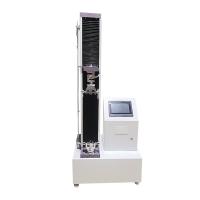
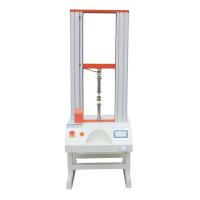
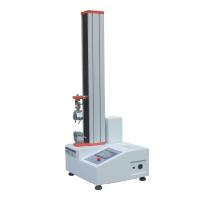
Measurement of winding wire elongation
The determination of elongation of winding wire mainly includes two important indicators of elongation at break and tensile strength.
Elongation is the ratio of the increased length to the original length; tensile strength is the ratio of the breaking force to the original cross-section when the conductor is broken.
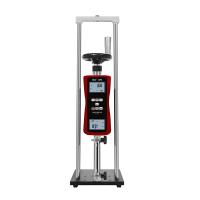
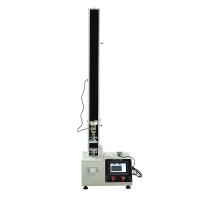
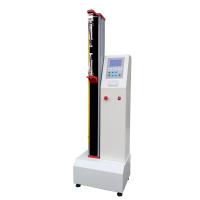
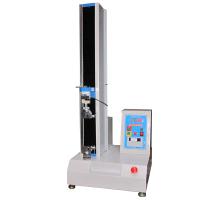
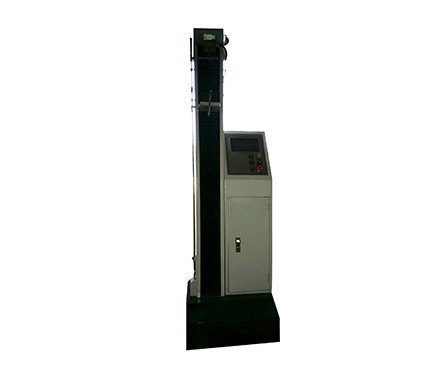
The measurement of winding wire elongation requires the use of extensometer or Tensile Testing Machine.
Method for determination of winding wire elongation
(1) The determination of elongation at break requires stretching a relatively straight sample with a free test length of 200-250mm at a rate of (5±1) mm/s on an extensometer or Tensile Testing Machine until the conductor breaks point, and then calculate the ratio of the linear increment of the length at break to the free test length, and express it as a percentage.
(2) The tensile strength test is performed on an extensometer or Tensile Testing Machine, and a straight sample with a free test length of 200-250 mm is also stretched at a rate of (5±1) mm/s until the sample breaks point, and record the breaking force at break.
The results of the elongation of the winding wires represent
(1) Elongation at break
Measure 3 samples, record 3 test values, and take the average as the elongation at break.
(2) Tensile strength
Measure 3 samples, record the original section and 3 breaking force test values, and take the average value of the breaking force and the ratio of the original section as the tensile strength.




- 1Tensile machine application in various industries
- 2Technical analysis of key parameters of Tensile machine: Scientific selection from force measurement accuracy to Power system
- 3Tensile machine purchasing guide [dry version]
- 4Talking about the performance test of epoxy resin film coated on PET
- 5ASTM D5019 Single-layer roofing film reinforced CSM board (chlorosulfonated polyethylene (PE)) standard interpretation
- 6Common problems and solutions in tensile testing
- 7Did you know that tensile strength is an important factor affecting the durability of plastics?
- 8What is tensile strength testing and which products can be tested?
- 9Factors Affecting the Performance and Accuracy of Tensile Testing Machines
-
![Patek Jushi LY-7012C Tensile Tester 1000KG]()
-
![BaidaJUSHI LY-7012A Small Tensile Testing Machine 200KG]()
-
![CHINA NBC-1024-2 Tensile Tester 5T]() CHINA NBC-1024-2 Tensile Tester 5T$ 6635.00
CHINA NBC-1024-2 Tensile Tester 5T$ 6635.00 -
![CHINA NBC-6820 Ring type initial tacking machine Tensile Tester]()
-
![CHINA NBC-1023-1 Computerized Double Column Tensile Testing Machine]()
-
![CHINA NBC-1021 Touch screen single column Tensile Strength Tester 10KG]()