This article lets you master the determination of Film thickness
Painted products have direct requirements on the thickness of the coating film according to their use and the environment in which they are used. In addition, the various properties of the coating film also need to use the thickness as a conditional parameter, that is, the properties of the paint film can only be compared at the same thickness. Therefore, paint film thickness is a very important control index in the process of coating construction.
The paint film thickness has wet film thickness and dry film thickness respectively. The wet film thickness is used for the direct control and adjustment of the paint film thickness on the construction site, and the dry film thickness is used for quality control and acceptance.
1. Determination of wet film thickness
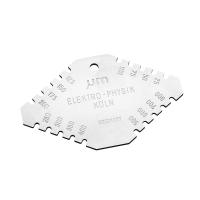
For the thickness of the wet film, use a toothed metal plate or back plate with sequentially changing depths, press vertically on the surface of the wet film, and take the sawtooth scale that is first stained with the wet film by direct pressing. (Related instruments: wet film gauge)
2. Determination of dry film thickness
Dry film thickness measurement can be divided into two categories: magnetic method and eddy current method.
(1) Magnetic method Magnetic method
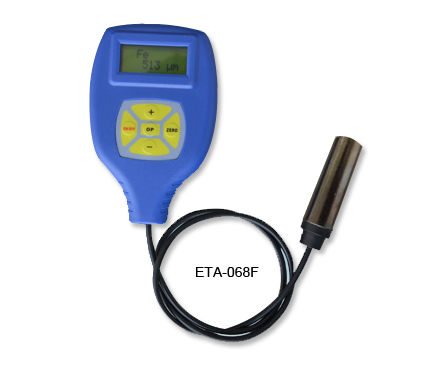
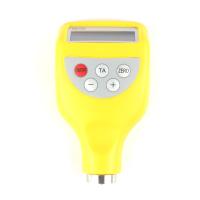
Based on the magnetic flux or mutual inductance current of the probe to the magnetic substrate, the thickness of the non-magnetic coating on the surface is different, and the linear change value of the magnetic flux or mutual inductance current of the mining head is used to determine the thickness of the coating. Therefore, the magnetic method is only suitable for measuring magnetic substrates. Non-magnetic coating on the surface. (Related Instruments: Magnetic Coating Thickness Gauge)
According to its measurement principle, the test instrument is divided into two types: permanent magnet Thickness Gauge and electromagnetic induction Thickness Gauge. The previous permanent magnet Thickness Gauges have poor measurement accuracy and accuracy. The new permanent magnet Thickness Gauges use rare earth drill metal permanent magnets and magnetized tungsten probes. They are wear-resistant and durable, and can maintain accuracy for a long time. In addition, there is a A pen-shaped Thickness Gauge, the measurement is not limited by the surface shape, and can be measured on the surface up to 230°C, with a measuring range of 5~500µm.
The electromagnetic induction Thickness Gauge has been developed from the original pointer type to the digital display type, such as the domestic QUC-200 digital display magnetic Thickness Gauge only, the operation process is as follows: turn on the power and warm up for 20 minutes → "Select" switch is set to " Voltage", check whether the battery is above 16.5V → then set the "selection" switch to "thickness" → adjust zero → calibrate and measure with a 100.0µm standard sheet.
When using the magnetic method to measure the coating film on the surface of the tinplate, because the thickness of the tinplate is too thin (0.5~0.8mm), the measurement error is relatively large. You can use a thick iron plate on the back of the tinplate or a standard substrate with the instrument for zero adjustment, standard and Test, measure and take the average value of the upper, middle and lower points 1cm away from the edge of the high test plate.
For some more professional Thickness Gauges abroad, it has the functions of automatic adjustment, data storage, statistics and printout, and can meet the requirements of IS09000 quality management standards.
(2) Vortex method Vortex method
The test probe has a built-in high-frequency current coil, which generates a high-frequency magnetic field in the coating to be tested, which causes a machine flow inside the metal substrate, and the magnetic field generated by the temperature flow reacts on the inner coil of the probe to change its impedance. The surface method As the thickness of the coating changes, the distance between the probe and the metal changes accordingly, and the E1 resistance that reacts on the probe wire circle also changes accordingly. The measured impedance of the probe coil reflects the thickness of the coating.
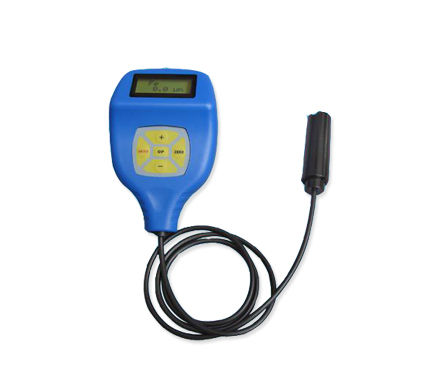
The eddy current method is generally used to measure the thickness of non-conductive coatings on non-magnetic metal substrates, and it is also suitable for measuring the thickness of non-magnetic coatings on the surface of magnetic substrates, and this type of Thickness Gauge usually has both electromagnetic and eddy current functions. (Related Instruments: Eddy Current Coating Thickness Gauge)
(3) Other methods
 Since the magnetic method and eddy current method can only measure the thickness of the coating film on the surface of the metal substrate, for non-metallic substrate materials (such as plastics, wood, broken glass, etc.), it is necessary to use other methods, such as the P0sitect0r100 series of the DeFelsk0 company in the United States, which uses the principle of ultrasonic And professional numerical control technology, non-destructive thickness measurement of non-metallic substrate surface coating, the measurement range of 100-C type is 8~500μm, and the measurement range of 100-C type is 50~4500μm.
The above measurement methods are non-destructive thickness measurement, but as an arbitration method, the microscope method is still used, and the test principle is shown in Figure 8-4. Use a cutting tool at a certain angle to make a "V"-shaped notch on the coating to the substrate, and use a microscope with a scale to measure the width of a' and b'. The scale division has been converted into micrometers through the calibration factor. What is read is the actual thickness of the paint film (a and b).
-
![EASTONG ETA-068F Wall Thickness Gauge measurement magnetic nonmagnetic coverage and nonmagnetic metal substrate]()
-
![DONGRU DR320 Coating Thickness Gauge electromagnetic induction principle for magnetic metal substrate surface platings measurement]()
-
![Japan KETT LE-373 magnetic Induction film thickness meter 2500 μm large range, with LEP-J probe]()
-
![DONGRU DR5000S Coating Thickness Gauge 0~5000μm]()
-
![DONGRU DR120 Coating Thickness Gauge]() DONGRU DR120 Coating Thickness Gauge$ 168.00
DONGRU DR120 Coating Thickness Gauge$ 168.00 -
![German EPK WetTest WFT gauge thickness range: 25~ 800μm]()
-
![DONGRU DR210 Coating Thickness Gauge Coating thickness measurement]()
-
![EASTONG ETA-068NF Coating Thickness Gauge measurement of nonmagnetic metal substrates such as copper, aluminum, zinc, tin, etc. Thickness of nonconductive coatings]()
-
![German EPK MiniTest 4100 precision platings Thickness Gauge MiniTest4100 with F05 iron-based probe]()


- 1Principle, Characteristics and Application of Wet Film Comb
- 2Determination method of dry and wet paint film thickness
- 3Coated steel coatings - Determination of dry-film thickness
- 4Wet film thickness measurement tool and applicable method
- 5Wet film thickness measurement and coating mass control
- 6Dry-film thickness measurement: an important step before Coating mass evaluation
- 7How to detect the thickness of steel structure paint?
- 8How to convert Dry-Film and wet film thickness of concrete structure paintings?
- 9Wet film thickness preparation and measurement

