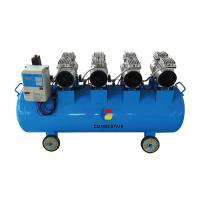
Structure design and working principle of oil-free Air Compressor
Structure
The main accessories of oil-free Air Compressor include: cylinder, piston, sealing ring, connecting rod, crankshaft and crankcase, etc. The piston is integrated with the connecting rod, and the piston cover tightly presses the sealing ring on the piston. The sealing ring is made of self-lubricating material and made into a cup shape, filled with polytetrafluoroethylene, and adapts to the swinging motion of the piston by using its flexible deformation compensation.
The difference between the structure of the oil-free Air Compressor and the traditional compressor is that the cylinder of the oil-free Air Compressor deviates from the rotation axis of the crankshaft. Specifically, there is an offset e between the cylinder and the side formed by the compressor, so that the piston , The swing amplitude of the sealing ring and the connecting rod is no longer symmetrical with respect to the axis of the cylinder. The effect of this is that the swing range of the piston and the sealing ring becomes smaller during the compression movement, that is, the compression movement is closer to a straight line, which effectively reduces the pressure on the side wall of the cylinder, reduces the elliptical deformation of the sealing ring, and makes the cylinder Improved sealing. On the other hand, the piston and seal ring swing more to the cylinder during compression, that is, there is a larger gap between the piston and seal ring and the side wall of the cylinder, and this side gap is used as the intake passage of the compressor. The existing swinging piston compressors have a symmetrical layout of the piston movement during their working process, that is, the side clearances during the intake and compression processes are the same. Then the tightness of the sealing ring cannot be guaranteed during the compression process, and it is difficult to give consideration to both [.
The principle of side clearance air intake
During the movement of the piston from the top dead center to the bottom dead center, the internal volume of the compressor continues to increase and a vacuum environment is formed. At this time, there is a side gap between the piston, the sealing ring and the side wall of the cylinder, and fresh cold air passes through the crankcase. The side gap then enters the working cavity of the compressor; when the piston moves from the bottom dead center to the top dead center, the volume of the compressor cavity is continuously reduced, and the internal gas is compressed and the pressure is gradually increased. The gap becomes smaller accordingly, and the sealing ring expands under the pressure and clings to the inner wall of the cylinder to form a sealed environment. The piston and sealing ring play the role of "valve" in the process of gas entering the compressor, so the compressor can realize the gas exchange process without an inlet valve.
- 1Basic Principle and Application of Permanent Magnet Air Compressor
- 2Five steps to choosing the right Air Compressor
- 3What kind of Air Compressor do you generally choose for air Spray Gun spraying?
- 4Air Compressor selection of Fusheng
- 5Air Compressor application industry one table
- 6Iwata Air Compressor model selection method
- 7Iwata Air Compressor series standard configuration characteristics diagram
- 8Iwata teaches you how to use Air Compressor comfortably and efficiently?
- 9Common faults and treatment methods of compressors