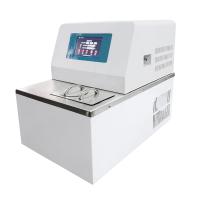
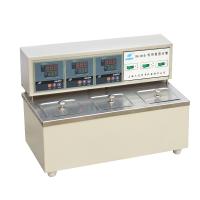
Thermostat structure and working principle introduction
The physical and chemical properties of substances, such as refractive index, viscosity, density, surface tension, vapor , equilibrium constant, rate constant, etc., are all related to temperature. The determination of these properties must be carried out under constant temperature conditions. To control the temperature of the system under study, two methods are usually used: one is to use the constancy of the phase transition temperature of the substance to control the temperature, such as a mixture of water and ice (0°C), boiling point water (100°C), liquid nitrogen ( -l959℃), etc. Although this method is simple, it has certain restrictions on the choice of temperature ; the second is to use the electronic regulation system to automatically adjust the working state of the heater or refrigerator, so that the controlled object is under the set temperature. This article mainly introduces the shape and structure of the constant temperature bath.
The following liquid media can be used according to the temperature control range:
-60~30℃ with ethanol or ethanol aqueous solution;
0~90℃ water
80~160℃ with glycerin or glycerin aqueous solution;
70~11300℃ use liquid paraffin, silicone oil, cylinder lubricating oil.
1. The structure and working principle of the constant temperature bath
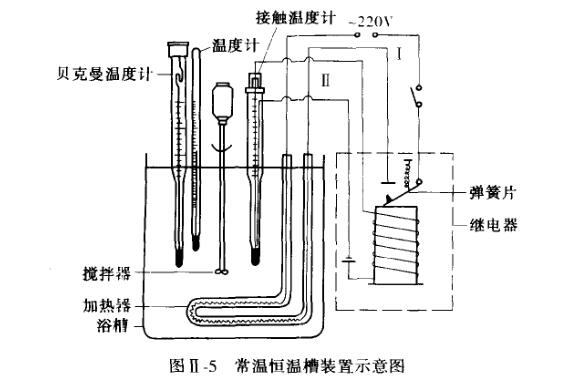
The schematic diagram of the constant temperature bath at room temperature (room temperature ~ 250°C) is shown in Figure II-5.
 1 bath
 1 bath
A bath includes a vessel and a liquid medium. If the temperature required to be set is not too different from the room temperature, a 20L round glass cylinder can usually be used as a container. If the set temperature is higher and lower, the entire warm, the speed of delivery should be increased, and the accuracy of constant temperature should be improved. The constant temperature Water Bath uses constant temperature water as the working device, and the device is slightly modified and other suitable materials are selected. If the device is slightly modified and other suitable liquids are selected as the public medium, the appeal constant temperature bath can be used in a larger temperature range.
2 thermometers
A mercury thermometer with a division value of 01°C can be used to observe the temperature and weight of the constant temperature bath, and a Beckmann thermometer should be used to measure the sensitivity of the constant temperature bath. The location should be as close as possible to the system under test.
3 stirrers
The stirrer is driven by a small electric motor, and its power can be selected as 40W, and the stirring speed is adjusted . The stirrer is generally installed near the heater, so that the heat can be transferred quickly, so that the temperature of each part in the tank is uniform.
4 heaters
In the case that the set temperature is required to be higher than the room temperature, heat must be continuously supplied to compensate for the loss of the Water Bath to the environment . The selection principles of electric heaters are small heat capacity, good conductivity, and appropriate power . If the tank with a capacity of 20L requires a constant temperature between 20-30°C, a 200-300W electric heater when the room temperature is too low, a higher-power heater or two sets of heaters should be used.
5 contact thermometers
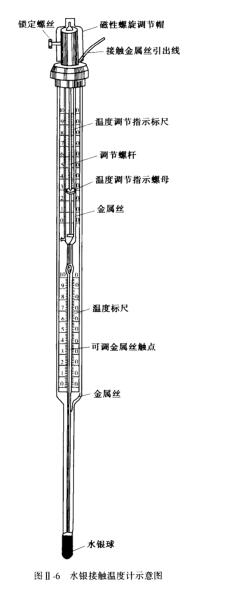
The contact thermometer is also called the mercury conductivity meter, and its structure is shown in Figure II-6. A metal wire that can move up and down is suspended in its capillary , and a metal is also drawn from the mercury tank, and the two metal wires are connected to the signal feedback terminal of the relay through the lead wire. On the upper part of the contact thermometer, there is a screw that can be rotated with the magnetic screw adjustment cap on the top to adjust the height of the wire contact (rotate the magnetic screw adjustment cap counterclockwise, the contact is lowered, turn the magnetic screw adjustment cap clockwise, the touch point rise.) There is a temperature adjustment indicator nut on the screw rod, and the temperature indicated by the upper edge of the nut locked on the temperature scale is the approximate temperature control set temperature value (for example, when the temperature is controlled at 30°C, the upper edge of the nut can be pointed to At 30°C on the scale, the wire contact is at 30°C on the lower half of the scale ).
When the temperature of the bath is lower than the set value, the heater starts to heat, the temperature of the bath rises, the mercury expands and the mercury column rises until the contact meets the metal wire, and the contact thermometer circuit is connected. At this time, the circuit II is a path (see figure Il-5), the inner coil of the relay is energized to generate a magnetic field, which sucks the spring sheet down, the line I is disconnected, and the heater stops heating. Then the heat of the bath bowl diffuses outwards, causing the temperature of the bath to drop . When the temperature of the bath is lower than the set value, the mercury shrinks and separates from the contacts, the line II is disconnected, the electromagnetic effect of the relay disappears, and the spring returns to its original position. The circuit I becomes a path again, the heater starts to heat again, and the bath temperature starts to rise again. In this way, the contact thermometer works repeatedly to control the temperature of the system. It can be said that the contact thermometer is the center of the constant temperature bath and plays .
Since the temperature scale on the contact thermometer is very rough, the precise temperature of the constant temperature bath should be indicated by another precision thermometer. When the required temperature control temperature is stable, tighten the locking screw on the adjusting cap so that it does not rotate.
6. Relay
The relay needs to be connected with a heater and a contact thermometer in order to control the temperature. Commonly include tube relays and tube relays. For the working principle of the relay, please refer to the relevant manual.


- 1Difference between Thermostatic bath and Water bath
- 2How to choose a laboratory constant temperature bath?
- 3Thermostatic bath working principle and its application in viscosity measurement
- 4How to install the Rotational Viscometer on the thermostatic tank?
- 5Operation steps and precautions of Tianling thermostat
- 6Tips for using thermostat
- 7GDH series ultra-high precision low temperature thermostat tank selection table
- 8GH series ultra-high precision constant temperature water and oil tank selection table
- 9NLDC low temperature thermostat series selection table