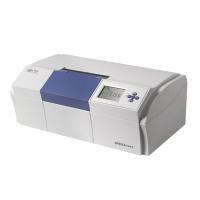
Polarimeter measurement principle
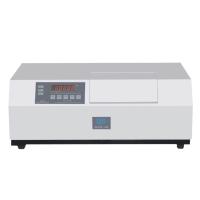
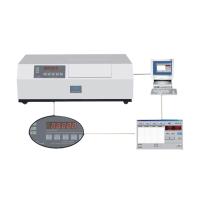
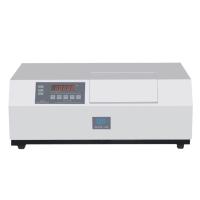
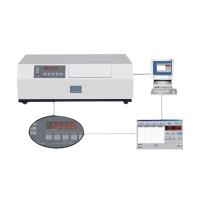
The optical rotation of a substance refers to the property that a certain substance can turn its polarization direction through an angle when an east plane polarized light passes through, and this angle is called the optical rotation. The instrument used to measure the optical rotation of substances is called a polarimeter. The main purpose of the polarimeter is two aspects: ① to study the structure of organic matter; ② to quantitatively measure the concentration of optically active substances, especially to accurately determine the existence of non-optical impurities in the solution. When the content of optically active substances.
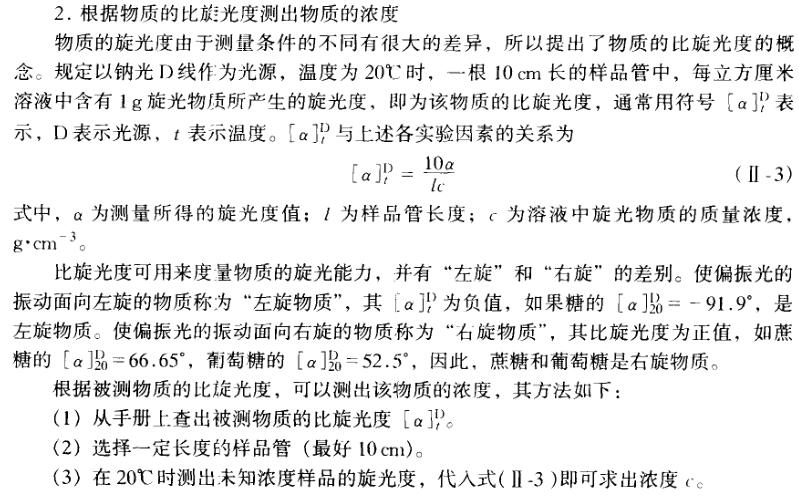
1. The relationship between optical rotation and substance concentration
The optical rotation of an optically active substance is not only determined by the nature of the substance, but also related to the measurement temperature, (ie, the length of the sample tube), the wavelength of the light source, and the concentration of the substance. If the length, temperature, thickness, and properties of the solvent to be measured are directly proportional to t, the optical rotation is proportional to the concentration of the solution, α=Kc (II-2)
In the formula, K is a constant related to the optical rotation ability of the substance, the nature of the solvent, the temperature, the wavelength of the light source, and the thickness.
1. Measure the optical rotation to find the concentration of the substance
Firstly, the sample with known concentration is diluted according to a certain ratio, with the concentration on the horizontal axis and the optical rotation on the vertical axis, and then diluted into several samples with different concentrations, and their optical rotations are measured respectively. , drawn as an α-c curve. Then take a sample of unknown concentration to measure its optical rotation, find out the corresponding concentration value on the α-c curve according to the optical rotation value, and this concentration value is the concentration of the sample to be tested.
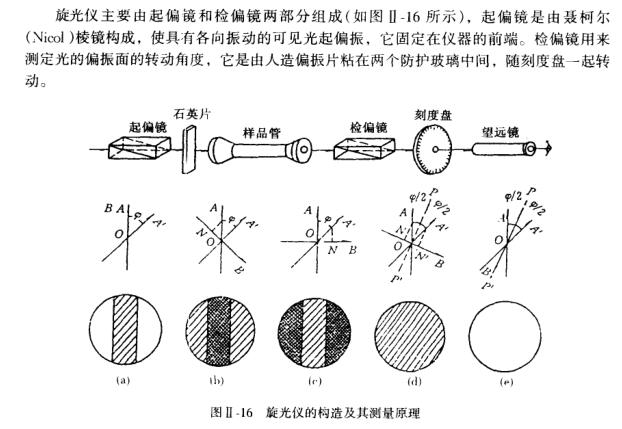
2. The structure and measurement principle of the polarimeter
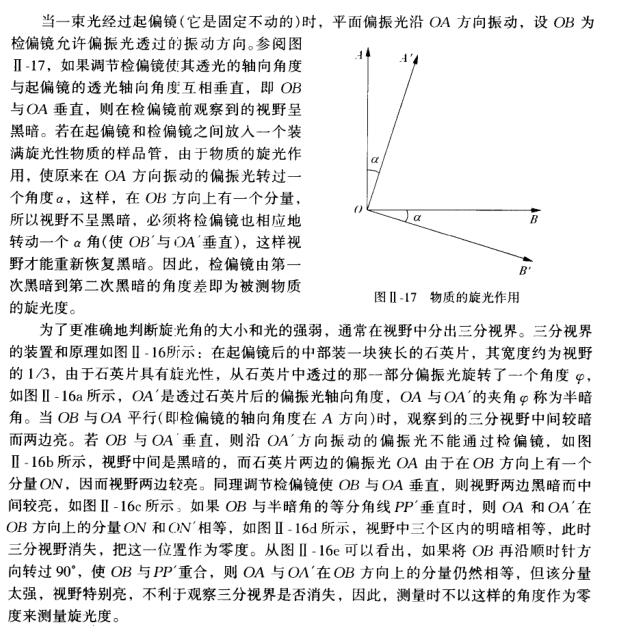
3. Determination of Optical Rotation
l. Polarimeter zero point calibration
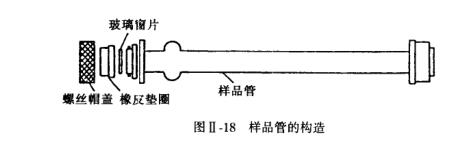
Take the sample tube (sample broken), clean the sample tube (the structure of the sample tube is shown in Figure II-l8) and unscrew the tube cap at one end (pay attention to the glass slide in the cover, in case of falling, use a distiller to fill it up, so that the liquid is in the mouth of the tube) Form a convex liquid surface, then gently push the glass slide into the cap along the tube mouth, and tighten the tube cap. There should be no air bubbles in the sample tube, so as to avoid blurred vision during observation. Dry the water stains on the outside of the sample tube with clean absorbent paper ,Wipe the water stains on the outside of the glass slide with lens paper. Put the sample tube into the polarimeter, turn on the power, and preheat it for a few minutes. Rotate the dial until the light and shade of the three-point field of view are equal, and this is the zero point.
2. Determination of optical rotation
Put the solution to be tested with optical rotation into the sample tube, and measure it according to the above method, and subtract the zero point from the measured angle to get the optical rotation of the solution to be tested.
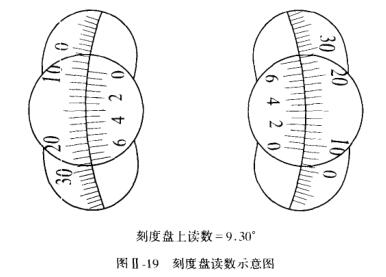
The instrument adopts double vernier readings to eliminate the eccentricity of the dial. The dial is divided into 360 divisions, each division is 1°, and the cursor is divided into 20 divisions, which is equal to 19 divisions on the dial. Use the cursor to directly read 0.05° (as shown in Figure II-l9, the reading on the dial is 9.30°). There are two 4x magnifying glasses in front of the cursor window for reading.
4. Maintenance of the instrument
(l) The instrument should be placed in a place where the air is ventilated and the temperature is suitable, and it should not be placed low, so as to prevent the optical components and polarizers from being damp, moldy and performance degradation.
(2) The sodium light tube should not be used for more than 4 hours. If it is used for a long time, it should be blown with an electric fan or turned off for 10~15 minutes, and then used after cooling. If the lamp tube only emits red light but cannot emit yellow light, it is often caused by the low input voltage (less than 220V). At this time, try to increase the voltage to about 220V.
(3) After the sample tube is used, it should be rinsed with water or distilled water in time, dried and stored.
(4) The glass slides should not be removed with unclean or hard cloth or paper, so as not to scratch the surface.
(5) When the instrument is not in use, put the instrument in a box or cover it with a plastic cover to prevent the intrusion of dust.


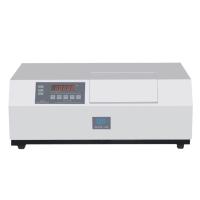
- 1Multi-wavelength high-speed polarimeter test application scheme
- 2How to Use WZZ-1S Automatic Polarimeter
- 3Application of Polarimeter in Food Analysis
何萍; 张京京 - 《辽宁化工》
- 4Zero Point Correction and Application of WXG-4 Polarimeter
钟红梅;侯德顺 - 《煤炭与化工》
- 5Determination principle of Polarimeter
钟红梅;侯德顺 - 《煤炭与化工》
- 6Instructions for operation and use of Polarimeter
-
![BANTE WXG-4 Disc Polarimeter -180 °~ 180 °]()
-
![INESA WXG-4L Visual Polarimeter (LED Light)]()
-
![INESA WXG-4 Visual Polarimeter Disc Polarimeter (Sodium Lamp)]()
-
![INESA INESA WZZ-1 Automatic Polarimeter]() INESA INESA WZZ-1 Automatic Polarimeter$ 1340.00
INESA INESA WZZ-1 Automatic Polarimeter$ 1340.00 -
![INESA INESA WZZ-3 Automatic Polarimeter]() INESA INESA WZZ-3 Automatic Polarimeter$ 1700.00
INESA INESA WZZ-3 Automatic Polarimeter$ 1700.00 -
![INESA WZZ-2B Automatic Polarimeter]() INESA WZZ-2B Automatic Polarimeter$ 1450.00
INESA WZZ-2B Automatic Polarimeter$ 1450.00