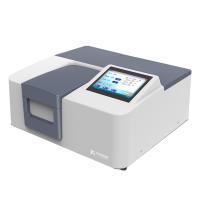
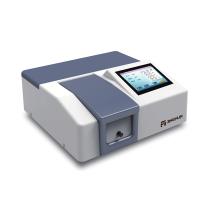
Atomic Absorption Spectrophotometer (Model 310) Operation Instructions
1. Structure
3l0 Atomic Absorption Spectrophotometer is a double-beam instrument, which can be used for the determination of the wavelength range of 190~860nm. The external structure of Model 310 Atomic Absorption Spectrophotometer is shown in Figure II-35. It is divided into five parts: the first part is the gas circuit system (1~4), the second part is the light source (5-18), the third part is the combustion chamber (9~15), and the fourth part is the control panel ( 16~22), the fifth part is the display system (23~29).
2. Operation method
1. Adjustment of the instrument
(1) Turn on the main power switch 22, the Recorder switch 27 and the lamp power switch 6, 7 to adjust the lamp current to the applicable range.
(2) Set the range 20 and time constant l8 to "1", the slit adjustment 17 to "2", and the negative high pressure adjustment l9 to "5". Open the light path slide plate l5, so that the light source enters the monochromator.
(3) Press the wavelength fast scan button and wavelength conversion button of the wavelength adjustment system 16, observe from the Recorder, and stop tf scanning when it is near the sensitive wavelength of the lamp. Then slowly adjust the wavelength rotating wheel on the wavelength adjustment system upwards by hand until the maximum value is observed on the energy meter 21. At this time, the monochromator radiates the sensitive wavelength of the lamp. If the energy meter indicates that it exceeds the value, the negative high voltage should be reduced. , so that the pointer returns to the blue zone.
(4) Adjust the hollow cathode lamp holder 5 so that the pointer of the energy meter falls on the maximum point in the blue zone.
(5) Press the record button to make the Recorder work normally, and adjust the zero adjustment 23 on the instrument to make the Recorder indicate at zero. Push the optical path slide plate into the optical path, adjust the full scale to 24, make the Recorder point at 100, and repeat the adjustment several times.
(6) To adjust the position of the atomizing burner, you can straddle the light plate in the middle of the burner slit, adjust the up, down, left, and right knobs and turn the handle of the burner, so that the light spot is about 6mm directly above the burner slit, and make the slit parallel to the optical axis.
2. Ignite the air-acetylene flame
(1) Fill the pre-mixing chamber with water and fill the water seal tube (on the back of the instrument, keep water in the water seal tube during the working process to avoid air leakage).
(2) Turn on the compressed air and turn the regulator valve 2 counterclockwise to make the air pressure indicated at 2kg·cm -2 ; open the acetylene cylinder and adjust the pressure reducing valve to make the acetylene pressure 0.6kg·cm -2 .
(3) Turn the assisted gas selection four to the air position, turn the stop valve 9 to "on", and turn the atomizing needle valve counterclockwise to make the air flow rate 4.4~4.5L·min -1 . Turn the acetylene stop valve to "On", and adjust the acetylene flow to 1.5L·minl in the same way.
(4) After the gas passes through for about 5 seconds, press the ignition button l2 again, and release it after ignition. After the flame is lit, change the acetylene and air flow ratios and spray with deionized water. (Note: close the combustion chamber glass door when igniting!)
3. Selection of measurement conditions
(1) Spray into the same standard sample, change the flow rate of acetylene and air and the height of the burner, and find out more suitable measurement conditions.
(2) On the premise that the instrument is stable, change the lamp current and negative high voltage to obtain a large absorbance.
4. Measurement of Absorbance
Spray with deionized water to adjust the zero point, and then push the slide plate on the optical path to adjust the full scale (100). Pull the slide plate, the test solution is sucked by the capillary, and record the absorbance of the test solution.
5. End of experiment
(1) Turn off the lamp current switch, the Recorder switch and the main power switch. Push up the light path slide plate, replace it with deionized water and continue spraying to clean the combustion system.
(2) Close the acetylene cylinder before the flame is extinguished, so that the residual acetylene gas in the pipeline is burnt out. Then turn the acetylene stop valve to "stop", and the pressure stabilizing valve is unscrewed clockwise (closed). Turn off the air source, turn the assisted gas stop valve to "stop", and unscrew the pressure stabilizing valve clockwise (close).
If it is necessary to extinguish the K flame during the experiment, first turn the acetylene stop valve to "stop" to exhaust the residual acetylene gas in the pipeline, and then turn the assisted gas stop valve to "stop" for the next use.
- 1Application of Flame Atomic Absorption Spectrophotometry in Detection of Food Talc Powder
- 2Talking about the performance test of epoxy resin film coated on PET
- 3Spectrophotometer principle, structure and application do you know geometry?
- 4Principle, characteristics and application of ultraviolet Spectrophotometer
- 5Spectrophotometer Color Measurement Fundamentals
- 6Differences between visible, ultraviolet-visible, infrared, fluorescent and atomic absorption Spectrophotometer s
- 7Detection of nicotine content by Spectrophotometer
- 8How to detect the color difference of fluorescent color-changing materials?
- 9Liquid color difference detection solution
-
![YueFeng 752N Ultraviolet-visible Spectrophotometer]()
-
![YueFeng 721 Single beam of light Visible Spectrophotometer Test Transmittance/Absorbance]()
-
![JINGHUA H300 Dual beam of light Spectrophotometer Wavelength range 190nm-1100nm]()
-
![HUXI Nano-900 UV-Visible, ultra-micro Spectrophotometer Light spectrum instrument]()
-
![JINGHUA JH752 Benchtop UV-Visible Spectrophotometer Bandwidth 4nm]()
-
![YUEFENG FP6428 Flame photometer Na/Ca]() YUEFENG FP6428 Flame photometer Na/Ca$ 1450.00
YUEFENG FP6428 Flame photometer Na/Ca$ 1450.00