Determination of tinctorial strength of Pigments by "sensory limit" method
After Sapogiel regarded tinting strength as the performance of a pigment that can give its own color to another pigment, he pointed out that in the same process that pigment B colored pigment A, the opposite process of pigment A coloring pigment B also occurred ( reciprocal coloration). Therefore, any pigment can show different degrees of tinting power according to the difference of another pigment mixed with it.
Sapogiel believed that a correct conception of the tinting power of one pigment to another can be obtained only by observing the whole process of their mutual coloring when the quantities between them are in various proportions.
This process can be combined into two parts of a parabola that are connected into a curved machine. According to these curves or the formulas connected with them, the mathematical analysis of the whole process (whether it is the whole process or its individual stages) can be carried out when any group (two kinds) of pigments color each other.
According to this point, Sapogier proposed the "perception limit" method for measuring the coloring power of pigments. This method is based on the "perception limit" using the sensitivity of human eyes or special instruments.
The practicality of the sensory limit measurement method can be illustrated by the following simple example. If a very small amount of any black pigment or color pigment is mixed into zinc white, when comparing the colors of the non-bleached white and the zinc white containing a small amount of f-paraffin, the human eyes will see Can't see any difference between the two.
As the blends build up, eventually the point will be reached where the human eye begins to detect a difference between a pure white pigment and a white pigment containing blends of other pigments. In this way, the sensory limit of human eye sensitivity is reached. This sensory limit can be relatively (for the normal eye) considered as the first sensory limit between the original pigment and the added pigment.
In this case, the shade of the color is meaningless, only the change in the white color seen by the human eye is important; this is a major difference between this method and other existing methods; because in the existing In this method, it is an important condition that the two pigments to be compared are mixed together with a third "comparative" pigment to obtain a consistent shade. The whole process of mixing pigments according to the "sense limit" method can be expressed by the parabola of y2=cx, this parabola graph is based on the pre-calculated points after measuring the initial positive sensory limit and the final negative sensory limit drawn. This provides the possibility to identify the mutual tinting power of the two pigments A and B in any quantitative ratio.
In order to obtain the first (positive) sensory limit Q1, pigment A must be mixed with pigment B, and to obtain the final (negative) sensory limit Q2, pigment B and A must be mixed in various different ways. The ratio is mixed until the human eye can see the change of color chroma.
Based on the determination of the positive sensory limit and the negative sensory limit, the amount of color light (perceived limit) that is automatically transformed when the two pigments A and B are mixed can be measured by calculation.
sensory limit formula
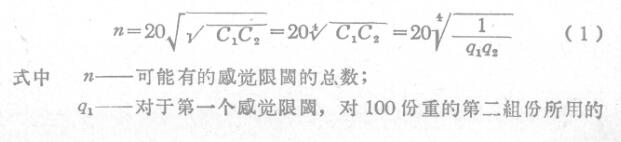
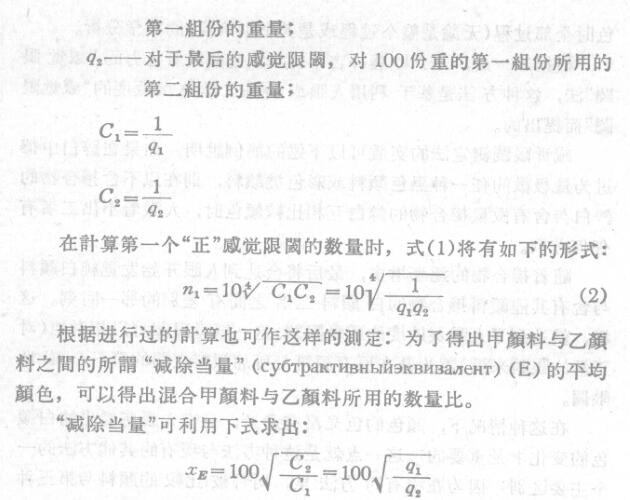
The advantage of the "perception limit" method is that it can measure the tinting strength of two pigments with different colors, and in the absence of standard pigments, it can measure the tinting strength of the pigment and calculate its deduction equivalent.
The disadvantage of this method is that the sensitivity of the eyes of the Tester will cause a certain degree of representation (the same is true for other methods), and another disadvantage is that the time for determining the initial sensory limit is too long.
- 1What is tinting power? How to test
- 2Explanation of the application of wire rod in GB/T13217.1 ink color and tinting power inspection
小潮 - 《南北潮商城》
- 3Pigment related ASTM testing standards
- 4Application of plane grinding machine in contrast of pigment tinting strength
- 5Pigment dispersion: Pigment dispersion assessment
郑顺兴 - 《涂料与涂装科学技术基础》
- 6Introduction of covering power and tinctorial strength of emulsion paint
- 7How is Pigment Volume Measured?
- 8Pigment specific gravity measurement method
- 9Sieve residue (fineness of ground) Determination of Pigment dispersion